
Curator’s statement
Every Korean knows that Jeju Island is special—for Korean nationals, it has been the go-to domestic holiday destination for generations. According to the Official Aviation Guide, the Seoul Gimpo-Jeju flight path is the busiest airline route in the world, servicing an estimated 14.4 million seats in 2025. However, Jeju still flies under the radar for many international travelers, who tend to favor the mainland destinations of Seoul and Busan. I’ve now been to Jeju seven times and counting, and I keep going back because in a country that feels largely homogeneous, Jeju is distinct. It still feels like Korea, but at the same time it’s unique. The black volcanic basalt rock, the dramatic coastline and azure sea, and the distinctive food are features that set it apart, and they’re all compelling reasons for including Jeju Island in your South Korea itinerary.
The Fora Difference
Book with Oblique Route to access exclusive perks and experiences on your trip.

Killer perks
Free upgrades, spa credits and more—we got you

Personalized recs
Customized travel planning for your style

Insider knowledge
Expert advice from people who’ve actually been there
Where to stay
Unlock perks by contacting Oblique Route to book your trip.
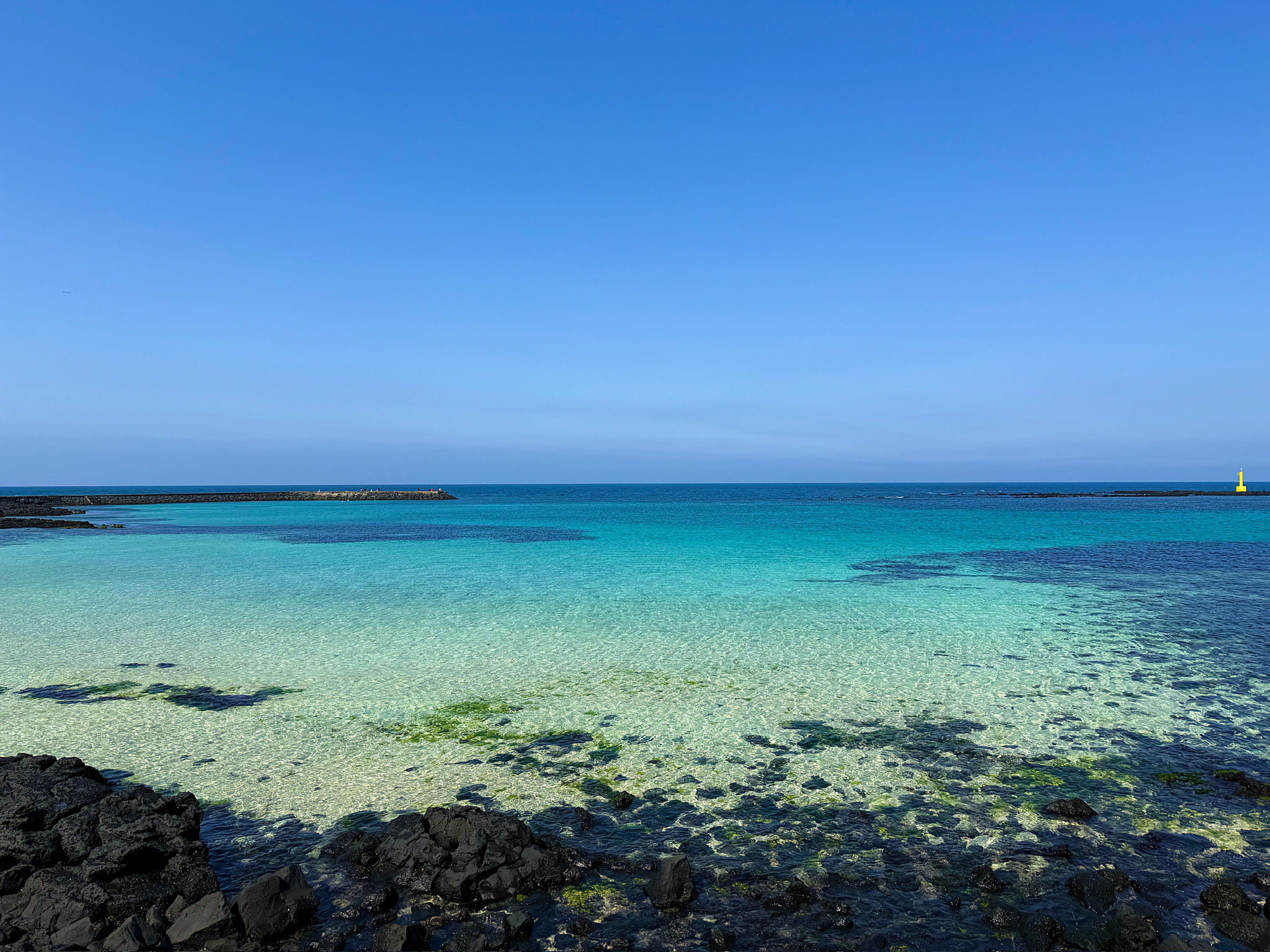
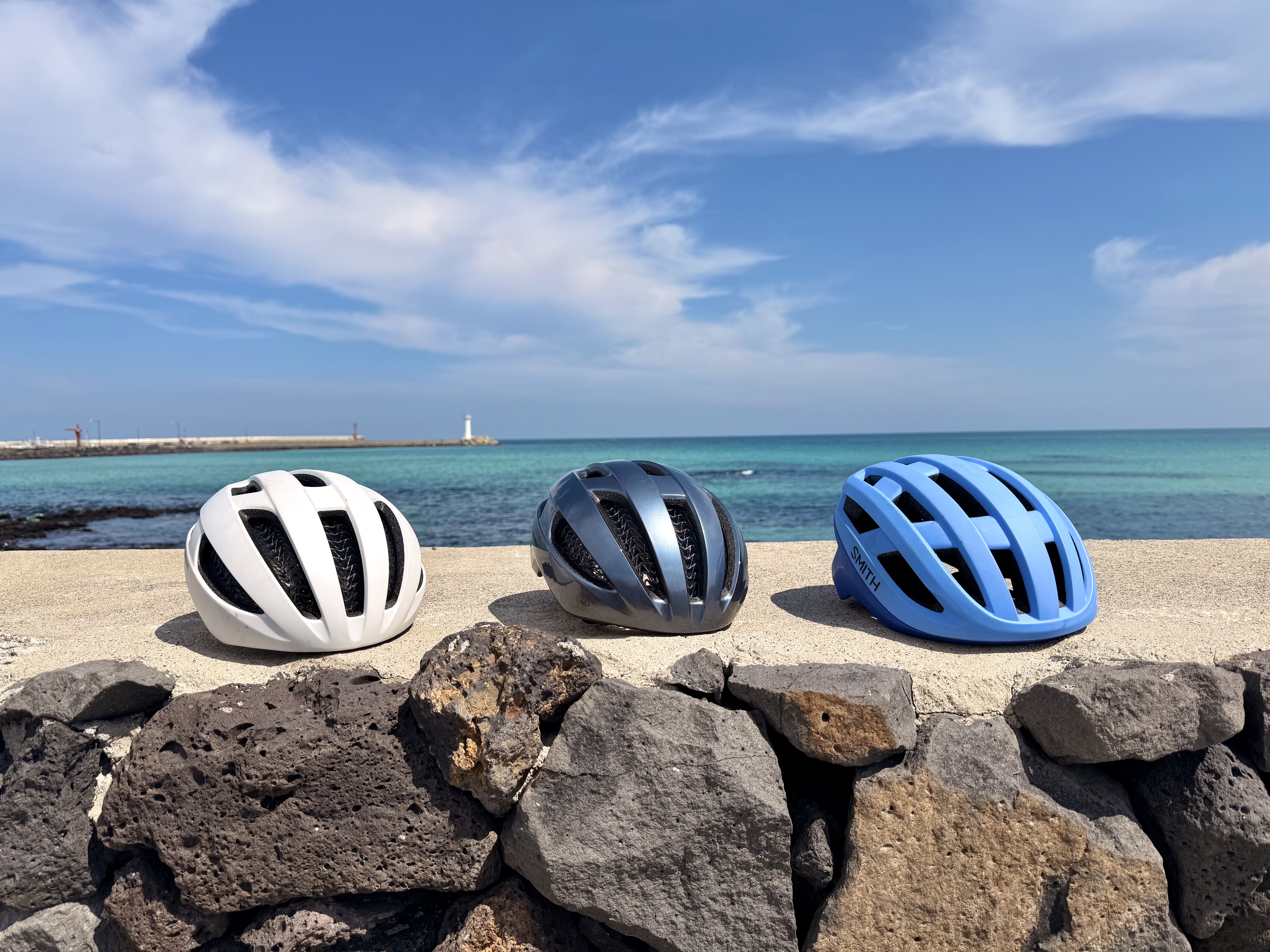
Typical Jeju Island scenery: black volcanic basalt rock, turquoise water, endless sky.
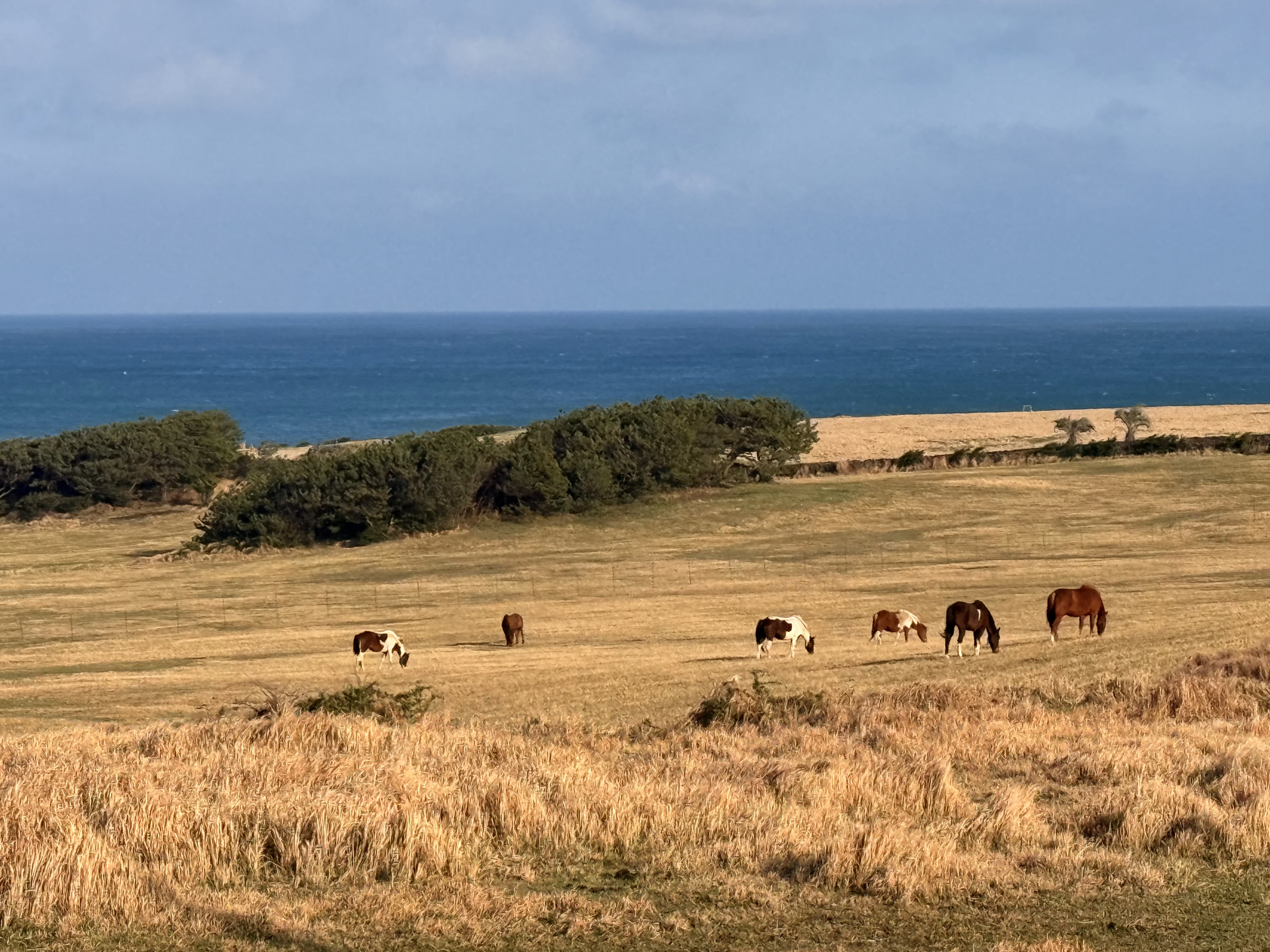
Jeju is a volcanic island that sits 100 km (62 miles) off the southern coast of the Korean Peninsula. At 714 square miles, it is roughly the same size as Maui. At its center sits Hallasan, a long-dormant shield volcano and South Korea’s highest peak. It is this volcano, combined with the island’s southerly location, that gives Jeju its distinct feel. Jagged black basalt rock is visible all over the island and along the coast, alongside palm trees and naturally growing citrus fruits—all things you won’t typically see on the mainland.
This sense of separation extends beyond the landscape. Even the language reflects it, as Jeju’s native dialect is largely unintelligible to mainland Korean speakers. Along the coast, the haenyeo (female free-divers who harvest seafood without oxygen tanks) continue a centuries-old tradition and have become a symbol of the island. Long isolated from the mainland, Jeju has developed a culture that feels self-contained, shaped as much by the sea as by the volcanic ground beneath it.
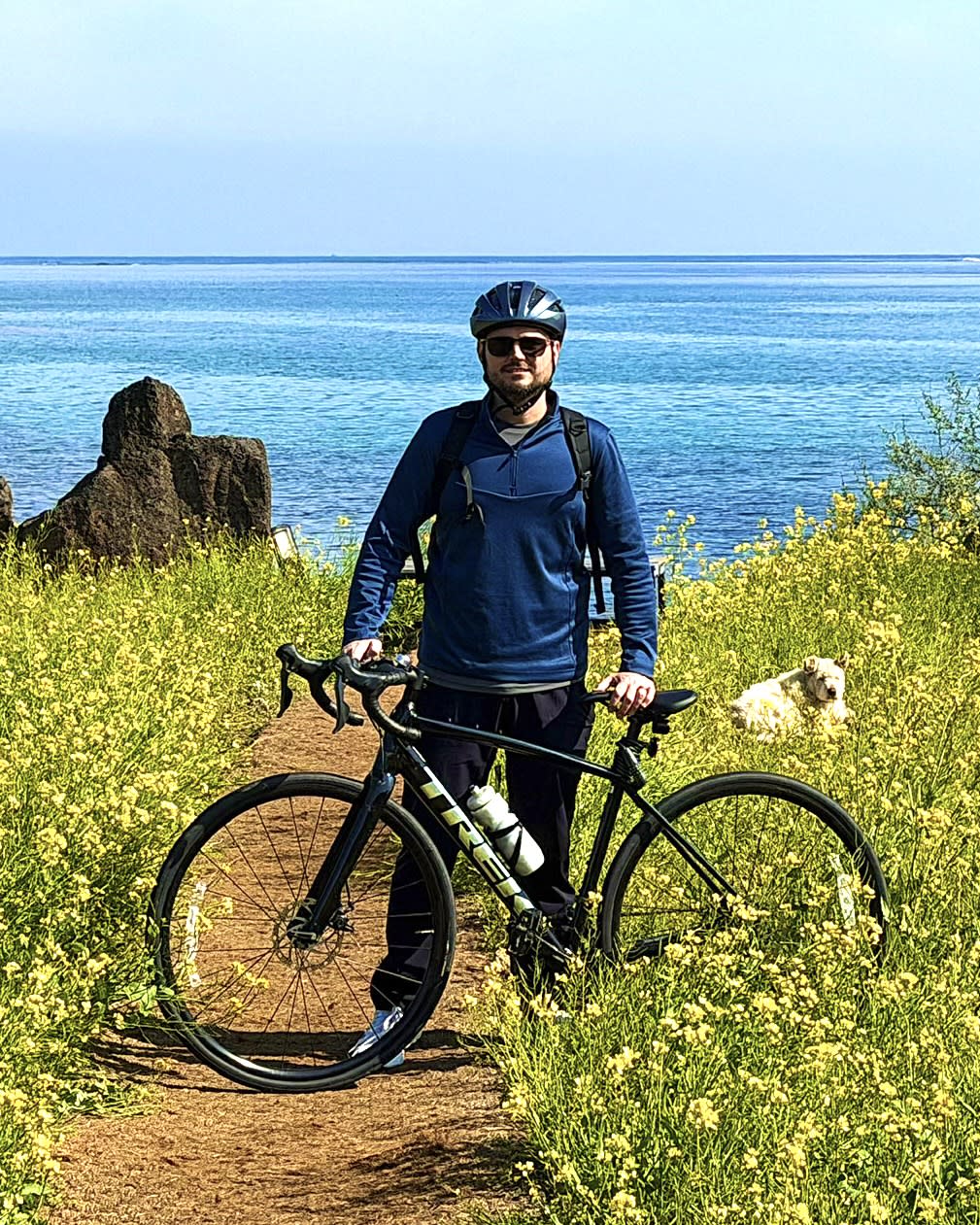
I’m no stranger to this island, having visited several times over the years. This is, after all, where I “popped the question” to my now-wife back in 2016. As a result, Jeju’s dramatic coastline and seaside vistas have become comforting, familiar sights for me. But on this particular trip, I would have an opportunity to see the island from a whole new perspective—on two wheels, from the saddle of my Trek Domane AL 2 road bike.
The Jeju Fantasy Bike Path
With two friends, I embarked on a three-day cycling trip along the Jeju Fantasy Bike Path, which follows the coast for 234 km (145 miles), encircling the entire island. This cycling path is part of a larger well-maintained national network of designated bicycle touring routes.
Throughout the country, South Korea operates a nifty cycling certification system—sort of like a stamp tour by bike. Here’s how it works. For just 4000 KRW ($2.69), you can get a small booklet, essentially a “cycling passport”, in which you can collect stamps from around the country. As you cycle along one of these designated routes, you will occasionally come across a “certification center” which looks like a bright red phone booth. Inside, you will find an ink pad and an official stamp unique to that particular location. You add the stamp to the corresponding page in your cycling passport, then continue on until you reach the next booth. Collect all the stamps for one of the routes, and you can get an official seal in the back of your booklet and a small sticker for your bike helmet.
Honestly, it’s one of the cooler, more well-designed pieces of tourism infrastructure in the country, and it supports a very unique way of exploring Korea, taking you well off the beaten path and through areas that you likely wouldn’t otherwise see.
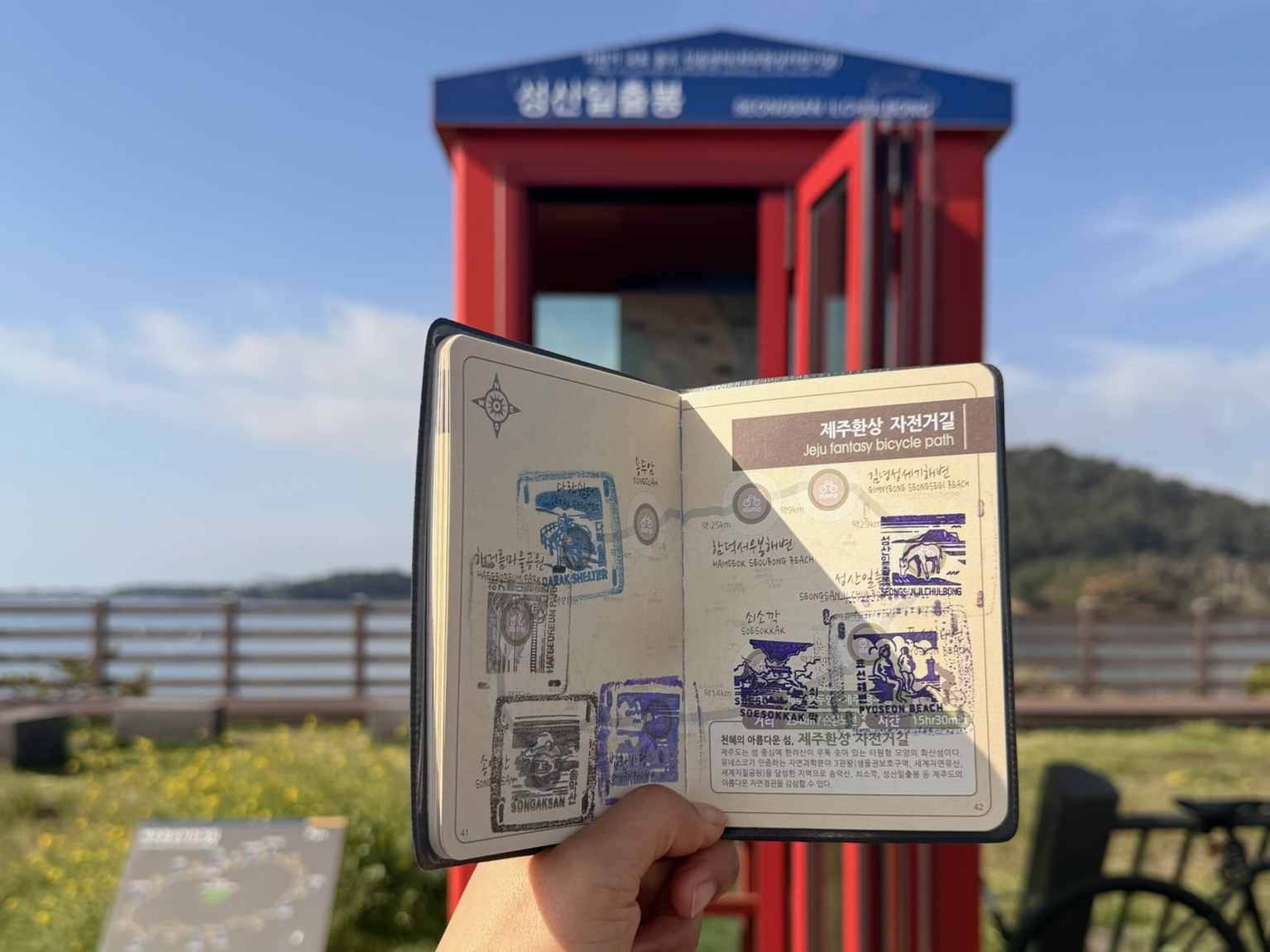
A close-up of the cycling passport, partially filled with stamps, with one of the red certification stamp booths in the background.
Cycling logistics
For those undertaking the Jeju Fantasy Bike Path, the logistical challenge of getting a bike to the island is actually less daunting than it may seem. Of course, the most straightforward method would be to simply rent a bike on the island once you arrive. There are a number of designated bike rental shops located near the airport in Jeju City. A decent road bike should run you about $30–60 per day, while higher-end carbon road bikes are more likely to be in the range of $60–90 per day.
If you want to bring your own bike, you have two options. One way would be to travel to Jeju from the mainland by ferry. There are multiple ferry services departing from different mainland ports (Mokpo, Busan, Incheon), and bringing a bike onboard is a relatively simple process. A ferry is cheaper and more scenic than a flight, but the travel time is much longer.
The faster, more efficient option is to fly with your bike, which is what my friends and I did for our trip. A Korean company called Roundel has made this an easy and affordable option by offering a bike box rental service. After contacting the company and arranging for a box, you simply show up at Seoul’s Gimpo airport with your bike, pack it in the box, and take it up to your airline’s check-in counter. For my trip, the round-trip cost for the Roundel bike box, plus the airline’s excess baggage fee, amounted to 80,000 KRW (about $54)—far cheaper than a three-day bike rental, and a very small price to pay to have my own trusty steed with me for the trip ahead.
Day 1
We arrived in Jeju City to fair weather on a balmy April morning. After collecting our bikes, returning the Roundel boxes, and grabbing a quick breakfast at the airport, we set off. The Jeju Fantasy Bike Path is marked by a blue line painted on the ground and occasional blue signs indicating upcoming turns in the route. We quickly realized, however, that the signage for the Jeju Fantasy Bike Path is not quite as clear and consistent as the routes on the mainland, which made finding our way out of the city a bit tricky. For this reason, it’s a good idea to have the Kakao Maps app installed on your phone to aid with navigation. Before long, we were well on our way, cruising along the coast and enjoying the scenery.
One thing Jeju is famous for is its cafés. Oceanfront coffeeshops with stunning views are ubiquitous along the coast, and café-hopping has become one of the defining experiences of modern Jeju tourism. About an hour or so into our ride, we made our first café stop to enjoy some coffee and a slice of strawberry cheesecake. We only stayed in the café for about half an hour, but in that short time, the weather had started to take a dramatic turn. By the time we were back on our bikes, the sky had clouded over and the wind had picked up significantly.
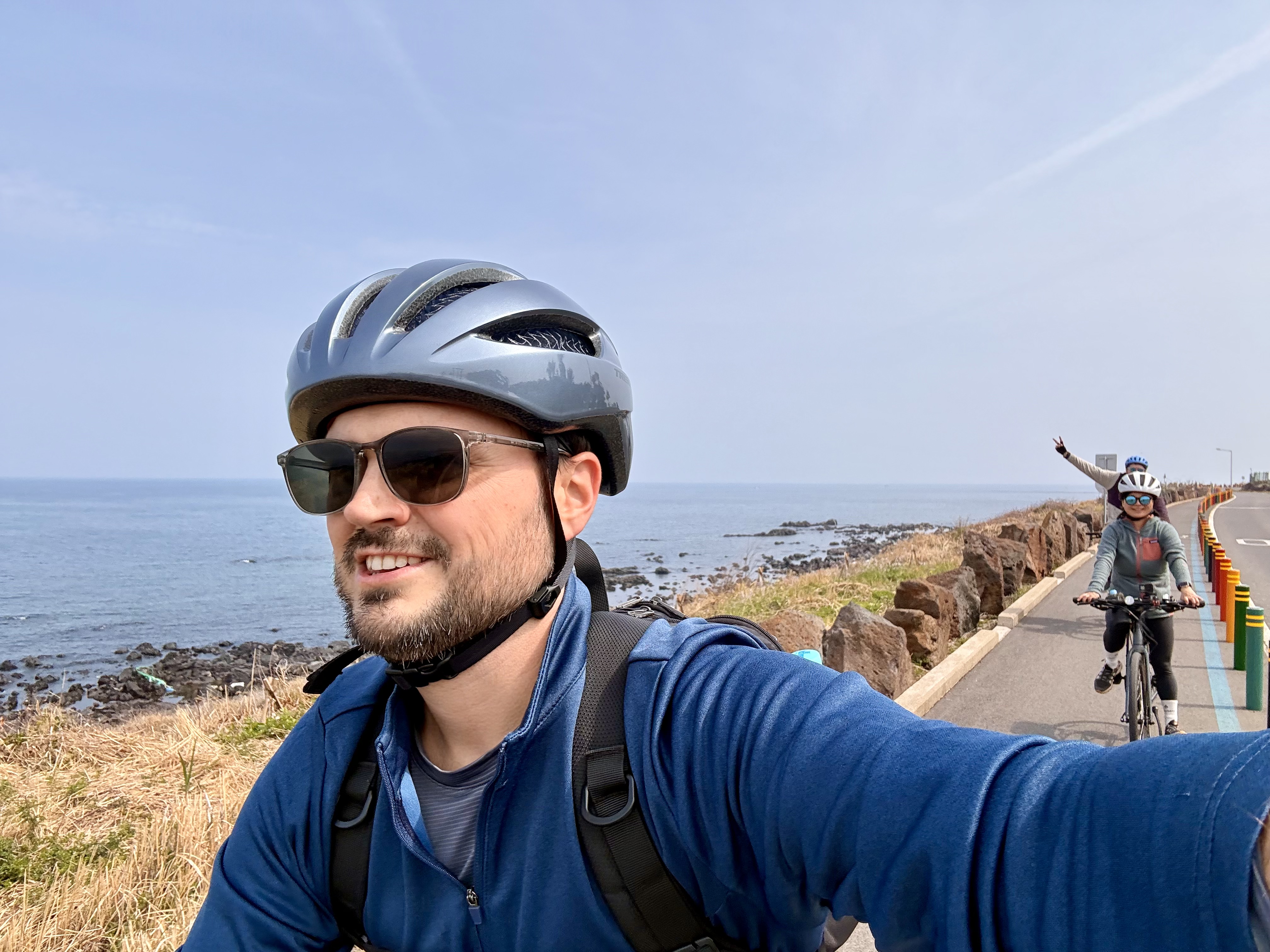
A cycling shot taken early on Day 1, before the weather turned.
We pushed on, slowed slightly by the wind. A little after midday, we found ourselves having lunch at Hyeopjae Beach—my favorite place on the whole island. The beach is gorgeous: white sand contrasting against the black volcanic rock, all framed by the brilliant aquamarine sea. The surrounding village is quaint and charming. After lunch, we popped into Josie’s Bottle Shop—a little place I first fell in love with 10 years ago and have visited on every subsequent visit to Jeju—where we enjoyed a free tasting of locally-brewed craft beer and picked up a few cans to be enjoyed at the end of the day’s ride.
After Hyeopjae, the weather continued to deteriorate. The wind got worse. It also rained a bit, but only briefly. The gloomy sky somewhat dampened our enjoyment of the coastal scenery, as we were obliged to keep our heads down in the teeth of the wind. Our legs began to ache, but we remained in good spirits as we rounded the western side of the island and approached our Day 1 destination.
Finally, after cycling for about 79 km (49 miles), we checked into our hotel near the foot of Sanbangsan, an isolated 395-meter lava dome prominently located on the southwestern coast. We treated ourselves to a dinner of delicious Korean-style fried chicken, drank the beers we’d bought earlier at Josie's, and called it an early night.
Day 2
Overnight, a storm ravaged the island with driving rain and gale-force winds. Fortunately, by the time we awoke and started our second day of cycling, the storm had passed and given way to a sunny, breezy morning. It was still windy, but this time it was mercifully at our backs.
As we cycled along the south coast, we were treated to the most stunningly beautiful scenery of the trip. It was classic Jeju: rugged coastline, endless blue sea, waves crashing against volcanic rock. The fact that we had timed our trip to coincide with Korea’s annual spring-time cherry blossom bloom added an extra layer of floral elegance to the scenery. We rode along cherry tree-lined boulevards, and every time a gust of wind rustled the branches, we were showered by white-pink petals.
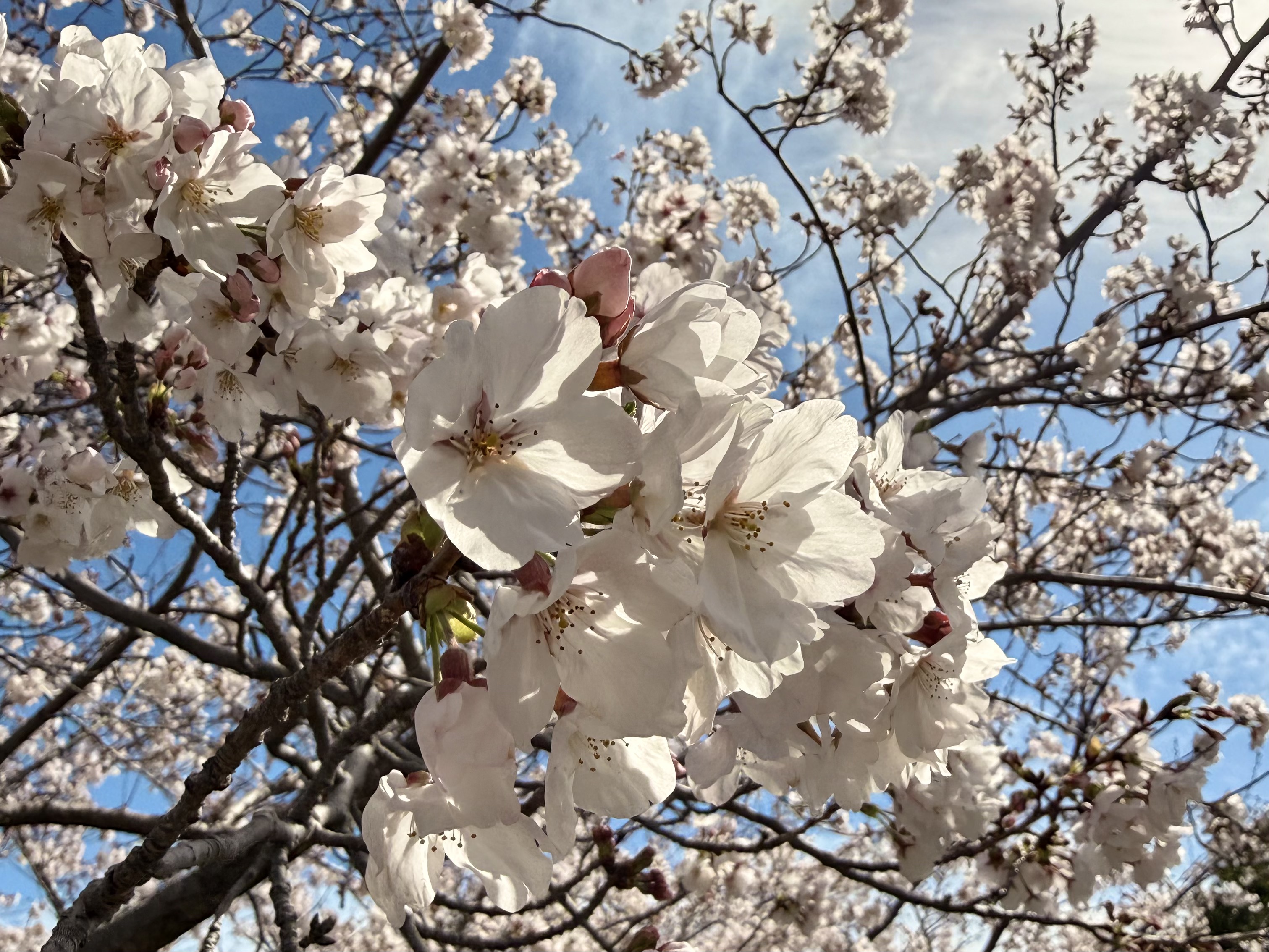
A close up of cherry blossoms
Approaching Seogwipo, the principal urban center on the south coast, we began to see an increasing number of greenhouses and fruit stands selling locally-grown 귤 (mandarins) and 한라봉 (a unique orange hybrid). Along the way, we continued to encounter the red certification booths, where we never failed to stop and dutifully stamp our cycling passports.
After a lunch of gogi guksu, a savory pork noodle soup special to Jeju, we began to round the southeastern corner of the island. It was at this point that the wind shifted to the north, becoming a headwind, and increased in strength until it was even more powerful than what we had experienced the day before. In the face of that wind, we slowed to a snail’s pace. It would be the most challenging bit of riding we’d have to endure on the trip, but the gorgeous coastal scenery was a major consolation. We slowly made our way up the east coast, stopping once for a café break near Pyoseon Beach, before finally arriving at our Day 2 destination—Playce Hotel, near another volcanic cone called Seongsan Ilchubong, one of Jeju’s most iconic natural landmarks.
For dinner, we indulged in a quintessential Jeju meal: 흑돼지, which translates to “black pig”. It’s a variety of pig native to the island, the meat of which is especially rich and flavorful. The pork is grilled right at the table, classic Korean BBQ style, and served with a variety of house-made side dishes, like kimchi. It was a very satisfying way to end what had been a spectacular but somewhat grueling 87 km (54 mile) day of cycling.
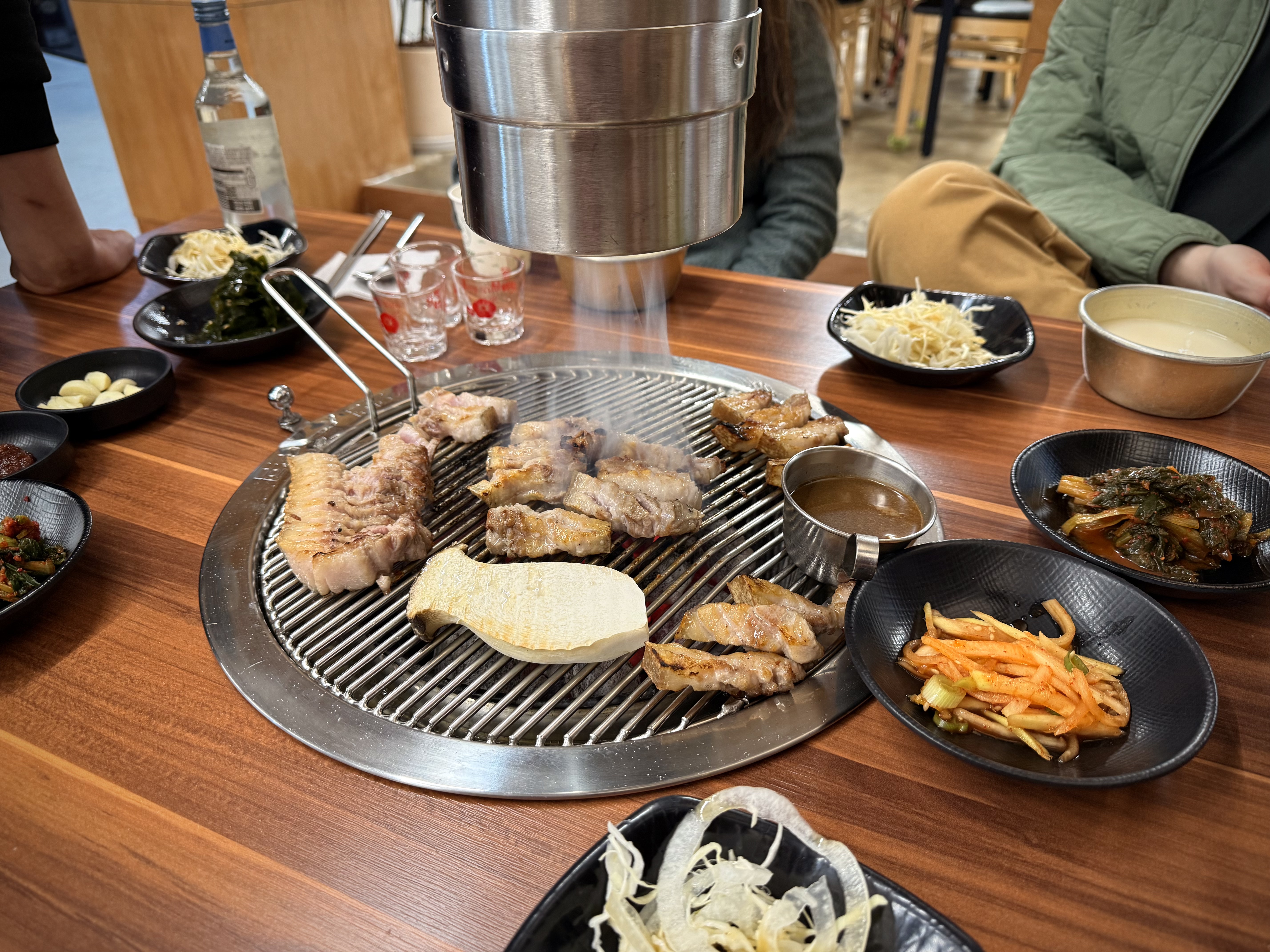
Grilled 흑돼지 (black pork) at the end of day two. It doesn't get any more 'Jeju' than this!
Day 3
The third and final day of the trip dawned sunny and mild, and we started the morning cycling along a beautiful stretch of coastline in the most pleasant conditions we’d seen yet. We adopted a leisurely pace, stopping often to take photos or to simply rest in the sand. Along the way, we stopped to explore the Sehwa Traditional 5-day Market, where we bought some local fruit and snacks. A little further on, we stopped again at an oceanfront café in Woljeong Beach for a warm drink and some Udo peanut ice cream.
As we made our way along the north coast, the now familiar scene of rugged black basalt leading down into intensely blue waves was our constant companion. After a late lunch at Hamdeok Beach, one of Jeju’s most popular destinations, we began to think of the finish line. The peaceful natural coastal scenes slowly gave way to urban development as we approached the outskirts of Jeju City. Before long, we were cycling along the same busy, traffic-choked streets where we had started our journey two days earlier. Before reaching the end, we made a pre-planned stop at Magpie Taproom to celebrate the completion of our Jeju circuit with a well-deserved round of beers.
We then mounted our bikes for the final time and cycled the short distance to the Yongduam certification booth, where we got the last stamp of the Jeju Fantasy Bike Path. We took our cycling passports inside the nearby information center to be officially verified, where we received our helmet stickers and had a seal affixed to a special page in the back of our booklets. A half hour later, we were back at the airport boxing up our bikes for the return flight to Seoul.
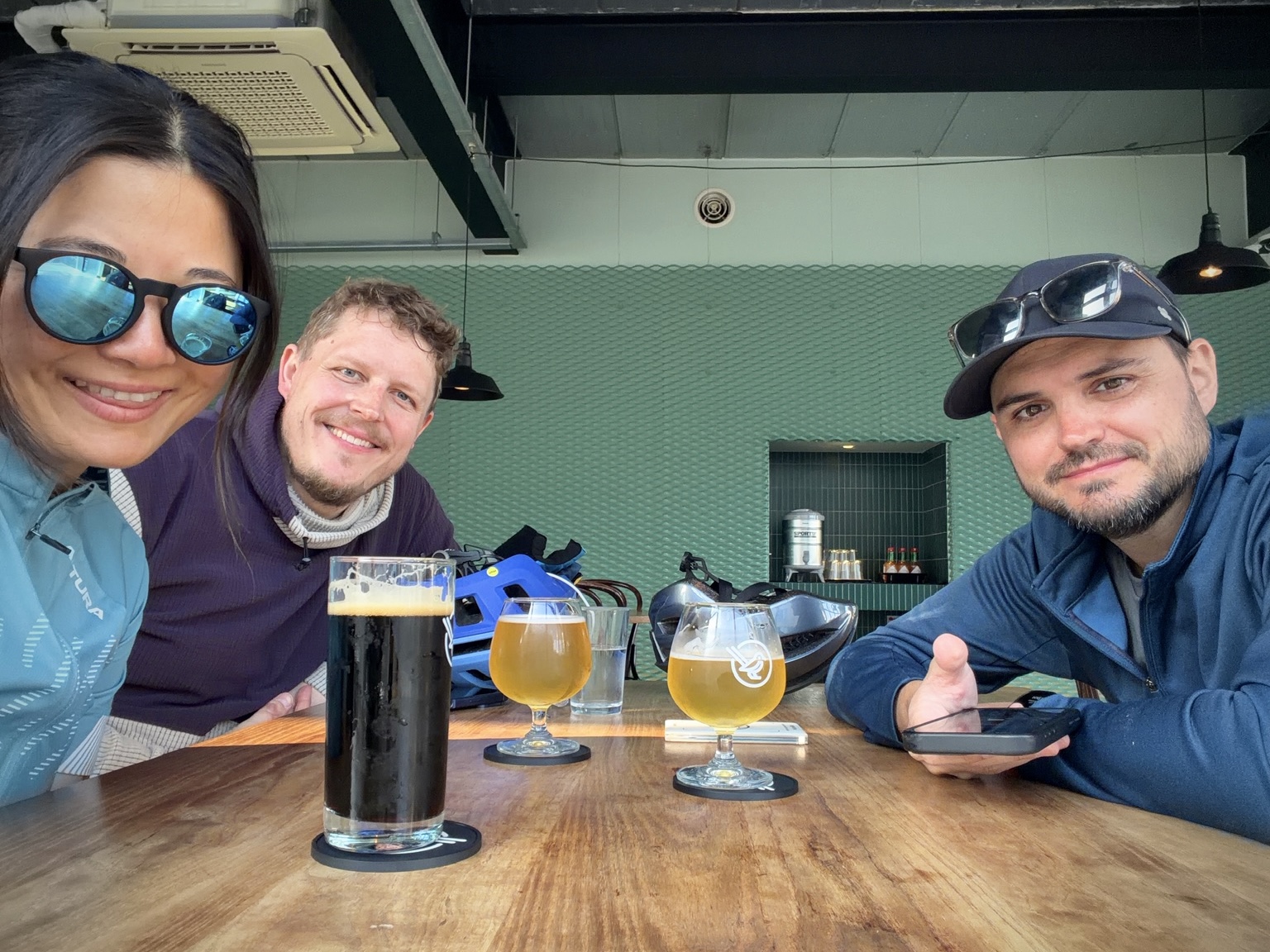
Our reward after crossing the finish line—a round of beers at Magpie Taproom.
The final tally
Three days, 234 km (145 miles), lots of wind, countless coastal vistas, and a bunch of new memories. Going into this trip, I thought I already knew Jeju quite well, but circumnavigating the island by bicycle was like seeing it through new eyes. The slow pace of a bicycle tour lends itself to a kind of immersion in the landscape that just doesn’t happen when you traverse the same roads in a rental car. The Jeju Fantasy Bike Path also took me to some parts of the island, particularly along the southeastern coast, that I hadn’t explored much on previous trips.
Finally, the sense of accomplishment you feel knowing that you’ve done all this with the power of your own legs is worth the sore muscles you’ll likely have by the end. For active, adventurous travelers who want an immersive experience that is truly off the beaten path, a cycling tour along the Jeju Fantasy Bike Path is one of the most authentic and rewarding ways to explore this remarkable island.
Need to know
There are heaps of things to do and places to see in Jeju that are not covered in this trip report. As repeat visitors, my friends and I were content to skip a lot of the more typical Jeju sights and activities on this trip—Osulloc Green Tea Plantation and Museum, the Manjanggul lava tubes, Hallasan National Park—because we’d already done it all before. That doesn’t mean these experiences aren’t worthy of your Jeju itinerary. A full Jeju destination guide covers all these and more. Get in touch with me if you’d like to learn more.
When to visit Jeju Island
Jeju might be at its best in the summer, when travelers can fully enjoy the beautiful beaches that can be found along the coast. However, the summer can be quite hot and humid, and rain is more frequent.
If swimming in the sea isn’t a top priority, the best all-around weather is probably in May or October, months that are neither too hot nor too cold, with less intense rainfall.
I wouldn’t recommend visiting in winter. While Jeju might have some of the aesthetics of a tropical island, it’s actually quite cold in the winter, meaning you’d be mostly confined to the indoors and cut off from the natural beauty that makes this island so special.
If you want to time your trip to see the cherry blossoms, as we did, aim for the first week of April.
Getting around Jeju Island
If cycling around the island doesn’t sound appealing, I would highly recommend renting a car for your Jeju trip. While public transportation exists, and it is possible to get around on local buses, a rental car gives you so much more freedom to explore beyond the main roads. Driving in Korea is straightforward—the roads are good, well-maintained, and easy to navigate.
Speaking of navigation, Google Maps isn’t useful in Korea, particularly as a navigation tool. As an alternative, you’ll want to get one or both of Korea’s homegrown map apps (Naver Maps and/or Kakao Maps) installed on your phone before you arrive. In my opinion, Naver Maps is the superior app in general and it’s the one I use for navigation while driving. But for cycling specifically, Kakao Maps suggests better routes, provides more detail about elevation gains, and does a better job of prioritizing cycle-friendly roads.
A final note about cycling
While you certainly don’t need to be a superathlete to undertake the cycling trip I’ve outlined here, a modest amount of fitness is required, especially if you want to do it in three days. There are no major hills to contend with, but the winds can be a significant factor. If you have more time, this trip could easily be broken up across four or five days, allowing for a gentler, less demanding pace.
For more information about where/how to obtain the cycling passport, reach out to me, your advisor.
Price note
The prices listed in USD in this guide accurately reflect the currency exchange rate at the time of writing (April 2026). As the exchange rate is constantly fluctuating, these prices may no longer be accurate. Be sure to double-check the current exchange rate before you travel to get a more accurate picture.
For more inspiration and insider recommendations, visit our South Korea page.


Travel Advisor
Oblique Route


Kevin Miller

Get in touch with Oblique Route
Did you like this guide? Reach out to customize and book your own experience. Or, just to chat about travel in general.