


Curator’s statement
In December of 2025, my wife and I capped off our 25th anniversary year with a six-day European Christmas Markets tour to Frankfurt, Strasbourg, Colmar, Basel, and Paris. Although I love to curate trips, planning a tour around the European Christmas Markets was a bit more challenging. I was unaware of the numerous choices of places to go, the amount of planning and logistics required, and the wealth of information available on the internet to sift through (bloggers, online videos, and social media posts…). Fortunately, I had a year’s head start to sketch out a trip and fine-tune all the trip details.
The Fora Difference
Book with John Keller to access exclusive perks and experiences on your trip.

Killer perks
Free upgrades, spa credits and more—we got you

Personalized recs
Customized travel planning for your style

Insider knowledge
Expert advice from people who’ve actually been there
Where to stay
Unlock perks by contacting John Keller to book your trip.
Trip background & planning
Leveraging the train system was an important variable for us for connecting Christmas market cities (less than four hours of direct travel between cities), as was the selection of airline arrival and departure cities (to secure a direct flight). Experiencing different countries, cities, and cultures was also key to creating our trip itinerary.
Once the itinerary was mapped, the selection of hotels followed. My wife and I both valued hotels that were within close proximity to the Christmas markets and that exuded an old-world charm and luxury (4 and 5 star hotels).
We purchased a four-day Eurail Flex Pass that allowed us to pick four days of rail use (over a 30 day period). If you do use Eurail, secure the Railplanner app to help you manage your rail pass. Find out which legs of your rail journey require a seat reservation. You will be asked by the train conductor to show your Eurail pass, seat reservation pass (if required) and your passport.
I booked refundable rates for both hotels and airfare. Hotel rates were tracked through the Fora Travel portal and airline rates were tracked with Google Flight tracker. I was hoping to book one-way air travel to our arrival and destination cities, but soon discovered airlines have gotten wise and charge very high one-way fares. Although hotels do book up early for the Christmas markets, I noticed most of our hotels still showed availability as of September.
Images to remember
Frankfurt
We arrived in Frankfurt a little past noon local time after taking an overnight flight into Paris then catching a short flight to Frankfurt. There are multiple transportation options to get to hotels in the city. In addition to taxis and ride-sharing services (we used Uber), you can use the train (S-Bahn train lines S8 or S9) from the airport train station (Frankfurt Flughafen Fernbahnhof) to the city center and then transfer to a local tram or walk a short distance to your hotel.
We grabbed a local city map at our hotel, then cross-checked our plans for the day. We had about 300 euros with us from a previous trip to Europe, so there was no need to stop at an ATM. We found that a majority of the craft and food vendors accepted credit cards, but there were several smaller vendors that did not. A good practice is to have around 80 euros in cash per day. For withdrawing cash from an ATM in Frankfurt, your best options are inside or directly attached to a major bank to ensure safety and get the most favorable exchange rates.
Frankfurt Christmas market
Frankfurt market
This year’s Frankfurt Christmas market was located between Romerburg and St. Paul’s square and in the streets running from Haupwache down to the river Main. The Frankfurt Christmas Market is one of the oldest Christmas markets in Germany, with origins that date back to 1393. Market hours are 10 am–9 pm (Sundays from 11 am–9 pm).
During our pre-trip planning, we decided to walk the Christmas markets both by day and by evening. The afternoon walk allowed us to see the market and surrounding old town by day as well as familiarize ourselves with the area. The evening walk (dusk is around 4–4:30 pm) allowed us to experience the magic of the Christmas market lights.
Note: Make sure you start your evening walk at dusk to ensure the full magical experience.
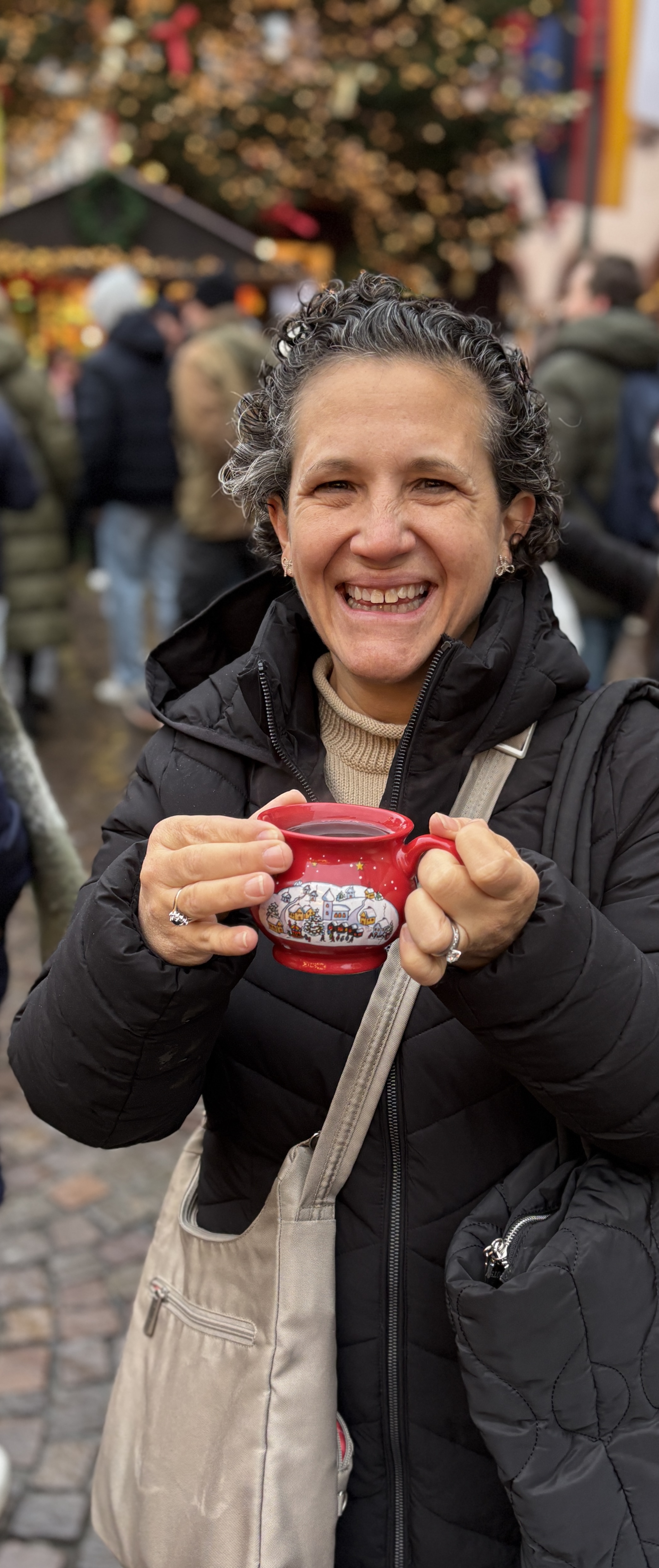
Since we only had 1 day in Germany, we decided to have our full dinner meal (in between our afternoon and evening walks) at a traditional German specialty restaurant—aka schnitzel and beer, then used the markets in the evening to “sample” additional foods and drinks (gluhwein). We were amazed at the incredible number of vendors selling food and drink!
Strasbourg
We left Frankfurt in the morning by train to Strasbourg (2 hours). Make sure if you are using a train to connect cities on your trip, that during your trip planning you check beforehand to see if seat reservations are required. For our trip to Strasbourg, the second half of the trip (Karlsruhe to Strasbourg) required a seat reservation.
To get from the Strasbourg train station to the Christmas Markets, you can walk for about ten minutes or take a tram located downstairs at the train station. Most of the markets, including the main ones around Strasbourg Cathedral, are within a short walk of the train station. We opted to use Uber from the train station to get as close to our hotel as possible before starting our walk around the markets.
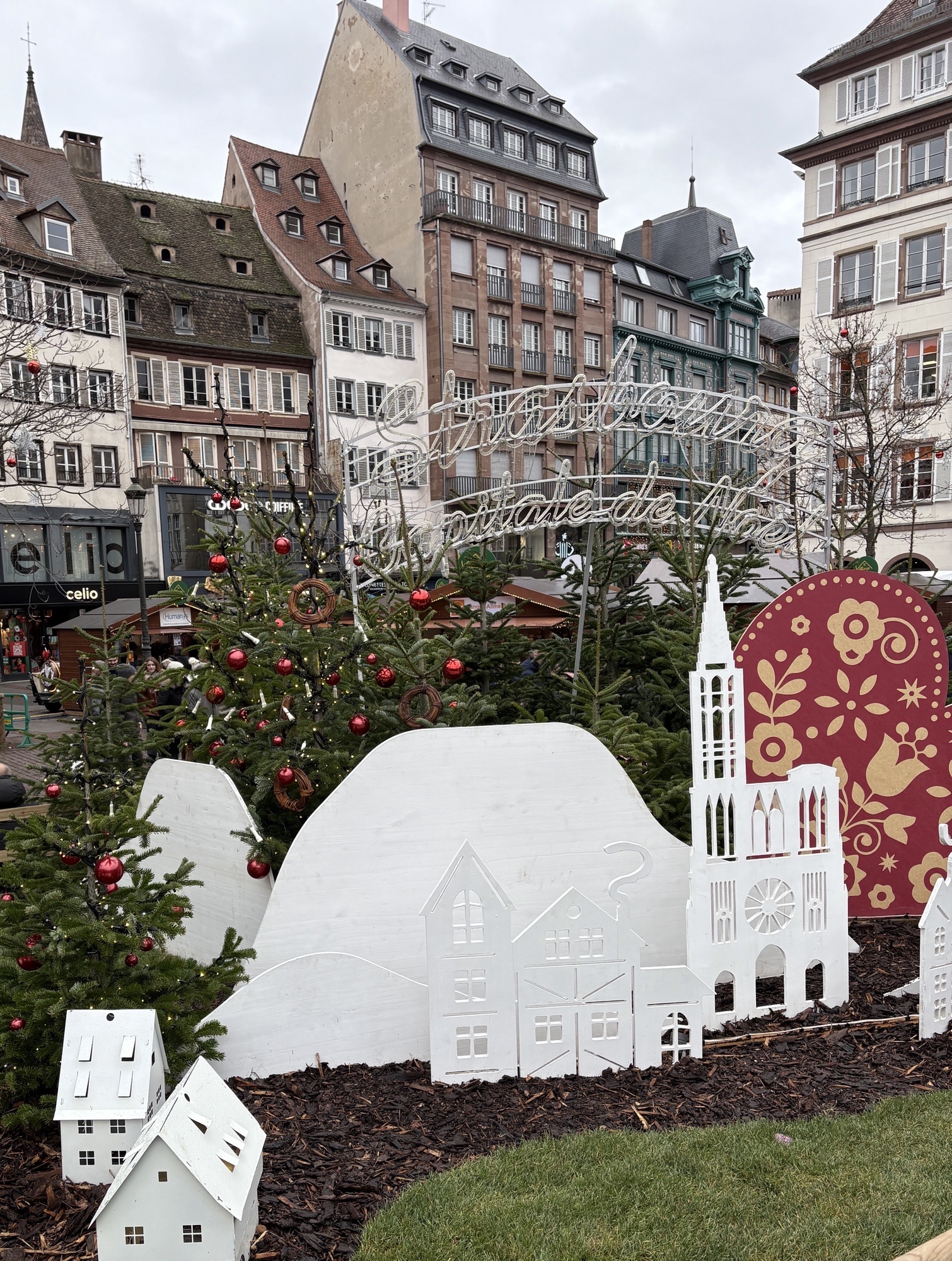
Strasbourg Christmas market
Strasbourg markets
The Strasbourg Christmas markets each year are recognized as being one of the most spectacular Christmas markets. There are three primary Christmas markets across the Grande Île: Place Broglie, Place de la Cathédrale, and Place Kléber, complemented by numerous smaller stalls spread throughout the city's smaller squares and streets. (approximately 300 stalls to explore). Market hours are 11:30 am–9 pm.
Strasbourg is definitely a city you want to see by day (i.e. Petite France, Notre Dame Cathedral, Carre D’Or, Teddy Bear house, various covered bridges), then appreciate even more at night.
Note: Bring a backpack or reusable bag for your purchases. A lot of the vendors are trying to be eco-friendlier and cut down on plastic, so will often just hand you your purchase wrapped in a bit of tissue paper. Those that do have bags, the bags tend to be tiny and don’t have handles.
The weather for our day (Sunday) in Strasbourg was horrible—steady rain, temperatures in the low 40’s and windy. The bad weather however did not deter the huge crowds nor the magical Christmas experience. The markets and the town take on a magical glow at night with all the lights and music.
Even though we had multiple days in Alsatian France (Strasbourg and Colmar) we decided to have our dinner in Strasbourg at a traditional Alsation Winstub (bistro) restaurant, then used the markets in the afternoon and evening to “sample” various foods and drinks (bretzels, Gluhwein).
Colmar
We took a short 30-minute train ride from Strasbourg to Colmar, arriving at 11 am when the markets opened. The Christmas markets are located in the historic town center, which is about a 15–20 minute walk from the train station.
Colmar has six distinct Christmas markets, each with its own theme located throughout the historic town center. Christmas market hours are 10 am–7 pm weekdays and 10–8 on weekends.
Place des Dominicains: This market features arts and crafts, and is known for its scenic backdrop of the Dominican Church with spectacular 14th century stained-glass windows.
Koifhus: Indoor market located within the Koïfhus, showcasing high-quality crafts from local artisans.
Place de L’Ancienne Douane: Another market for arts and crafts, located in the historic Old Customs house area.
Place Jeanne d”Arc: Alsatian village
Petite Venise Children’s Market: In the Petite Venise area at Place des 6 Montagnes Noires.
Place de la Boucherie: Gourmet market on Place de la Boucherie.
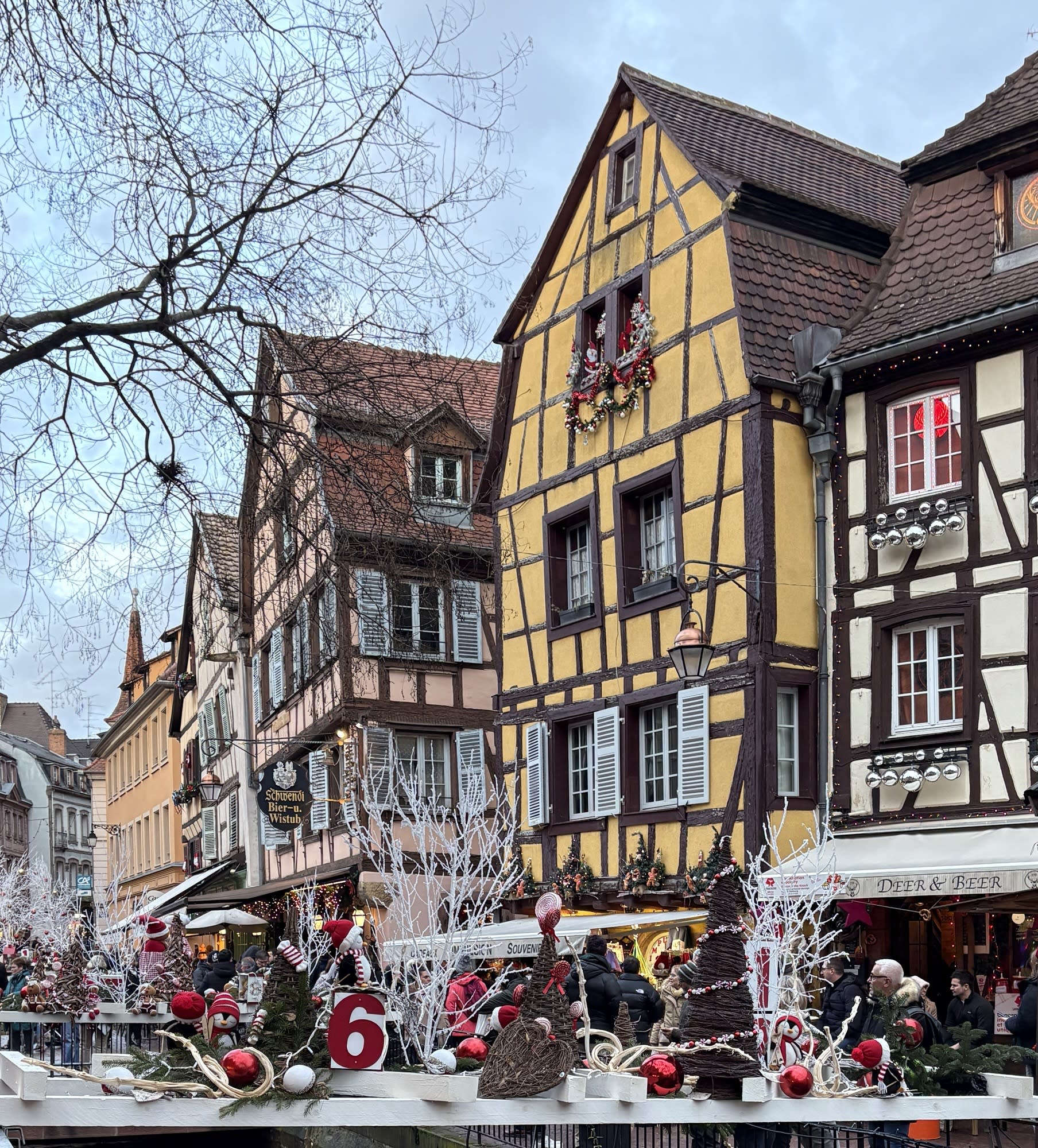
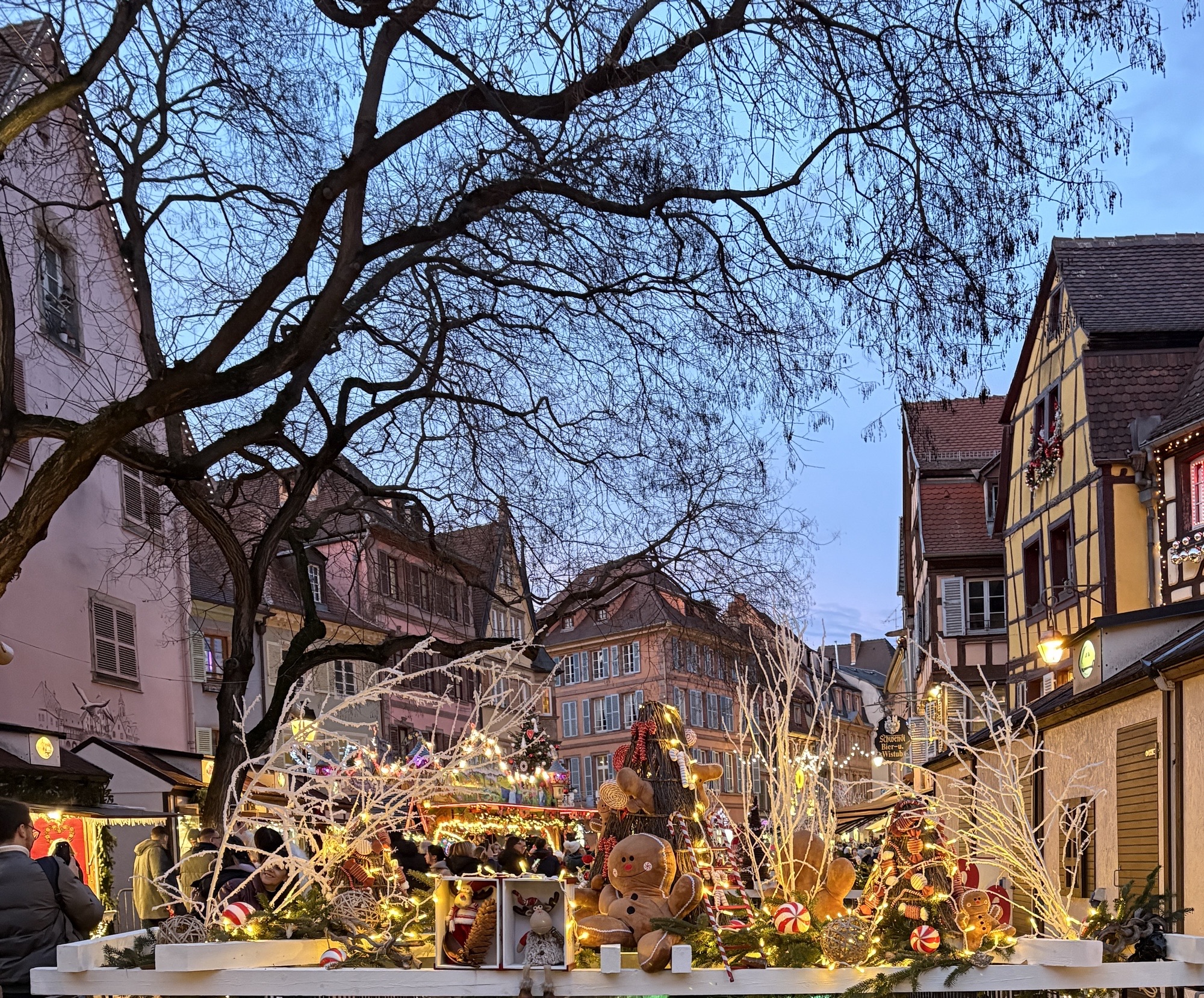
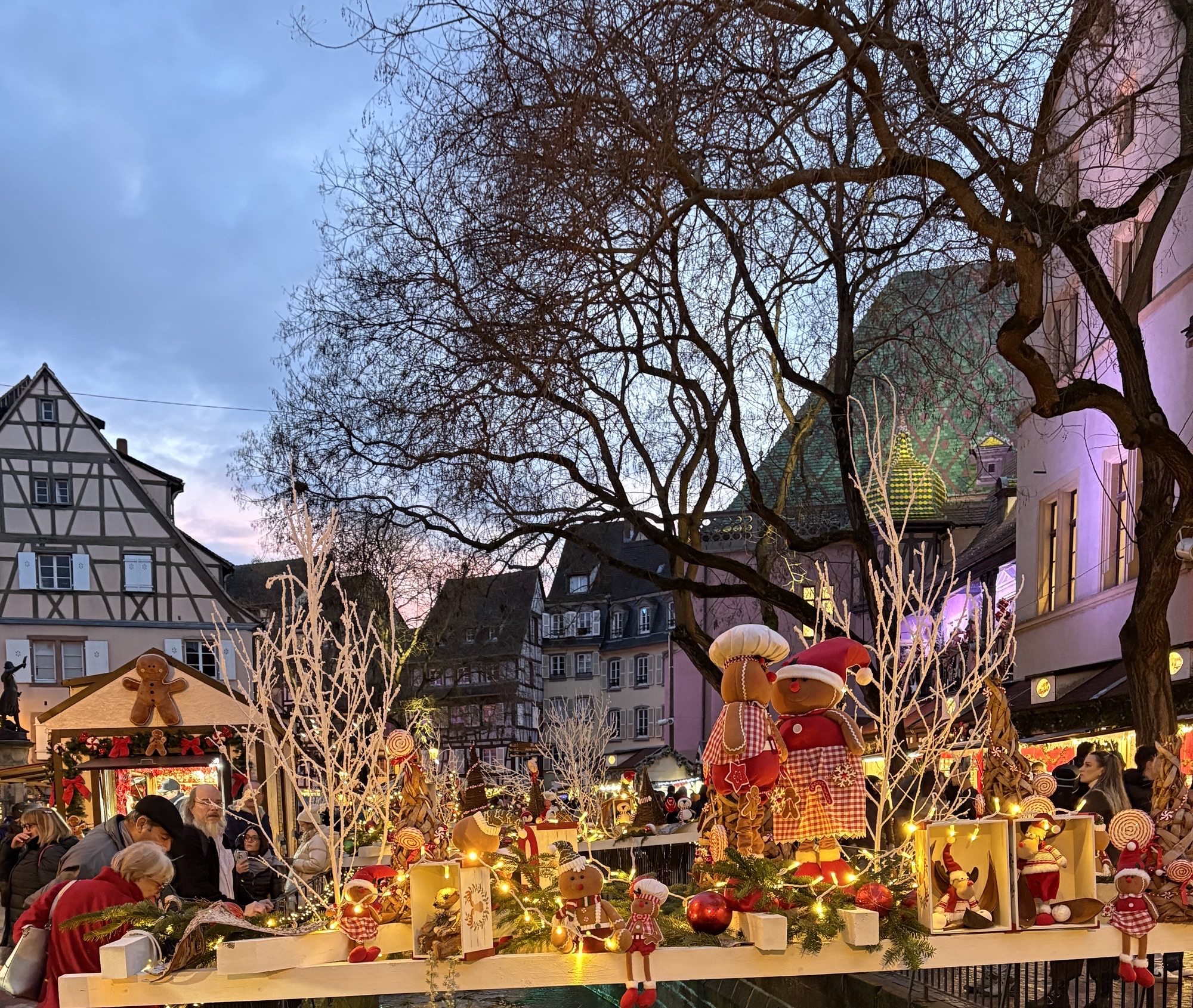
We spent the morning and early afternoon walking around the shops and markets of Colmar looking for Christmas gifts and sampling food and drinks. Colmar is known for its beautifully decorated half-timbered houses and cobblestone streets. During Christmas time, the city becomes an even more of a picturesque wonderland. Of all the Christmas markets we visited, my wife and I both felt that Colmar was the most magical and authentic.
We stayed in Colmar through the twilight and early-evening hours to witness the stunning themed lighting illuminating historic houses, canals, and alleys before taking the train back to Strasbourg.
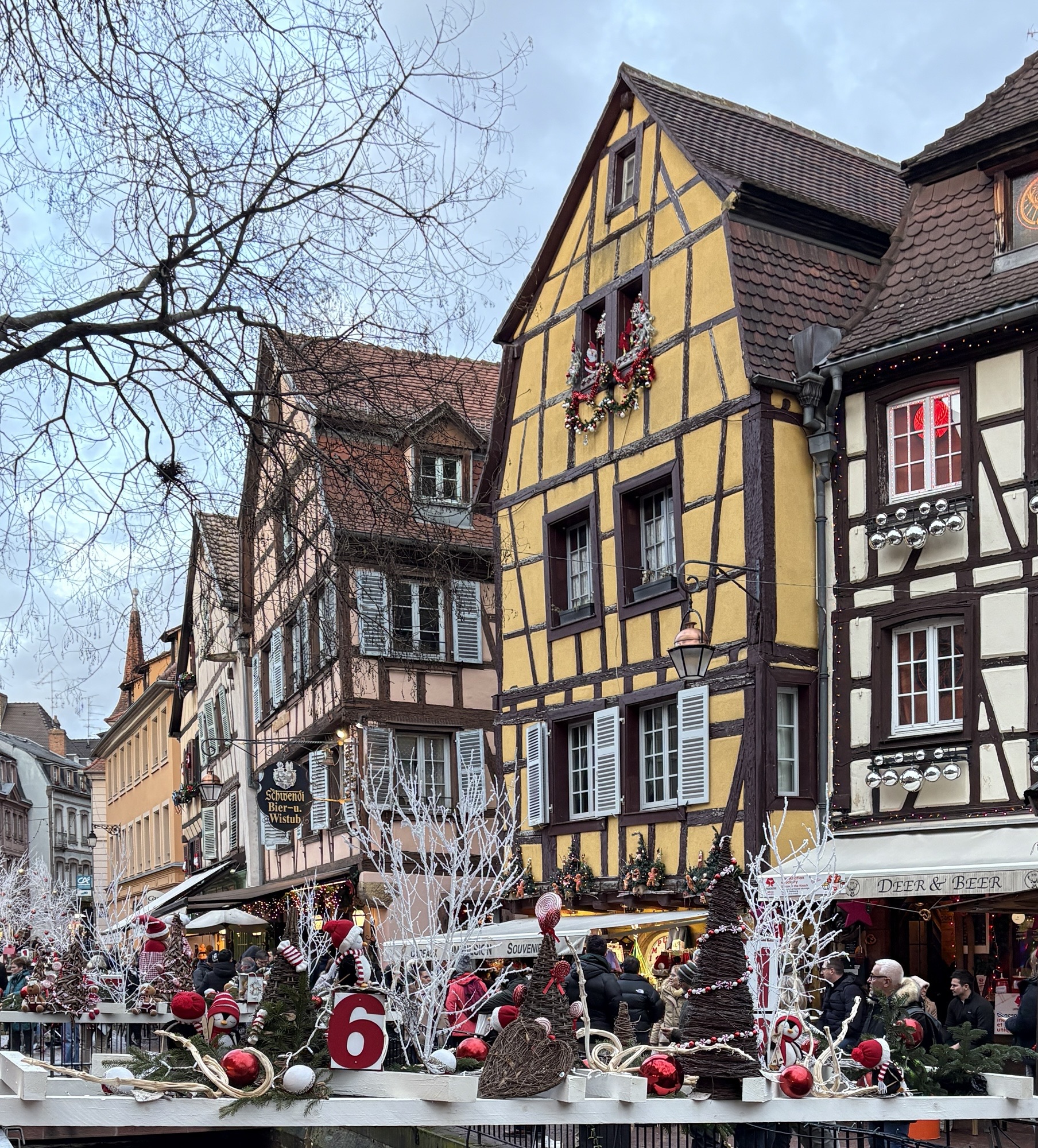
Colmar Christmas market
Basel
We arrived in Basel, Switzerland around noon after a 90-minute train ride from Strasbourg.
From the Basel train station, you can walk, take a tram, or catch a bus to reach the Christmas markets in the city center. The markets are easily accessible from the station, with trams and buses departing from right outside the station building. We opted to take an Uber to our hotel to check our bags before walking around the markets.
Basel, Switzerland sits at the crossroads of France and Germany; the city is split in two parts by the Rhine River.
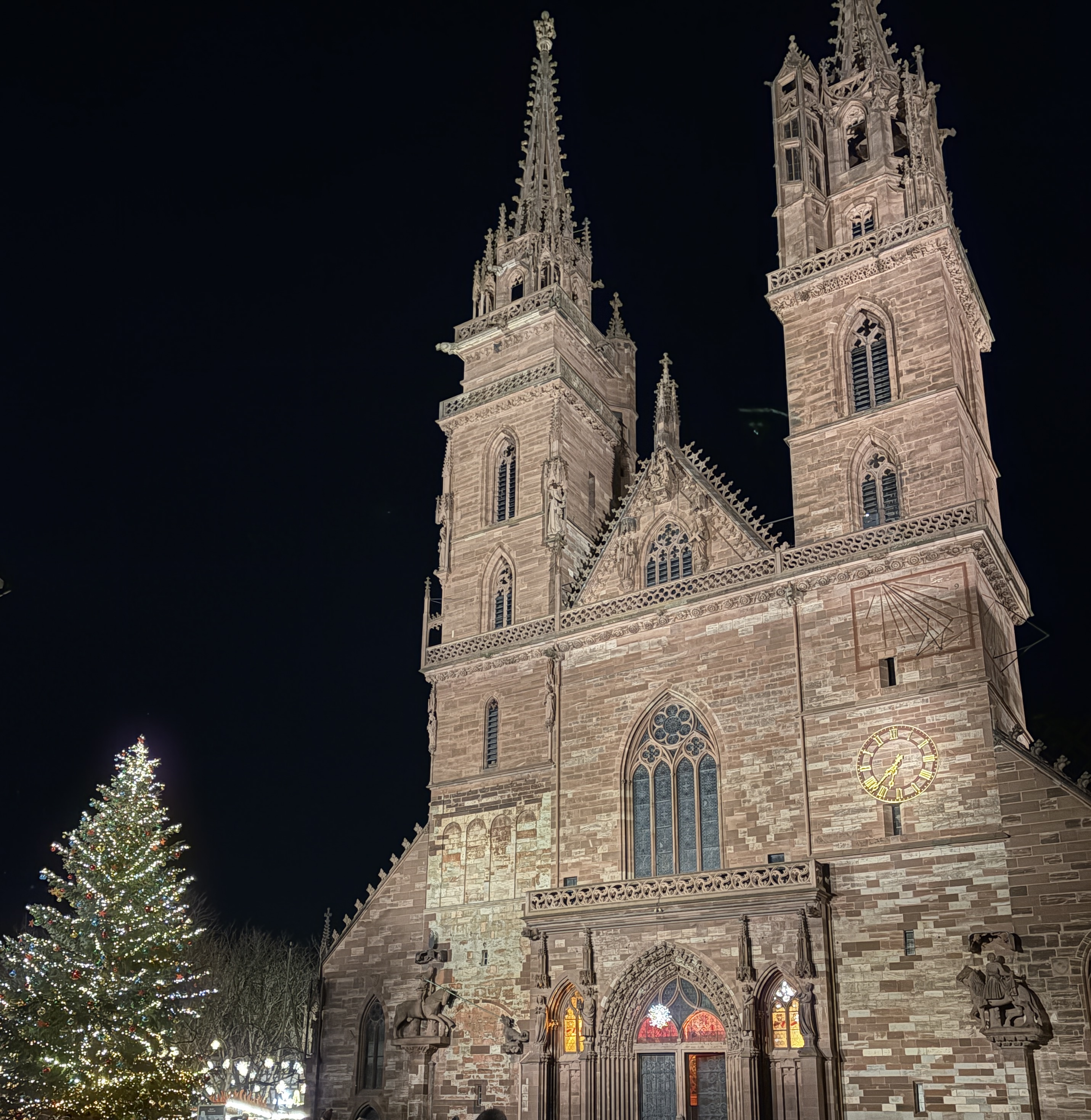
Basel Christmas market
Basel markets
Basel has two main Christmas markets, typically set up in the city's historic center at Barfusserplatz (best for shopping) and the area around the Munsterplatz (known for its rustic chalets and located near the cathedral).
Note: You can climb the steps of the cathedral to get great views of the city and the market. There is a third market across the Rhine River, The Adväntsgass Market, which focuses on food.
We walked around the markets and the historic old town in the afternoon. We found the crafts at the Basel Christmas market to be very authentic (versus mass-produced). The Basel market is where we ended up purchasing most of our Christmas gifts. We returned to walk the markets at night, adding in the Advantsgass (food market).
The Basel Christmas market was smaller in size and less frenetic than the markets in Strasbourg and Colmar. The change in pace and scope was a welcome change.
Paris
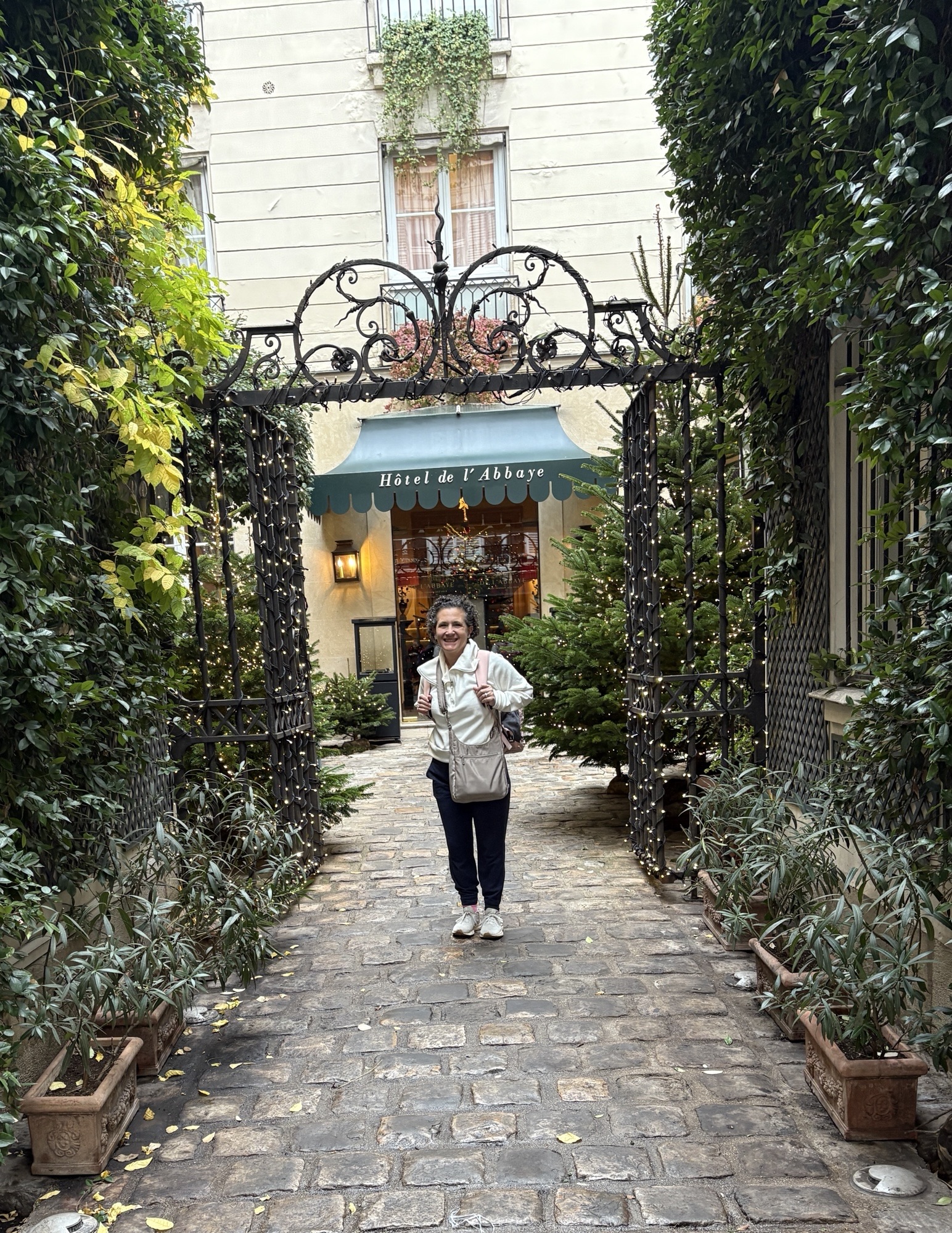
We took the fast train from Basel to Paris (3 and a half hours), arriving at the Gare Du Lyon station at noon. Drawing on our 2019 family trip to Paris in 2019, we chose the neighborhood of Saint Germain (6th arrondissement) as our base to explore the Paris Christmas markets. After checking into our hotel, we explored the following Paris Christmas markets on foot, sampling various foods and drinks.
The Saint-Germain-des-Prés Christmas Market: Located on Boulevard Saint-Germain, a short walk from St. Germain, offering an authentic Parisian holiday experience.
Magic of Xmas-Tuileries Garden Market: A very popular and large market located in the Tuileries Garden, offering a festive experience with numerous stalls and activities. Next to Louvre Museum and the Place de la Concorde (21 min walk from Saint-Germain-des-Prés Christmas Market).
Marche de Noel: Across from Notre Dame Cathedral
Before dinner, we attended a classical music concert (Bach, Mozart, and Vivaldi) at the Saint Julien le Pauvre Church in the St. Germain area.
After the concert, we walked to dinner—Brasserie Des Pres (French cuisine)—then walked back to our hotel.
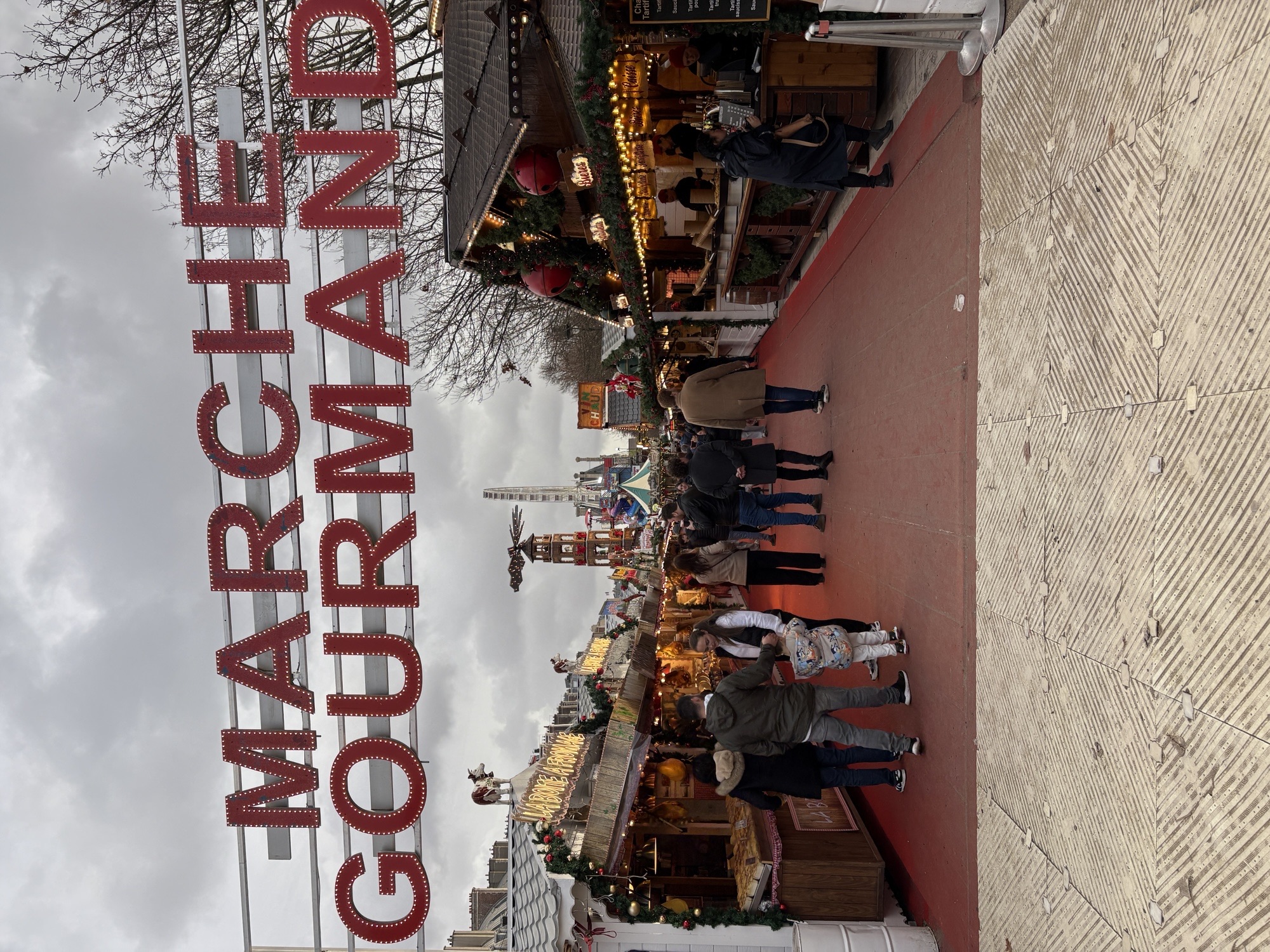
Paris Christmas market
Exploring Paris
For our last full day of our European Christmas market tour, we decided to focus less on the Christmas markets and enjoy Paris. To get around Paris, we used the Paris metro. It is highly recommended that you secure a Paris Metro map and study the map before you begin your travels on the Paris Metro. If you are traveling for the day and plan to visit several places, its best to determine the number of independent rides you need then purchase a day pass and add the number of rides you need. The “services” station at the Metro is very helpful and has their own travel translator to help with communication
From St. Germain, we took lines 4 and 10 to get to Galeries Lafayette–Hausmann Department store (a historic and iconic department store in Paris, known for its grand Art Nouveau architecture, particularly the stunning glass dome). If you have time in Paris, this is a recommended visit—be prepared to be amazed by the number of buildings, floors, and shops.
We then took lines 9 and 1 to get to the La Defense Christmas market- Paris’ largest festive market located in the Paris’ modern business district with over 300 chalets.
We then took Metro line 1 to FDR station and explored the shops along the festively lit Champs Elysees.
We returned to St. Germain via the Paris metro. We enjoyed dinner (Mediterranean cuisine) followed by another classical music concert at another beautiful church (Eglise Saint-Germain-des-Prés Church) before walking back to our hotel.
Travel back home
We enjoyed our final morning of our trip at our hotel (a leisurely breakfast) before catching an Uber to the airport and our flight back to Atlanta in the afternoon.
Leaving for home
Need to know
Christmas market background
Street markets tied to the celebration of Christmas during the four weeks of Advent. (Roughly the first day of December until just before Christmas, though some markets open in mid-November and close in early January.)
Christmas markets originated in Germany but are now held on four continents (Europe, Asia, North America, and Oceania).
Date to the late Middle Ages in the German-speaking part of Europe and in many parts of the former Holy Roman Empire.
Traditionally held in the town square, markets offer food, drinks, and seasonal items from open-air stalls accompanied by traditional singing and dancing.
How popular is the Christmas market travel segment?
Roughly 85 million people visit European Christmas markets each year.
28 different countries in Europe hold Christmas markets. The largest number of Christmas markets are held in Germany.
Most visited markets are: Dortmund and Cologne, Frankfurt and Stuttgart, Nuremburg and Dresden, Strasbourg and Budapest.
Markets tend to be most crowded at nights and weekends.
Planning for your Christmas market trip
Lots of information on the internet to read—every writer has their favorites. Cull through the list and pick out your favorite cities/markets.
Review the operational dates and market operating hours for each of the markets you plan on visiting and note that the peak tourism dates are closer to Christmas.
Determine how much time you have to visit the markets, the number markets you want to see, logistically how far apart each of the markets are, and how you will travel to each of the markets. Coordinate all of this information with your flight arrival and departure cities.
Most Christmas markets accept credit or debit cards (generally for large items) but some stalls, especially food markets, accept cash only. It is definitely a good idea to have cash available in the currency of the country you are visiting—roughly $25-$30 per meal. You can plan ahead before your trip to secure the currency needed or go to an ATM in the country you are visiting (best to choose an ATM affiliated with a bank).
Transportation
Determine your mode(s) of transportation between cities (i.e. air, rail, bus, or car?)
Many cities have multiple markets and most are walkable from one market to the other, but you may need to use the bus or metro. Use Google Maps as part of your pre-planning research
It is highly recommended that you book your international air travel and hotel accommodations in late summer or early fall—travel to visit the Christmas markets is very popular for Americans as well as Europeans. Booking one-way fares for your arrival and departure cities has become very expensive. Seats on direct flights are very limited. You might have to pick your final destination as your arrival and departure city and fly a one-way route inside Europe (flights within Europe are relatively inexpensive).
If your travel includes rail-to-connect cities in your itinerary, you’ll have to decide whether to purchase a Eurail pass (see types below) or purchase direct city to city (point-to-point) rail fares.
Eurail Global Pass & Eurail One Country Pass
Each of the above pass types is available as either a continuous or Flexi format to allow for continuous daily travel or a set number of days within a larger time frame. A Eurail Global Pass provides access to trains in over 30 European countries, while a Eurail One Country Pass focuses on travel within a single nation.
Important: With your Eurail Pass, you may still need to make seat reservations on certain trains. Please use the Eurail reference site: Book your reservations to check for train times and whether a seat reservation (additional fee) is required.
Note: Deciding between point-to-point rail travel versus a rail pass
Purchase a Eurail Pass for flexibility in travel, multiple stopovers, and when traveling as a group or with children, especially for expensive routes in countries like Switzerland. Buy individual tickets for specific, predetermined travel, and for routes in countries with good deals or competition (like Italy and Spain). The general rule is to compare the total cost of the Eurail Pass plus required seat reservations against the total cost of point-to-point tickets for your specific itinerary to determine the better option.
What to see, eat & purchase at a Christmas market
See destination information below for specific food and market details.
Most food and drinks purchased at the Christmas market will be served in glass or porcelain dishes, not disposable products. For drinks, the cost includes a deposit for the mug. There will be a central dish return area where you get your deposit back after returning the dish or mug. You can keep the mug as a souvenir if you want and forego the return of the deposit.
Many of the food stalls will require payment in cash. Roughly, you should assume around $25–$30 per meal costs.
Frankfurt (Germany)
One of the oldest and largest Christmas Markets in Germany (market has been operating since 1393). Over 200 stalls.
The market is one large, interconnected event spread across multiple squares and streets in the city's historic center, including Romerberg, Paulsplatz, and Mainkai (there are six markets in total). There is a pink Christmas market at Friedrich Stoltze-Platz (decorated in pink with rose lights) as well as the Sachsenhausen Christmas market near the Goethe Tower.
Most vendors at the market speak some English. Google Translate can be used if needed to help translate to and from German.
Traditional German foods available include: bratwurst, pretzels, flammkuchen, kartoffelpuffer (potato pancakes), and maroni (roasted chestnuts).
Traditional German sweets include: bettmannchen (marzipan pastry), christstollen (spiced fruit bread), lebkuchen (gingerbread), gebrannte mandeln (roasted almonds), and stollen (fruit bread).
Traditional German drinks include: gluhwein (spiced mulled wine), feuerzangenbowle (a flaming rum and wine drink), eierpunsch (a warm, sweet, egg-based punch similar to eggnog), and apfelwein (spiced hot cider).
Strasbourg (France)
Strasbourg features three primary Christmas markets across the Grande Île: Place Broglie, Place de la Cathédrale (Notre Dame Cathedral), and Place Kléber, complemented by numerous smaller stalls (12 markets in total) spread throughout the city's smaller squares and streets. (approximately 300 stalls to explore).
Listed by most experts as traditionally one of the best European Christmas markets.
Most vendors at the market speak some English. Google Translate can be used if needed to help translate to and from French.
Traditional Alsatian foods available include: pretzels, knack sausage, spaetzle, crepes, raclette, tartiflette (made from potatoes, reblochon cheese, bacon, and onions), schupfnudeln (Potato dumplings). reilekuchen (potato fritters), tornado potatoes.
Traditional Alsatian sweets include: bredele cookies, a variety of gingerbreads, mannele bread, waffles, pretzels, and regional brioche varieties like kugulof and longoff.
Traditional Alsatian drinks include: vin chaud (hot mulled wine-often made with local white wine and spiced with cinnamon, cloves, and citrus), Feuerzangenbowle, a German tradition where a rum-soaked sugar cube is set aflame and melts into the mulled wine.
Colmar (France)
Colmar has six distinct Christmas markets, each with its own theme, located throughout the historic town center. These markets are spread across several areas, including the Place des Dominicains and Place de l'Ancienne Douane.
Most vendors at the market speak some English. Google Translate can be used if needed to help translate to and from French.
Traditional Alsatian foods available include: flammekueche (tart flambee), spaetzle, choucroute (sauerkraut with meat), foie gras, baeckeoffe (stew of marinated meats), grumbeerekiechle (potato pancakes with munster cheese).
Traditional Alsatian sweets include: pain d’epices (gingerbread), macaroons, pretzels, pastries, and cookies.
Traditional Alsatian drinks include: vin chaud, Alsatian wines.
Basel (Switzerland)
Basel has two main Christmas markets, typically set up in the city's historic center at Barfüsserplatz (best for shopping) and the area around the Münsterplatz, (known for its rustic chalets).
Most vendors at the market speak some English. Google Translate can be used if needed to help translate to and from German or French.
Traditional Swiss foods available include: Rosti (fried potatoes, Kartoffelpuffer (fried potato pancakes), Raclette, Fondue, Grilled Sausages, flamed salmon, Alpermagronen (macaronoi dish with cheese, potatoes, onions served with apple sauce).
Traditional Swiss sweets include: Basel lackerli (gingerbread cookies), magenbrot (spiced sweet bread), apfelkuchlein (deep-fried apple slices coated in cinnamon sugar), massmogge (sweets with hazelnut filling), Chimney Cake.
Traditional Swiss drinks include: gluhwein (mulled wine), eierpunsch (eggnog), hot chocolate.
Apfelküchlein: Deep-fried apple slices coated in cinnamon sugar.
Mässmogge: Colorful, thumb-length sweets with a hazelnut filling that are a specialty of Basel fairs.
Paris (France)
Paris offers a wide range of Christmas markets, with about 15 to 20 main markets each year, plus numerous smaller pop-up and neighborhood markets.
The six key Christmas markets include the Tuileries Garden market, La Defense Christmas Village, Hotel de Ville market, Notre-Dame Christmas Market, Saint-Germain-des-Prés Christmas Market, and the Eiffel Tower Christmas market.
Traditional French foods available include: marrons chauds (roasted chestnuts), sausages, aligot (mix of mashed potatoes with cheese, garlic, and wine that can be served with sausage), flammekueche (tart flambee), BBQ meats, French onion soup.
Traditional French sweets and treats include: pain d’epices (gingerbread), crepes and waffles, nougats and pralines, marrons glacés, candied chestnuts, bûche de noël (yule log).
Traditional French drinks include: vin chaud, hot chocolate.
For more inspiration and insider recommendations, visit our Europe page.


Travel Advisor
John Keller

John Keller

Get in touch with John Keller
Did you like this guide? Reach out to customize and book your own experience. Or, just to chat about travel in general.