
Regenerative Sustainable Cambodia Honeymoon: 14 Nights Temples, Mountains & Island Paradise
Curated By
Sharon Schneider
Curator’s statement
No ordinary honeymoon—this regenerative travel itinerary oozes romance and luxury while making a measurable conservation impact. Over fifteen extraordinary days, you’ll trace ancient temple corridors as golden light illuminates thousand-year-old stones, zipline into a rainforest sanctuary where your presence funds anti-poaching patrols that means species return from the brink of extinction, and fall asleep to the sound of waves lapping against your overwater villa in Cambodia’s first marine reserve. You’ll dine on ingredients from organic gardens and foraged from jungle floors, receive traditional Khmer spa treatments using herbs grown on-property, and return home knowing your honeymoon didn’t just create memories of a lifetime—it protected habitats, supported communities, and preserved Cambodia’s rich biodiversity for generations to come. Barefoot luxury meets conservation frontlines, creating the ultimate sustainable honeymoon experience in Southeast Asia.
The Fora Difference
Book with Sharon Schneider to access exclusive perks and experiences on your trip.

Killer perks
Free upgrades, spa credits and more—we got you

Personalized recs
Customized travel planning for your style

Insider knowledge
Expert advice from people who’ve actually been there
Where to stay
Unlock perks by contacting Sharon Schneider to book your trip.
Day 1–5: Siem Reap—Ancient temples meet barefoot luxury

Angkor Wat—first light
Your Cambodian love story begins the moment you step off the plane in Siem Reap. Your driver eagerly greets you with jasmine garlands and cold towels scented with lemongrass, as well as a selection of cut fruit and your own “refill not landfill” water bottle filled with cool filtered water for the drive to your hotel. Since the opening of the new SAI Airport, located a little further out of town, the drive (through rice paddies and palm groves) takes around one hour.
Sharon’s accommodation recommendation: Phum Baitang by Zannier Hotels
For an ‘all private villa’ ultimate honeymoon indulgence.
Positive impact on people in Cambodia through Zannier Holybaby Foundation, which supports two orphanages in Cambodia as well as establishing schools for disadvantaged children.
Sustainable practices, plastic-free, waste sorting, recycling, and using local and biodegradable products. Organic restaurant with an on-site vegetable garden.
Hand-carved teak wood on stilts, a sprawling terrace with daybed swings, and your own plunge pool reflecting the sky. Inside, reclaimed timber beams frame whitewashed walls adorned with locally woven textiles, while the outdoor rain shower surrounded by bamboo becomes your morning ritual.
This is Cambodian village life reimagined as barefoot luxury—no shoes required, just sarongs, sundowners, and the sweet anticipation of temple adventures ahead.
Day 1: Arrival & sacred lotus welcome
After settling into your villa, ease into Cambodian time with the “Sacred Lotus Flower Folding” experience. Local artisans guide you through the intricate art of shaping lotus petals into six distinct styles, each carrying deep spiritual meaning. The lotus—rising pure from muddy waters—symbolizes enlightenment in Buddhist tradition, and as you fold each delicate petal, you’ll understand why this flower is central to Khmer culture. The meditative practice calms jet-lagged minds while your fingers learn an ancient craft.
As the sun dips toward the horizon, make your way to Bay Phsar restaurant for your first taste of Cambodia. Dinner tonight is a journey through Khmer flavors, starting with green mango salad tossed with crushed peanuts and dried shrimp, followed by fish amok—Cambodia’s national dish of freshwater fish steamed in banana leaves with coconut curry and kroeung (an aromatic lemongrass paste—all herbs and veg picked in house from the garden). Pair it with a crisp Chenin Blanc, and toast to the adventure ahead.
Day 2: Bayon’s faces & sunset at Phnom Bakheng
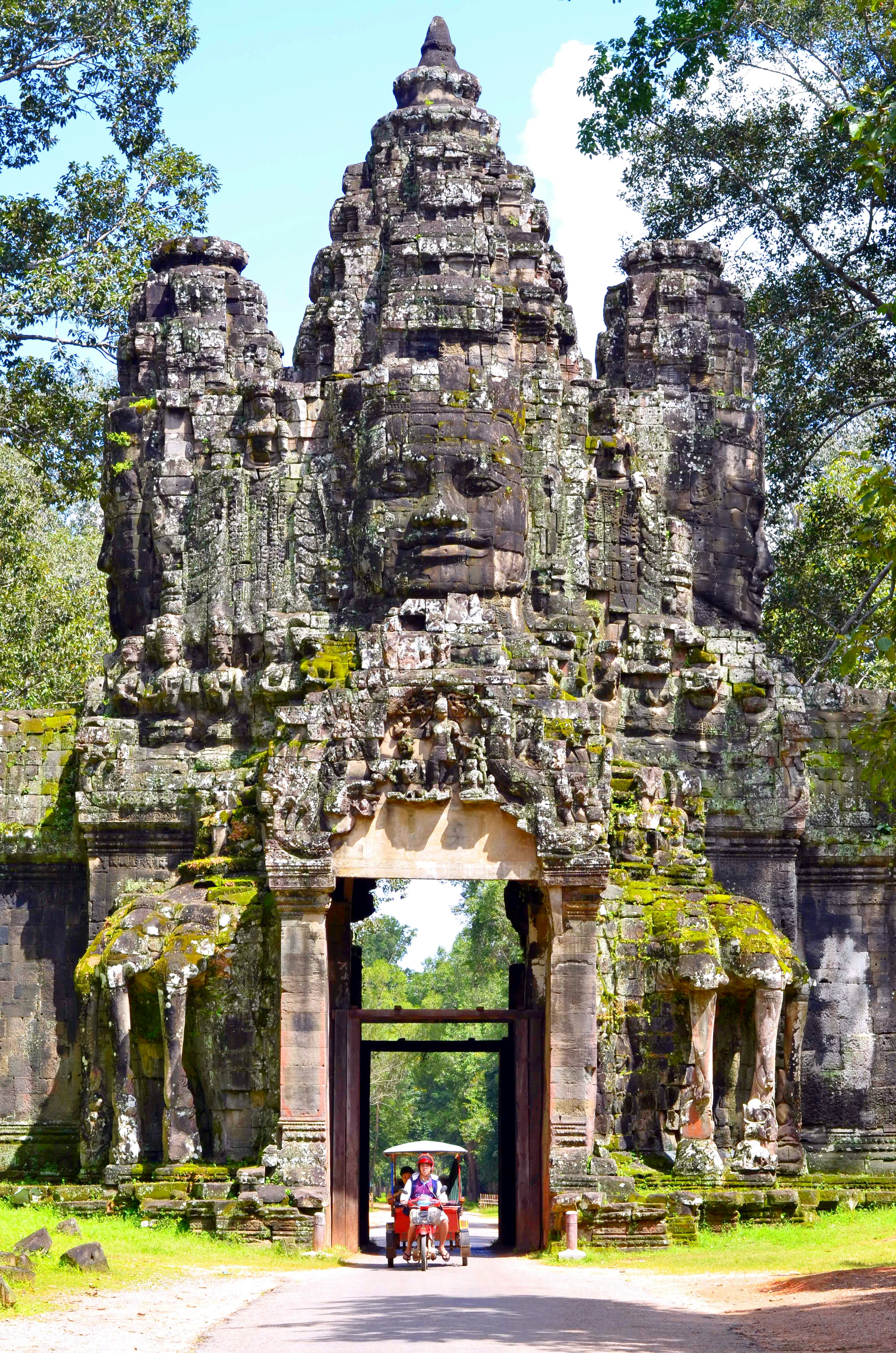
After breakfast (served poolside in your own private villa complex), your guide for the day collects you for the ‘Grand Circle Tour’. First stop: Bayon, Angkor Thom’s mystical centerpiece. Walk the galleries, where 216 serene stone faces gaze in all directions—some scholars say they depict Avalokiteshvara, the bodhisattva of compassion—others claim they’re King Jayavarman VII himself. Either way, as you turn corners and faces appear from unexpected angles, you’ll feel watched by something ancient and knowing.
Continue to the Elephant Terrace, where kings once stood to review troops, and then the Terrace of the Leper King—its walls carved with apsaras (celestial dancers) so detailed you can see their jewelry. Your guide points out the different styles: earlier work shows Indian influence, while later carvings are distinctly Khmer.
Lunch today at Chanrey Tree, where Cambodian fine dining meets social impact (the restaurant trains disadvantaged youth in hospitality). Try the “loc lac”—tender beef cubes seared with Kampot black pepper, served with tomato-lime dipping sauce and a fried egg on fluffy rice. The Kampot pepper (Cambodia’s protected geographical indication product) has a complex floral heat that makes ordinary pepper seem dull.
Late afternoon, you’ll head to Phnom Bakheng for sunset, but you’re taking the scenic route. The temple mountain sits 65 meters above the plain, and while most tourists ascend the front stairs, your guide leads you on a quieter path through the forest. At the top, stake out your spot on the upper terrace—timing is everything, as only 300 people are allowed up at once. As the sun descends, Angkor Wat’s towers appear in the distance, silhouetted against orange and pink skies. This is the moment for that sunset champagne your guide somehow produces from his bag.
Dinner tonight at Mahob Khmer Cuisine, where traditional recipes meet modern techniques. The tasting menu walks you through regional specialties: Kampong Cham snails in lemongrass broth, Siem Reap-style grilled beef with ant egg salad (yes, really—it’s delicious), and num banh chok (Khmer noodles) with fish-based gravy and a rainbow of fresh herbs. Each dish comes with stories of how the chef researched these nearly-lost recipes from the grandmothers of the village.
An early night tonight, in preparation for an early start ahead.
Day 3: Angkor Wat sunrise & temples
Your alarm seems unkind as it bursts to life at 4:45 am, but there’s magic waiting. By 5:15 am, you’re in the tuk-tuk, fresh pain au chocolat and cappuccino in hand, heading toward Angkor Wat. In the dark, your guide ushers you away from the crowds on the northern library’s stone steps and finds you the perfect spot… The morning is quiet and the light arrives slowly… and then it happens: the sun breaks over the jungle canopy, transforming Angkor’s iconic towers from silhouette to golden stone. The reflection pool mirrors the scene perfectly. You’re witnessing what has captivated travelers for centuries, but in this moment, it feels like it was built just for you.
Top timing tip: Visit during the spring or autumn equinox (March and September) and experience the perfect alignment of the sun with the architectural design of the central tower of the great temple.
After the sunrise spectacle, breakfast awaits at a secret spot—your guide knows a family-run restaurant where locals eat, and you’ll feast on bobor (Khmer rice porridge) with ginger, spring onions, and crispy fried garlic, alongside fresh fruit from the market. Fortified, you’re ready to explore.
Your exploration of the grounds continues throughout the morning. Your guide brings the stones to life: pointing out bas-reliefs depicting the Churning of the Ocean of Milk, explaining how 5,000 workers carved these galleries, sharing stories of French archaeologist Henri Mouhot’s “rediscovery” in 1860. The morning light slants through windows, creating dramatic shadows on ancient faces—a photographer’s dream.
Mid-morning, retreat from the heat to Ta Prohm, where nature and architecture engage in their famous dance. Massive silk-cotton tree roots drape over carved doorways like melted wax, and stranger figs burst through temple roofs. This is the “Tomb Raider temple,” yes, but it’s also a powerful reminder of nature’s persistence. Your guide explains the ongoing restoration debate: clear the trees to save the structure, or leave them as testament to the jungle’s power?
Lunch at your hotel offers refuge from temple crowds and midday heat. The pool beckons—fresh towels appear as if by magic. The afternoon is yours—nap in your villa’s hammock, float in your plunge pool, or book a traditional Cambodian massage. Honed over centuries, the combination of herbal compresses (dry ginger root, lemongrass, turmeric, kaffir lime, and cinnamon) and applied pressure on energy meridians releases any lingering travel related tension or fatigue from exploration.
Day 4: Countryside cycling & cooking class
Today breaks the temple rhythm with an intimate look at rural Khmer life. After breakfast (don’t skip the fresh coconut pancakes—“or nom krok”), you meet your guide at 9 am for a day of exploring the countryside by scooter.
These aren’t your typical scooters—they’re electric, quiet, and surprisingly zippy as you wind through villages on roads that haven’t changed much in decades. Your guide (who rides alongside) stops at a silk-weaving cooperative where women work on traditional looms, earning their wages through fair-trade enterprise.
Continue past rice paddies where farmers transplant seedlings by hand, exactly as their ancestors did. You’ll stop to help for a few minutes—it’s harder than it looks, bending double in the mud while keeping rows straight. The farmers laugh good-naturedly at your attempts, and produce cold sugar cane juice as a reward for your efforts.
The West Baray dam offers spectacular views—this massive 11th-century reservoir once supplied water to Angkor’s million inhabitants, and today provides fishing livelihoods for floating village communities. Your guide points out schools and shops built on pontoons, homes that move with water levels, and children who paddle to class in metal basins.
Stop for lunch at a local market where your guide orders: veg stir-fry with ginger and holy basil, grilled fish wrapped in banana leaves, and the ubiquitous rice. You’re sitting on plastic stools, ceiling fans stirring humid air—no tourists for miles. This is the real Cambodia.
By early afternoon, you’ll be back at your hotel, in time for an afternoon swim, siesta, or magical floral GnT. Then once your tummies signal “time”, it’s off to the in-house organic garden, for a cooking demo and dinner. Chef explains how they’ve eliminated single-use plastics and chemicals—pest control with marigolds planted between vegetables to repel insects naturally.
Under his guidance, you’ll harvest your dinner: picking Thai basil, lemongrass, turmeric root, tiny bird’s eye chilies. Then pound the mix into kroeung paste using a heavy granite mortar. The rhythmic pounding might feel more awkward than meditative, but the aromas are intoxicating. You’ll prepare three dishes: fish amok, chicken with ginger and mushrooms, and stir-fried morning glory with garlic before sitting down to eat your creations with Chef’s recipe stories and a chilled glass of chenin in hand.
Day 5: Wellness journey to Kbal Spean & final temple
Your final full day in Siem Reap deserves something special. The 5:30 am departure feels brutal until you’re 30 minutes deep in the forest, trekking up to Kbal Spean, and realize you have this sacred place almost to yourself.
The “River of a Thousand Lingas” reveals itself gradually: first, the sound of rushing water, then carved sandstone riverbed where thousands of phallic symbols (lingas) have been sculpted into the rock—an ancient fertility blessing for the waters flowing to Angkor. But the real magic is the waterfall at the source, where your yoga instructor has laid out mats on smooth stones. You won’t easily replicate this experience again—doing sun salutations as the sun streams through the canopy and the cascading water provides the soundscape.
Afterwards you’ll continue on to Banteay Srei, the “Citadel of Women,” built entirely of rose-pink sandstone while snacking on fruits and energy balls packed by the hotel. Here the intricate carvings are considered the finest in all of Angkor—the stone’s fine grain allows for extraordinary detail, and because the temple is small, every surface is a masterpiece. So much so that French explorer André Malraux attempted to steal several panels in 1923. (He was caught—the panels were returned.)
On the return journey, if season permits, you’ll witness palm sugar making—a process unchanged for centuries. Watch as workers climb 40-foot palm trees using nothing but rope loops, tap the flower for sweet sap, and boil it down in massive woks until it crystallizes into golden sugar. You’ll taste it still warm—unlike anything you’ve had before, with notes of caramel and smoke and something indefinably tropical.
Your final evening in Siem Reap deserves celebration. Dine at Chef’s Table in Bay Phsar’s kitchen garden. The tasting menu might include: heritage tomato salad with burrata and black sesame, followed by butter-poached lobster with saffron and lemongrass beurre blanc, then finishing with a dessert that involves palm sugar, coconut, and the morning’s garden harvest.
A nightcap at the bar, feet in the pool, stars emerging overhead. Tomorrow, the Cardamom Mountains beckon.
Day 6–9: Cardamom Mountains

Cardamom Mountains Range—Cambodia
The journey
Your morning departure from this sacred place feels bittersweet, but adventure awaits and excitement is buzzing. You have two transfer options:
Option 1: Helicopter Transfer (approximately 80 minutes)—The ultimate in luxury and efficiency. Your pilot flies over Angkor’s temple complex (aerial views that put your sunrise photos to shame), then south across the Tonle Sap Lake’s vast expanse, and finally over the Cardamom Mountains themselves—an unbroken carpet of rainforest canopy. The aerial perspective reveals Cambodia’s wild untamed nature: no roads, no power lines. Landing at the property’s helipad, you’ll transfer in a vintage army jeep to the entry point for the final jungle approach.
Option 2: Private Luxury Vehicle (approximately 4 hours)—For those who want to see Cambodia’s countryside evolve from rice paddies to coastal plains to mountain jungle. Your driver stops at viewpoints overlooking Tonle Sap, pauses at roadside markets where you’ll sample fresh mangosteen and rambutan, and navigates increasingly wild terrain until suddenly you’re at the ranger station. From here, you’ll transfer in a vintage army jeep (to handle the terrain) deeper into the jungle along a rutted track that crosses rivers and climbs into the mountains.
Sharon’s accommodation recommendation: Shinta Mani Wild
Exclusive luxury jungle tents with a compelling conservation backstory.
Positive impact on people in Cambodia through the The Shinta Mani Foundation, which funds programs in education (Shinta Mani Hospitality School), healthcare (mobile clinics), microfinance (interest-free small business loans).
Positive impact on place: partnering with Wildlife Alliance to protect threatened wildlife and support a ranger station in Cardamom Mountain region.
The arrival
At the end of your Jeep journey sits the base of Eastern Tower, where you’ll climb 102 steps through the forest canopy. At the top, your “Bensley Butler” (named after Bill, co- founder) helps you into a harness, clips you onto double cables, gives you a reassuring smile, and then you’re flying—400 meters at up to 50 kmph, soaring over treetops and the river valley, waterfalls rushing below, until you touch down at Landing Zone Bar, where your favorite cocktail is waiting.
Welcome to the jungle.
Your tent
Let’s be clear: “tent” is a technical term only. Tent 7 or Tent 12 (the waterfall tents for honeymooners)—features a king bed under a draped canopy, an outdoor deck with daybed and dining table overlooking Big Raging Sister Falls, an indoor-outdoor bathroom with soaking tub and rain shower, and yes, air conditioning (although the design and airflow through your luxury abode is such that you may not ever use it). Bill Bensley’s design aesthetic genius is “safari meets Raiders of the Lost Ark”—vintage leather trunks, brass fixtures, botanical prints, carved wooden elephants. Think Jackie Kennedy on an expedition, with modern plumbing.
The 24/7 soundtrack is rushing water. Light sleepers should request the “wild tents” further upstream, but honestly? You’ll sleep better than you have in months. Something about waterfalls and jungle air acts as nature’s Ambien. (And there’s a ton of research now—check out “blue mind” research, Wallace J Nicols.)
The Shinta Mani Wild Philosophy
Before diving into your days here, understand what makes this place extraordinary: everything is included. And I mean everything. Meals, premium drinks, laundry, spa treatments (as many as you want), all guided excursions. It’s only the helicopter transfers, should you choose them, that are additional. Even land-based transfers (lux SUV with wi-fi hook-up) from Phnom Penh or Sihanoukville are included for your scenic journeys in and out. No menu to decipher or bill to sign. This is real all-inclusive luxury—far from the buffet lines or watered-down cocktails.
More importantly, your stay directly funds Wildlife Alliance rangers who conduct daily anti-poaching patrols in this 350-hectare private reserve. Since opening, Shinta Mani Wild has removed over 15,000 snares, confiscated hundreds of chainsaws and guns, and documented the return of Asian elephants, sun bears, clouded leopards, and over 140 butterfly species. The battle to protect the Cardamoms is real, and your honeymoon becomes part of the solution.
Day 6: Arrival & river immersion
After that adrenaline-pumping zipline arrival, spend your first afternoon settling into jungle rhythms. Your Bensley Butler (who you’ll come to regard as a guide, friend, and miracle worker) gives you a camp orientation, explaining that there are no rules here—dine wherever you want, do whatever you want, ask for anything.
Lunch at Headquarters (the central dining room) might be Vietnamese banh mi, followed by a nap in your tent’s hammock, then an afternoon spa treatment. The spa itself is a masterpiece—two treatment rooms perched among granite boulders in the forest canopy, accessed via a jungle path where butterflies outnumber people.
Sunset cocktails are a Shinta Mani Wild tradition. Your butler sets up a pop-up bar for two on a massive flat boulder in the middle of the river—you sit with feet dangling in cool water (tiny toothless fish nibbling your toes), campfire flickering, gin and tonic in hand, watching the light turn golden on the forest canopy. This might be the most romantic (& decadent) happy hour on earth.
Dinner: The chef announces tonight’s menu (it changes daily based on what’s been foraged). Perhaps river prawns with holy basil, followed by slow-roasted pork shoulder with tamarind and chili, then mango sticky rice made with local palm sugar. The wine list is surprisingly deep for a jungle camp—they maintain a serious cellar. Your butler recommends a Pinot Noir from Oregon, and he’s right.
Day 7: Anti-poaching patrol & waterfall adventures
Wake to the jungle’s cacophony—gibbons howling their territorial songs, hornbills’ wings beating overhead, the ever-present waterfall roar. Breakfast at Headquarters (fresh croissants, tropical fruit you’ve never heard of, eggs any style, strong Cambodian coffee) fortifies you for today’s main event: the Anti-Poaching Ranger Patrol.
This is not a performative eco-tour—this is the real thing. At 8 am, you’ll meet the Wildlife Alliance rangers at their on-site station: armed, uniformed, and deeply committed to protecting this forest. Your guide (often a reformed poacher himself—the organization employs locals who once hunted wildlife, giving them alternative income) explains what you’ll be doing: checking camera traps for overnight visitors, dismantling any snares discovered, and patrolling known poaching routes.
You’ll travel by motorbike deeper into the Cardamoms, bouncing along tracks that barely qualify as paths. The rangers stop frequently to inspect the forest—there’s a snare, disguised with leaves, meant to catch a sun bear. Your guide carefully dismantles it, explaining how these wire loops slowly strangle animals. By mid-morning, you’ve removed four snares and checked three camera traps. One captured footage last night: a family of wild boar trotting past, a flash of something that might have been a clouded leopard, and—jackpot—a clear shot of an Asian elephant, a species making a comeback in the Cardamoms after near-local extinction.
The patrol is intense, eye-opening, and absolutely unforgettable. This is conservation at the front lines, and you’re part of it.
Return to camp by noon, dusty and triumphant. Lunch (cold Cambodian beer mandatory) might be pad thai with foraged mushrooms, followed by the most-earned siesta of your life. Mid-afternoon, revive with a riverside foot massage—your therapist sets up two portable massage chairs on smooth rocks beside the waterfall, and for 60 minutes works every pressure point in your feet while you watch kingfishers hunt and the water rush past.
Late afternoon, join your butler for kayaking. The Southern Cardamom’s waterways are gentle this time of year, perfect for floating downstream through palm-draped channels. You’ll spot six different kingfisher species (your guide knows them all), watch bee-eaters catch dragonflies mid-flight, and maybe—if you’re very quiet—glimpse a family of long-tailed macaques moving through the trees.
Tonight, you dine al fresco—your butler will set up a table deep in the jungle, lit by hurricane lanterns, where you’ll feast on beef tenderloin grilled over an open fire, served with vegetables picked from the organic farm that morning. For dessert, chocolate lava cake appears from somewhere (the kitchen is a quarter-mile away—how?) with fresh passion fruit. You’re dining in a world where most animals are still asleep, where the biggest danger is getting chocolate on your white linen napkin, and where luxury and wilderness coexist perfectly.
Day 8: Expedition boat & foraging
Today explores the estuarine ecosystem where river meets sea. After breakfast, board the expedition pontoon boat—a custom-designed vessel with full bar, daybeds, toilet, and a top deck with sun loungers.
The journey takes you through the upper Srey Ambel Estuary, where freshwater mingles with tidal saltwater, creating brackish ecosystems that support incredible biodiversity. Your guide points out trojans, Asian water monitors sunning on mudflats, and mangrove channels where juvenile fish shelter. You’ll spot local fishermen checking crab traps, and pass stilted villages where children wave from wooden docks.
Mid-morning, your captain pulls into a quiet mangrove channel perfect for exploring by kayak. Paddle through the tangled root systems (mangroves are critical nurseries for marine life), watching mudskippers hop across the mud and crabs scramble into burrows. The water is glass-calm, the only sound is your paddle’s dip and bird call.
Around noon, your crew sets up a picnic on a deserted golden sand beach—white tablecloths on driftwood, champagne on ice, and a feast: lobster salad with lime and chili, Vietnamese spring rolls, grilled fish with green mango, and fresh coconut for drinking. You’re on a beach that sees maybe a dozen people per year. The sand is fine as powder, the water warm as bathwater, the vibe utterly Robinson Crusoe.
The afternoon brings a wild foraging experience with the camp’s expert foragers—often reformed loggers who know the jungle intimately. You’ll venture into the forest to discover what’s edible: wild potatoes dug from the ground, exotic fruits picked from trees (mangosteen, rambutan, langsat), mushrooms growing from logs, even red ants (yes, eat them—they taste like lime). It goes carefully into the basket for tonight’s dinner.
Return to camp by late afternoon, just in time for your couple’s Hot Stone Body Healing treatment. The spa’s natural heated stones (warmed in a wood-fired oven) are placed along the spine, shoulders, and palms—their gentle heat penetrating deep into muscles.
Tonight’s dinner showcases your foraged ingredients: perhaps wild mushroom soup with coconut milk, followed by grilled fish wrapped in forest leaves, then a dessert incorporating wild honey and tropical fruits you picked yourself. The chef presents each dish with explanations of where it came from, how it was prepared, and the traditional Khmer techniques involved.
Day 9: Waterfall wellness & departure prep
Your final full day here should balance romance, adventure, and reflection. Begin with sunrise yoga atop Eastern Tower. While you salute the sun, you’ll observe the forest canopy emerge from the shadows and understand why this place is called Wild. The class finishes just as full daylight arrives, and you get to zipline back to Headquarters for breakfast. Best. Commute. Ever.
Relax for the rest of the morning, soaking up the surroundings.
The afternoon offers choices: mountain bike through the forest with the resident butterfly expert, float down the river on inner tubes, forage for dinner, visit the spa, or simply claim your spot on a boulder in the river with a book and a cocktail. Your butler materializes periodically with fresh towels, more drinks, and occasionally a piece of fruit carved into an elaborate flower.
Your farewell dinner is somewhere special—dinner above a waterfall. Your butler will set up a table on a platform overlooking cascading water, lit by dozens of candles, where you’ll dine on the chef’s most ambitious menu: perhaps butter-poached lobster, or dry-aged beef tenderloin, finishing with a chocolate soufflé that arrives perfectly timed and impossibly risen. Pair it with wines from the cellar, toast to the jungle, and prepare for the next chapter: Island paradise awaits.
Day 10–14: Tropical island time

Your private island awaits, Sihanoukville
The journey
Your farewell from this wild place may feel emotional—you’ve bonded with your Bensley Butler, as well as the biodiverse jungle alive with species fighting for their status here. But your island paradise awaits.
Transfer options:
Option 1: Helicopter (25 minutes)—Fly to Sihanoukville’s helipad, soaring over the Cardamom rainforest one last time. From above, you’ll see the extent of the protected forest, the rivers cutting through the jungle, and eventually the coastline emerging. It’s spectacular, efficient, and worth every dollar.
Option 2: Private Luxury Vehicle (90 minutes)—The road journey to Sihanoukville passes through coastal Cambodia, offering glimpses of everyday life: fishing villages, roadside fruit stands, Buddhist temples with monks in orange robes. Your driver stops as requested for photos and snacks.
From Sihanoukville port, it’s a 45-minute speedboat ride to your island paradise of choice. The mainland recedes and tiny jungle-covered islands emerge from turquoise water.
Sharon’s accommodation recommendation: Song Saa Private Island
For the ‘private water villa’ ultimate honeymoon indulgence.
Positive impact on the people through the non-profit Song Saa Foundation, whose focus is on community welfare in Cambodia’s Koh Rong Archipelago. They achieve this through providing medical and dental care via programs like the “Boat of Hope,” and running educational initiatives for local youth.
Positive impact on the place: Also through the Song Saa Foundation, they established Cambodia’s first marine reserve where the focus is on environmental regeneration. They have also implemented a waste management program.
The arrival & your villa
Song Saa’s speedboat captain navigates to the dock, where your butler greets you with lemongrass-scented cold towels and fresh coconut water. A short golf cart ride delivers you to your villa (the island is small—27 acres total between the two connected “sweetheart” islands, where they derive their name).
For honeymooners, there’s only one choice: the Oceanfront Pool Villas. Your accommodation sprawls across multiple levels: ground floor houses the bathroom (outdoor rain shower, indoor soaking tub with ocean views, double vanity), middle level holds the bedroom (netting-draped king bed), and top level features your living area opening onto a massive deck with infinity pool, daybed, dining table, and nothing between you and the Gulf of Thailand except sea breeze and possibility.
The design aesthetic? Reclaimed elegance. Every piece of timber was salvaged from old fishing boats, factories, or driftwood beaches. The carved wooden panels, the driftwood furniture, the woven rattan lights—everything has a past life, now reimagined as barefoot luxury. Single-use plastic doesn’t exist here—your water comes from the on-island bottling plant in glass bottles you’ll keep refilling.
Understanding impact
Before diving into your days here, grasp what makes this hotel different: this isn’t a resort that does some conservation on the side—conservation is the point. The property created Cambodia’s first marine reserve (100 hectares of protected reef), employs full-time marine biologists running coral restoration programs, operates the Boat of Hope, providing free medical care to remote island communities, and trains locals in sustainable fishing practices.
Since 2012, they’ve planted over 10,000 coral fragments, reforested mangrove coastlines, eliminated single-use plastics (before it was trendy), and funneled millions into the Song Saa Foundation’s community programs. Your honeymoon isn’t just a vacation—it’s an investment in Cambodia’s coastal future.
Day 10: Arrival & marine sanctuary snorkel
After settling into your villa (protip: immediately jump in your infinity pool—it’s mandatory), lunch awaits at Vista restaurant. The open-air design captures every breeze, and the menu celebrates sustainability: local fish grilled with lime and chili. Everything is caught by local fishermen using traditional methods, or grown in the organic gardens you can see from your table.
Afternoon brings your introduction to the marine reserve with House Reef Snorkeling. Wade in from the beach, and within minutes you’re floating above fields of coral—staghorn, brain coral, table coral—teeming with parrotfish, angelfish, and spotted rays. This 200-meter sanctuary represents years of restoration work, and you’re swimming through the results.
Late afternoon to sunset: grab your villa’s complimentary bubbly from the mini-fridge, settle into your infinity pool, and watch the sun melt into the Gulf of Thailand.
Day 11: Coral restoration & jungle exploration
Morning begins at the Discovery Centre (before your first snorkel) with a resident marine biologist who shares survival rates above 80 percent, fish populations rebounding, the reef expanding year by year. Your honeymoon is literally helping rebuild an ecosystem.
Mid-morning, cross the footbridge to Koh Bong (the second island) for the Island Nature Trail. The jungle path winds through primary rainforest—fan palms, strangler figs, trees draped in epiphytic orchids—to an observation deck overlooking both islands. Alone time. The silence here is profound, broken only by bird calls and rustling leaves. You might spot hornbills, kingfishers, or the endemic island flying fox (fruit bat).
Upon return, enjoy a lunch of Khmer fish curry with pumpkin and eggplant, followed by fresh fruit sorbet. Afternoons are for doing absolutely nothing—float in your pool, read in the daybed, nap in the hammock strung between palm trees. Your butler materializes with fresh passion fruit juice without being summoned. It’s possible he’s psychic.
Late afternoon, could include a Coconut Body Scrub treatment for two at the spa. You’ll get to exfoliate away, and then replenish your sun-dried skin with the healing powers of coconut in all its forms.
Tonight, your butler transforms a secluded beach into an intimate dining room: a driftwood table set with linens and candles, hurricane lanterns marking a path through the sand, and a personal chef preparing a multi-course feast. The menu might include: scallop ceviche with lime and coconut, followed by whole grilled fish with lemongrass and chili, then mango sticky rice for dessert. You’re barefoot in the sand, stars emerging overhead, waves lapping at the shore, and if this isn’t what honeymoons are about, I don’t know what is.
Day 12: Community connection & mangrove kayaking
This morning offers a profound cultural experience: join the village visit to see how your stay impacts local communities. A short boat ride takes you to Prek Svay village on the mainland, where the Foundation operates education programs, healthcare initiatives, and sustainable livelihood training.
You’ll meet with community leaders who explain how tourism revenue has transformed village life: kids attend school instead of working fishing boats, families have access to clean water and basic healthcare, women have learned alternative income skills like weaving and organic farming.
Return to the hotel with a new-found appreciation of what “regenerative tourism” means. Lunch at the island, then an afternoon of relaxation, or for those seeking more action—the kayak through the coastal mangrove forests thriving in the Koh Rong Marine National Park.
The tangled root systems act not only as a juvenile fish nursery (for 80 percent of commercial fish species), they protect coastlines from erosion, and sequester carbon more effectively than terrestrial forests.
The kayaking is low-impact but gives you an arm workout. You’ll return pleasantly tired, ready for a well earned cocktail.
Tonight, dine at Driftwood Bar & Grill (the beach restaurant): fresh seafood grilled over coconut husks, served with salads and coconut rice. The vibe is casual with a cocktail list that leans heavily towards rum. Try the Dark & Stormy made with Cambodian rum and homemade ginger beer.
Day 13: Snorkeling safari & bioluminescence
Today starts with a lazy, long poolside breakfast and plenty (island) time.
Perhaps later a snorkeling safari at Coral Reef Island with Marine Scientist at a remote site far out in the archipelago, accessed by speedboat, where few people snorkel. Massive table corals spanning meters, schools of yellow snappers flowing past like liquid gold, spotted eagle rays gliding effortlessly, and if you’re very lucky, seahorses camouflaged among soft corals. Your marine scientist guide points out species, explains coral health indicators, and shares why this site has remained pristine (remoteness helps, but so does marine park protection).
Then time for a picnic lunch on a deserted beach: fresh fruit, sandwiches, cold drinks, and then maybe just one more snorkel session, before the speedboat journey back for hammock down time, and cocktail sampling.
After a light dinner, once the sky has darkened completely (the new moon is best). Your guide motors you out into deeper waters. As you slip into the warm ocean, every movement of your hand creates an explosion of blue-green light—phosphorescent plankton in bloom, igniting like underwater stars. Swim through the liquid galaxy, watch your partner glow with each stroke, dive down, and trail sparkles in your wake. This is beyond romance—this is swimming through stardust, creating constellations with your bodies. Moments that make you believe in magic.
Return, salt-crusted to your villa. Sip champagne beside your infinity pool, and replay the luminous memories.
Day 14: Free-diving, final snorkel & farewell
Your final full day. Morning begins with an optional free-diving introduction with the resort’s certified instructor. Free-diving—snorkeling without tanks, relying on breath-holding—offers a different perspective on the marine world. You’re quieter, more fish-like, able to duck-dive to the reef and hold still among the corals.
The instructor teaches breath-work techniques, equalization methods, and safety protocols, then takes you to the house reef to practice. Even reaching 3–4 meters of depth feels like an accomplishment, and the sensation of gliding underwater on a single breath is meditative and thrilling simultaneously.
Mid-morning, claim your spot on the beach for one final snorkel, one more float in your villa pool, one last fresh coconut drunk in a hammock. Your butler brings departure drinks—probably something involving champagne—and you toast to an unforgettable two weeks.
At 3 pm, you depart for Sihanoukville. From there, an easy transfer to the airport (45 minutes) for your evening flight home.
As the islands recede in the speedboat’s wake, you’ll understand what makes this honeymoon different: you didn’t just visit Cambodia—you participated in the story of its preservation.
Need to know
Best overall: November through March (dry season, optimal for all activities).
Comfortable temperatures (25–30°C/77-86°F).
Clearest water for snorkeling (15–20m visibility).
Best conditions for temple exploration (cooler mornings).
Note: Christmas/New Year brings crowds and premium pricing.


Travel Advisor
Sharon Schneider
Sharon Schneider
Get in touch with Sharon Schneider
Did you like this guide? Reach out to customize and book your own experience. Or, just to chat about travel in general.
For more inspiration and insider recommendations, visit our Cambodia page.