
Tanzania Safari Itinerary: Serengeti Olakira, Chada Katavi & Greystoke Mahale

Curated By
Everwilde Travel
Curator’s statement
Western Tanzania is where the country truly clicked for me. Off the usual circuit, Katavi and Mahale felt raw and honest—“back to Africa” in the best way—where you live inside the landscape instead of just looking at it. In shoulder season, the quiet lets you go deeper—days run on light and weather, not timetables. This itinerary deepened my love for Tanzania because it felt authentic and unforced—safari at the level I want my clients to feel.
The Fora Difference
Book with Everwilde Travel to access exclusive perks and experiences on your trip.

Killer perks
Free upgrades, spa credits and more—we got you

Personalized recs
Customized travel planning for your style

Insider knowledge
Expert advice from people who’ve actually been there
Where to stay
Unlock perks by contacting Everwilde Travel to book your trip.

Serengeti plains
I arrived late into Kilimanjaro, transferred to Rivertrees in Arusha, and did the reset I build into every itinerary: a hot shower, something simple to eat, and windows cracked to the garden. By morning I was on the bush plane north (about 60–90 minutes, airstrip and stops depending), coffee in hand, bag already packed for the soft-sided weight limits.
Olakira was my Serengeti base for three nights, and we caught it mid-migration—the camp literally packing to move south with the herds. Guides were reading wind and the first storm lines while canvas came down and trucks loaded. We ran one long bush-brunch day instead of racing back, which paid for itself in moments: a cheetah working in short grass, lions warming on rocks, the sky going theatrical on the horizon.

Injured leopard from a poachers snare—an unfortunate reminder that this is happening in the area.
Evenings fell into the rhythm I love under canvas—lanterns, low voices, and a tent angled so sunrise meets you at the zipper. For clients, I always add a private-vehicle day here to chase light and linger when it’s interesting rather than looping the same tracks.
The west changed the tempo. The hop from the Serengeti to Katavi is a haul by small-plane standards—roughly three to five hours with a stop—but stepping off at Chada Katavi felt like crossing into another season. The air was warm and heavy the instant I hit the ground—heat lifted off the plain in waves. Chada is “back-to-Africa” style in the best sense: solar-led, light footprint, canvas, and wood with just enough polish.

Chada Katavi tent
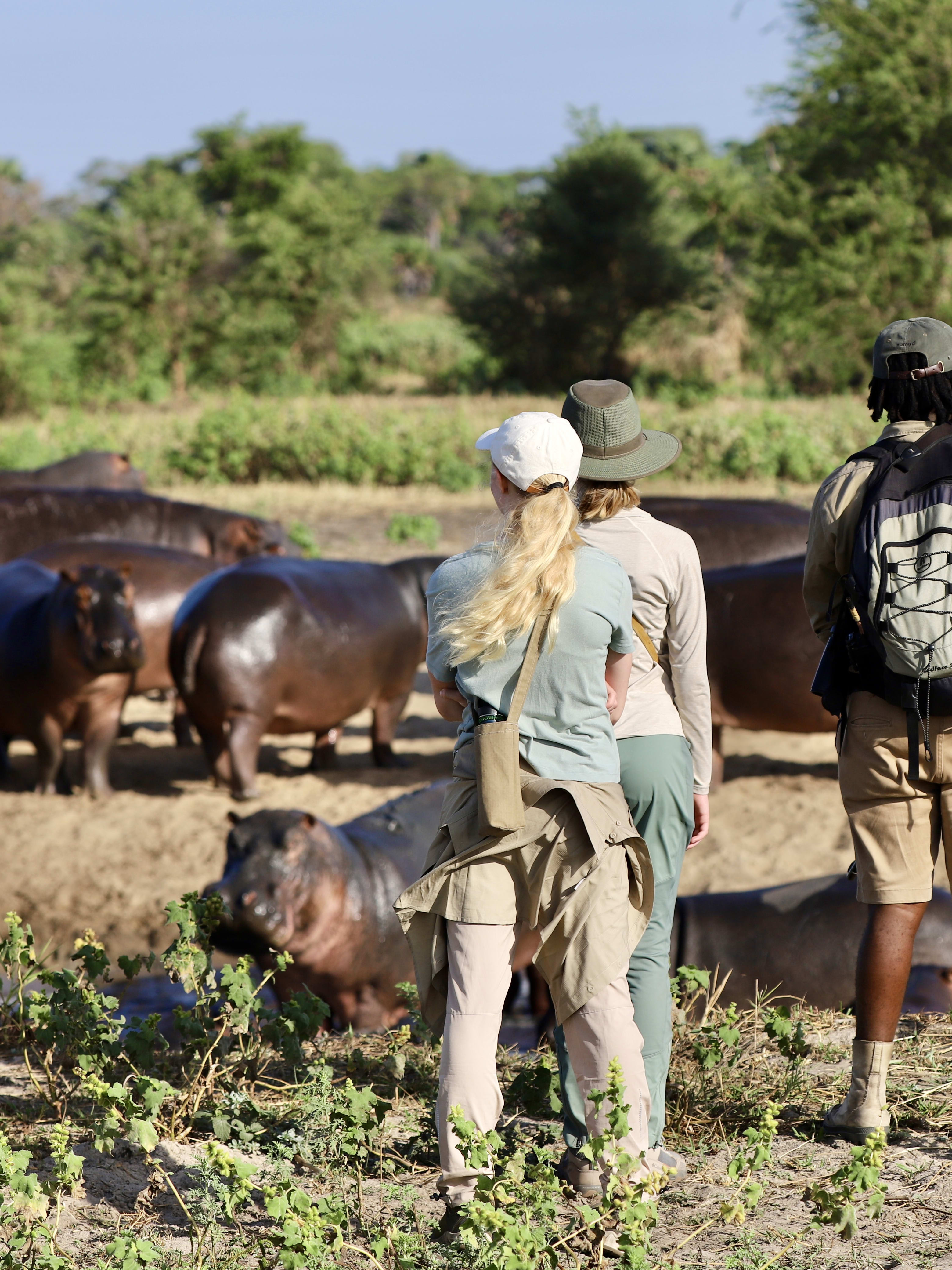
Katavi is among Tanzania’s least-visited parks—we didn’t see another vehicle the entire time. The hippos were outrageous—stacked into channels like a living, grumbling city—and without an audience, you can simply sit and let behavior unfold. We were there a couple of weeks before the seasonal closure—that shoulder when thunderheads build and the plains start to take on water. I booked a morning on foot with our guide—without the engine, you hear the park breathe and realize you’re living inside the landscape, not just looking at it.

The chimps of Mahale
Mahale was the exhale. From Katavi, it’s a short hop (30–60 minutes) to the Mahale airstrip and then a 60–90-minute dhow ride across Lake Tanganyika to Greystoke, a pale arc of sand where the forest relents just enough to make room. Mornings belonged to the chimps—steep, humid treks where there is no path, one hour of real social politics, then sudden calm. Afternoons slid into the lake: swims in water so clear it looks lit from within, slow sails, bandas thrown open to the breeze. Meals are fresh, the bar becomes the beach’s living room, and everything runs beautifully without being precious. I plan two chimp days to hedge weather and the chimp’s agenda, and four nights is the sweet spot.

Our banda at Greystoke Mahale

Greystoke Mahale main lodge
The run back to Arusha/JRO from Mahale typically takes four to five-plus hours on scheduled hops with stops—if your international departure is tight, add a buffer night in Arusha so the trip ends as quietly as it began.
Who should do this?: Travelers who want space over show and don’t mind soft duffels, small planes, and a little sweat if it buys real wilderness. It’s a strong fit for photographers, naturalists, and couples (or families with older teens) who like honest camps and great guiding—migration-savvy canvas at Olakira (Asilia), the remote hush and wild hippo scenes at Chada Katavi (Nomad), and rainforest-meets-lake adventure at Greystoke Mahale (Nomad). If constant Wi-Fi and hotel-polish every night are non-negotiable, there are easier circuits. If you’re after something more authentic, this is the version of Tanzania I stand behind.

Olakira Migration Camp
Need to know
Here’s what I tell clients, plainly:
Shoulder season is the smart play—rates are friendlier, especially out west—and the logistics are doable if you plan for them.
Soft-sided duffels only (15–20 kg total with camera gear).
Arusha → Serengeti is roughly an hour by bush plane.
Serengeti → Katavi is a longer bush plane day with a stop (think three to five hours).
Katavi → Mahale is a short hop plus a 60–90-minute boat ride across Lake Tanganyika.
Coming home from Mahale back to Arusha/JRO is a multi-stop afternoon on a bush plane—if your international flight is tight, add a buffer night in Arusha so you end calm.
Camp life in the West is honest by design:
At Chada, the shower is outside your tent—a classic bucket—best taken in daylight.
At Greystoke Mahale the bandas are open-front and the loo/shower are a short walk behind the room.
Wildlife moves through the camp at all hours—after dark, you don’t leave without an escort.
Mahale’s shoreline has hippos and crocodiles, and chimps can wander through—this circuit isn’t for young kids—I recommend older teens and up.
Expect charging in the main lounge, little to no Wi-Fi, and pack for heat, dust, and a bit of rain (trail shoes for chimp treks, headlamp by the bed, strong insect repellent, a small power bank).
The western circuit isn’t for everyone. Operators make it as comfortable as it can be given how remote it is, but you have to be genuinely okay with basic amenities and the fact that here it’s about the experience, not the room.
For more inspiration and insider recommendations, visit our Tanzania page.


Travel Advisor
Everwilde Travel


Amanda Ford

Get in touch with Everwilde Travel
Did you like this guide? Reach out to customize and book your own experience. Or, just to chat about travel in general.