
Solar Eclipse Chasing: Why a Cruise Might Be the Best Way to Experience a Total Solar Eclipse

Curated By
Calliope Travel


Curator’s statement
If you've ever seen a total solar eclipse—or spoken to anyone who has—you know the first thing they'll tell you: Being in the path of totality is essential! If the sun is only 99 percent covered, you won't get the same experience. That last one percent silences the birds, turns day into night, and reveals the sun's dancing corona. For me, the spectacle is very moving and "totally" addictive.
The Fora Difference
Book with Calliope Travel to access exclusive perks and experiences on your trip.

Killer perks
Free upgrades, spa credits and more—we got you

Personalized recs
Customized travel planning for your style

Insider knowledge
Expert advice from people who’ve actually been there
Where to stay
Unlock perks by contacting Calliope Travel to book your trip.
Aside from being in the path of totality, the second requirement is, of course, a clear sky in the direction of the sun. For my first two total solar eclipses, I got lucky: My first was from a winery in Oregon, and we had lovely clear skies. After that, I was determined to see as many more as I could. As luck would have it, the next one in North America—in 2024—went straight over my backyard! The chance of cloud cover was 50/50, but fortunately, on the day, there were only wispy clouds, and the experience was just as magical as the first time.
If you can't find somewhere that is almost certain to have clear skies, I recommend being at sea. For next year's eclipse over Greenland, Iceland, and Spain, I'm not trusting luck. I'll be sailing in the Mediterranean because the advantages of being at sea are obvious: the captain can adjust position to try to dodge local cloud cover and also to get a clear view to the horizon—which will be essential in 2026 because, for Spain, the eclipse will be in the evening, just before sunset.
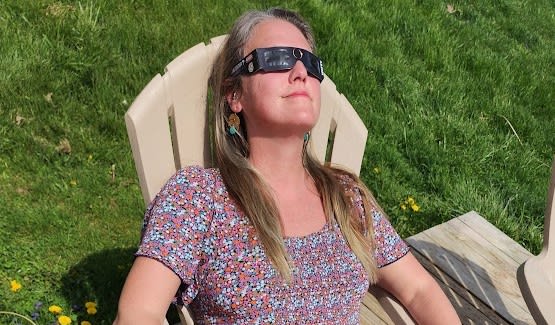
The 2024 solar eclipse—totality in my backyard!
Future total solar eclipses
2026: Greenland, Iceland, Spain
2027: Spain, North Africa, Middle East
2028: Australia, New Zealand
2030: Southern Africa, Australia
2031: Mostly over the Pacific
Resources such as timeanddate.com are essential for eclipse trip planning. On that site, each eclipse has its own map, and you can click at different locations to see the exact timing of the eclipse and the all-important chance of cloud cover. The ideal is 100 percent obscuration (of the sun by the moon) and zero percent average cloud cover—a rare combination but possible for the 2027 eclipse on the Nile.
Many cruise companies open their eclipse sailings two years in advance—sailings for 2027 are now available—and can have the additional benefit of featuring astronomers and other experts on board to give talks and guided viewing. On land, hotels do not accept reservations so early, and when they do, it's possible for those to be displaced by block bookings for larger groups.
Need to know
My best advice? Pick a cruise or land itinerary you'd be thrilled to take even if there were no eclipse. That way, the voyage itself is already a reward: new places, new flavors, new horizons. And if the weather grants you clear skies and that thrilling plunge into darkness—well, then you've added one of life's rarest wonders to a journey you were going to love anyway!
Also, plan ahead! Things do tend to fill up quickly and the early bird usually gets the best deal as prices tend to track upwards.
For more inspiration and insider recommendations, visit our cruises page.


Travel Advisor
Calliope Travel

Heather Budd

Get in touch with Calliope Travel
Did you like this guide? Reach out to customize and book your own experience. Or, just to chat about travel in general.