

German Christmas Markets by Land or River Cruise? What Our Family Trip Settled for Me

Curated By
The Bēhaven Collective
Curator’s statement
Ask anyone planning a Christmas markets trip and the same fork appears: river cruise or land? Last Thanksgiving, my sister Caroline and I drove the land version through Frankfurt, Trier, and Nuremberg to spend the season with family we hadn’t seen in 30 years, on her first trip to Europe. Eleven days and three river valleys later, I came home with an answer I didn’t expect: My next Christmas markets trip will be on a ship. This is the trip that settled it, and it might settle it for you in either direction.
The Fora Difference
Book with The Bēhaven Collective to access exclusive perks and experiences on your trip.

Killer perks
Free upgrades, spa credits and more—we got you

Personalized recs
Customized travel planning for your style

Insider knowledge
Expert advice from people who’ve actually been there
Where to stay
Unlock perks by contacting The Bēhaven Collective to book your trip.
Frankfurt held the family act. We picked up the rental at Frankfurt Airport and drove to The Westin Grand, where our aunt and uncle, who’ve lived in Germany my whole life, were waiting in the lobby. Breakfast was handled every morning, one less decision in a week that needed the help, and evenings we walked to the market as the stalls lit up, the carousel glowing against the old town’s stepped gables with the Commerzbank tower behind it. If you’re weighing the cruise question, hold that geography: the market reaches Mainkai on the river, and ships on Main itineraries tie up at its edge.
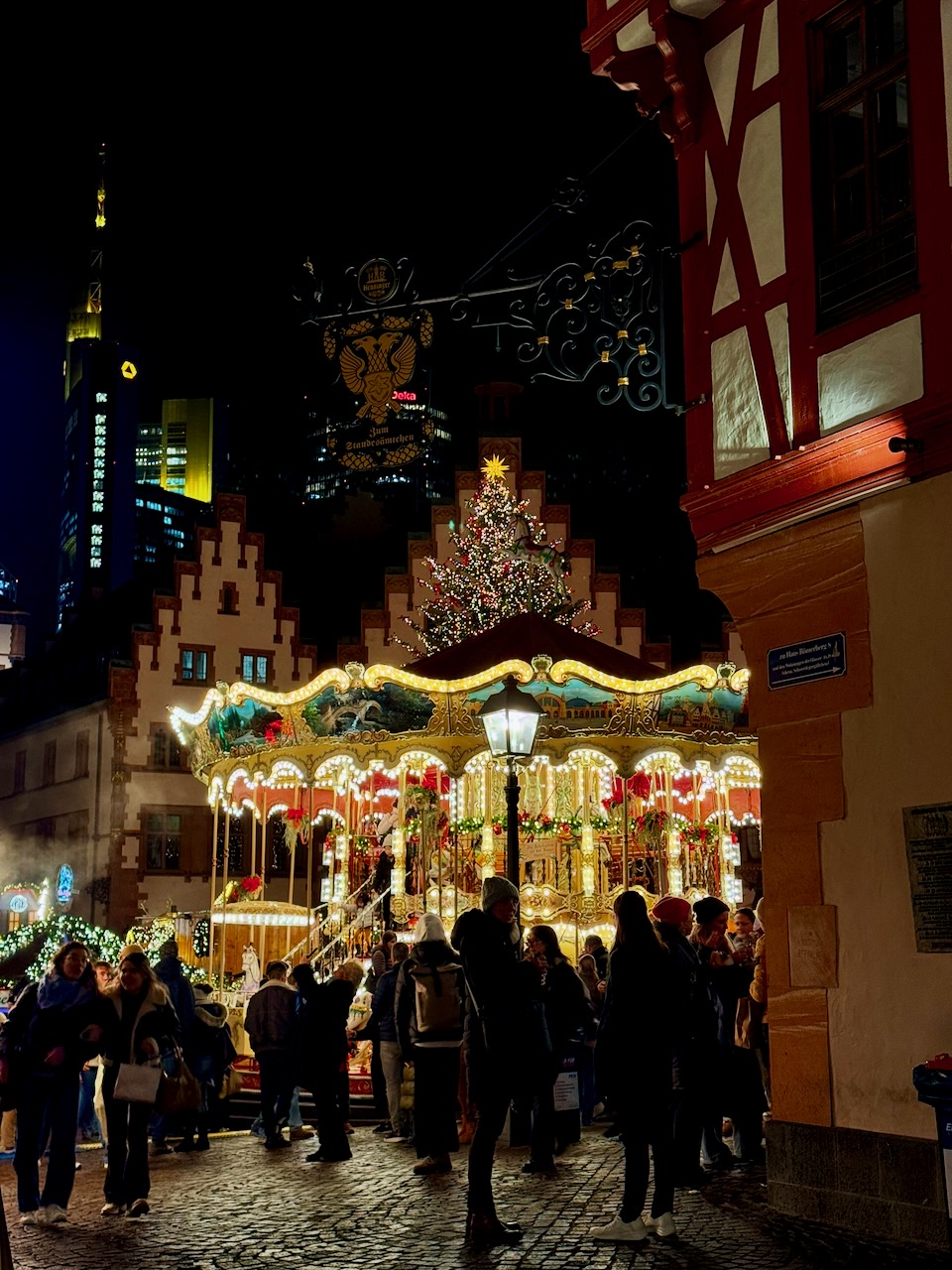
Frankfurt's market, medieval square in front, banking skyline behind.
The honest food report: The road ate our appetite for restaurants, and room service won more nights than I’d like to admit. The meals that stuck were the simplest ones. Mussels and frites at Fisch Franke, a Frankfurt seafood institution, were great. And when Caroline needed a recovery day, my uncle improvised: Klassikstadt, a 1910 brick factory full of restoration workshops, classic car dealers, and a few hundred vehicles you can wander for free. On land, the trip bends around a slow morning.
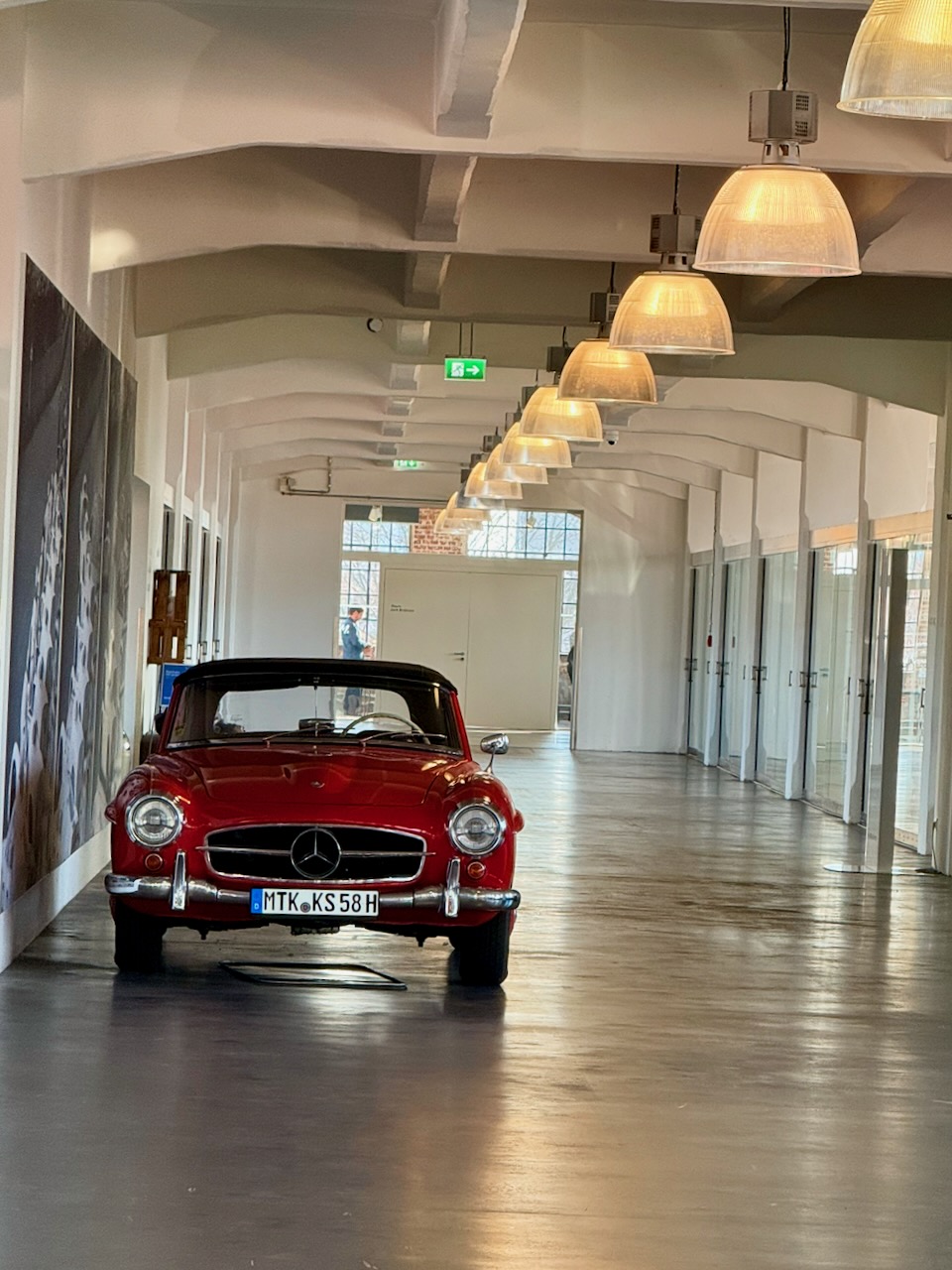
Klassikstadt, Frankfurt's answer to a recovery day.
One morning, my uncle drove us up the Rhine Valley toward St. Goar and the Loreley. This is the castle corridor every Rhine cruise sells as its signature scenic day, and I’d love to tell you about the castles. The truth is the weather was gloomy, my uncle narrated them from the front seat, and what we mostly saw was traffic. From a ship’s lounge, that same gray morning is atmosphere, a blanket, and a coffee while the towers slide past. From the road, it’s wipers and taillights. Driving has tunnel vision, too. Rüdesheim was on our route map, and I honestly couldn’t tell you whether we passed its market. Two days later, we drove by Würzburg the day its market opened, with Rothenburg ob der Tauber just off the same route. When you’re the driver, stops cost you, so you don’t make them. On a ship, the stops are the product, and the repositioning happens while you sleep.
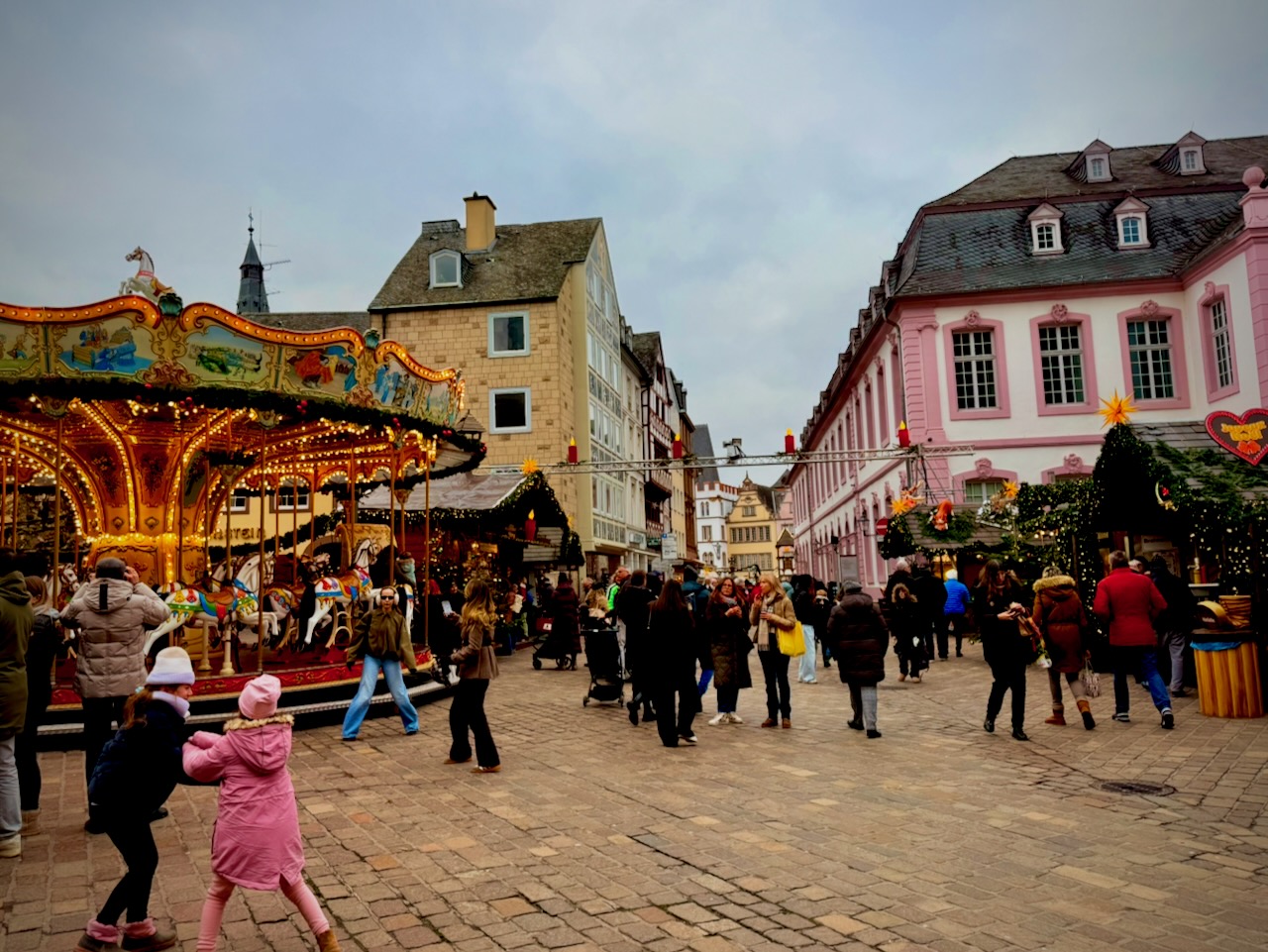
Trier's market, Roman city, storybook square.
Trier taught the hardest lesson. Germany’s oldest city sits on the Moselle, a bit over two hours from Frankfurt by car, and we went for the market and a family lunch. Caroline was under the weather, our aunt moves carefully these days, and parking left everyone a long walk from the square. We saw the carousel turning in front of the pink Walderdorff palais and the great wooden pyramid with its star-covered blades, had an old wirtshaus lunch where the Bitburger—brewed half an hour away—outshone the plate, and turned the car back toward Frankfurt. Four and a half hours of driving for two hours of market. Watching my aunt manage that day did more for my advising than any brochure. She’s exactly who the river ship was built for. Unpack once. No parking. The city starts at the gangway, and the ship waits a short walk away whenever you need a break.
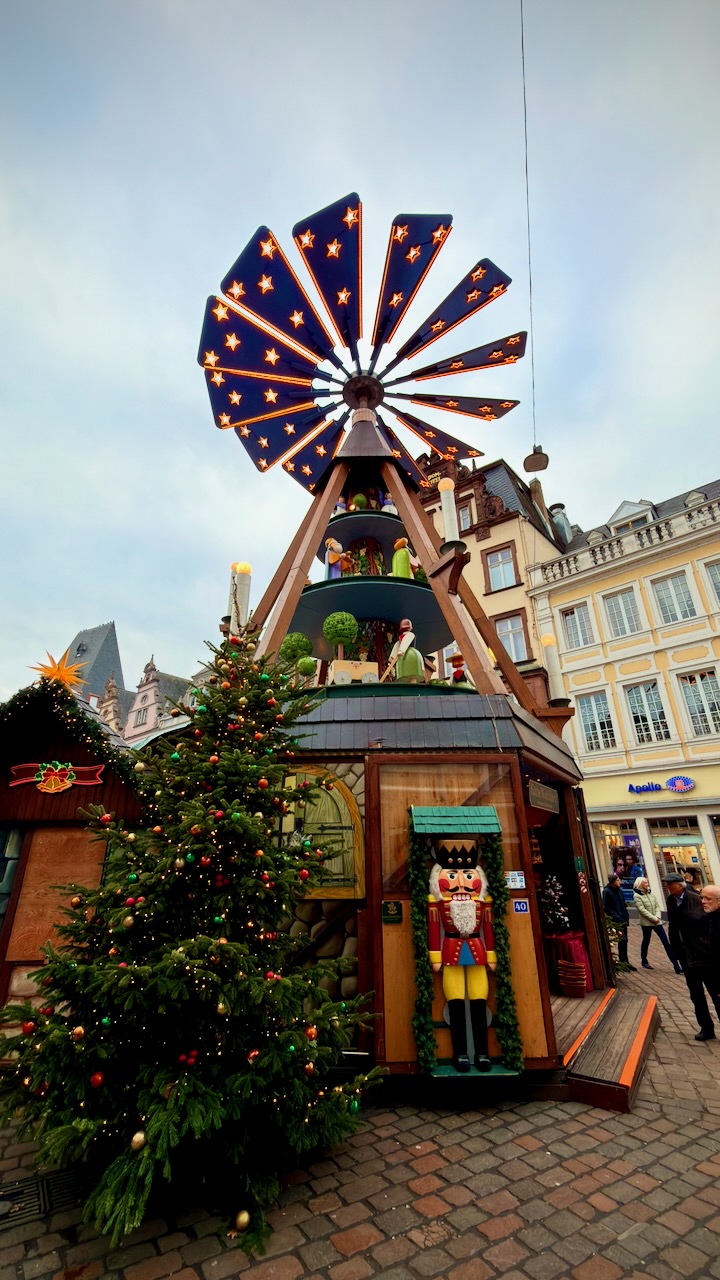
The pyramid on Trier's Hauptmarkt, worth the drive even on a hard day.
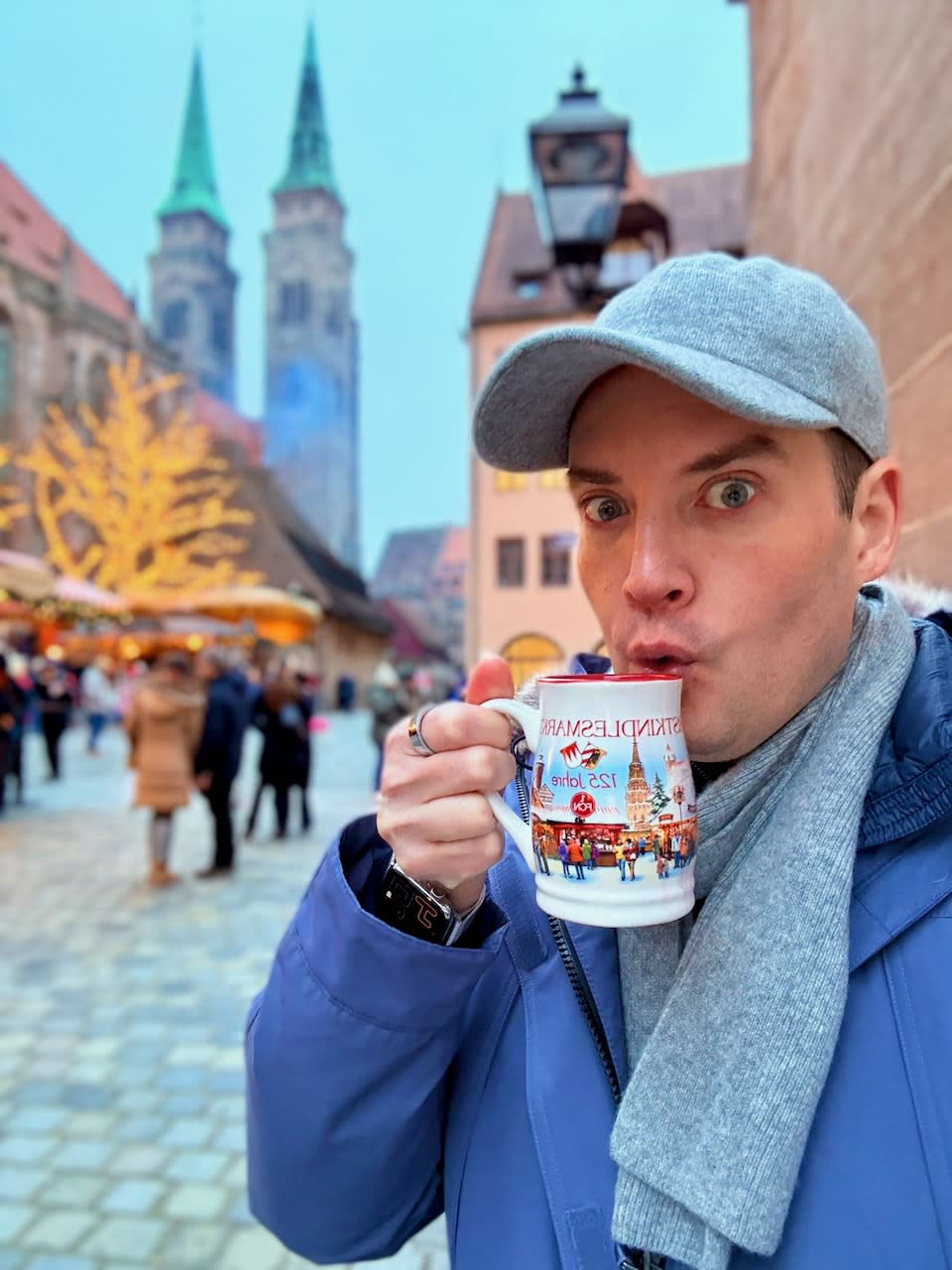
Nuremberg was just the two of us, and it started with a hotel decision. Karl August sits at Augustinerhof 1, one minute from the Hauptmarkt, and we checked in on opening day. At 5:30 p.m., the Christkind gave the prologue from the Frauenkirche balcony, and the lights came on over 180 red-and-white stalls. We ate Nürnberger bratwurst, three little sausages in a roll with sauerkraut, and drank gluhwein, more when-in-Rome ritual than love affair, from the official 125 Jahre collector mug, paying the small deposit to keep it. Then we shopped Inge-Glas, the Bavarian glassmakers. Our mother gave us a hand-blown glass ornament every year, and we keep the tradition alive: a dachshund on a beer stein for Otis, a German pretzel since we’d eaten our weight in the real thing, and a tiny pair of lederhosen. A few handmade felt pieces joined them, a mermaid and, noticing a trend, a reindeer dachshund. The mug flew home with the ornaments, and they’ll all be on the tree in South Carolina this December.
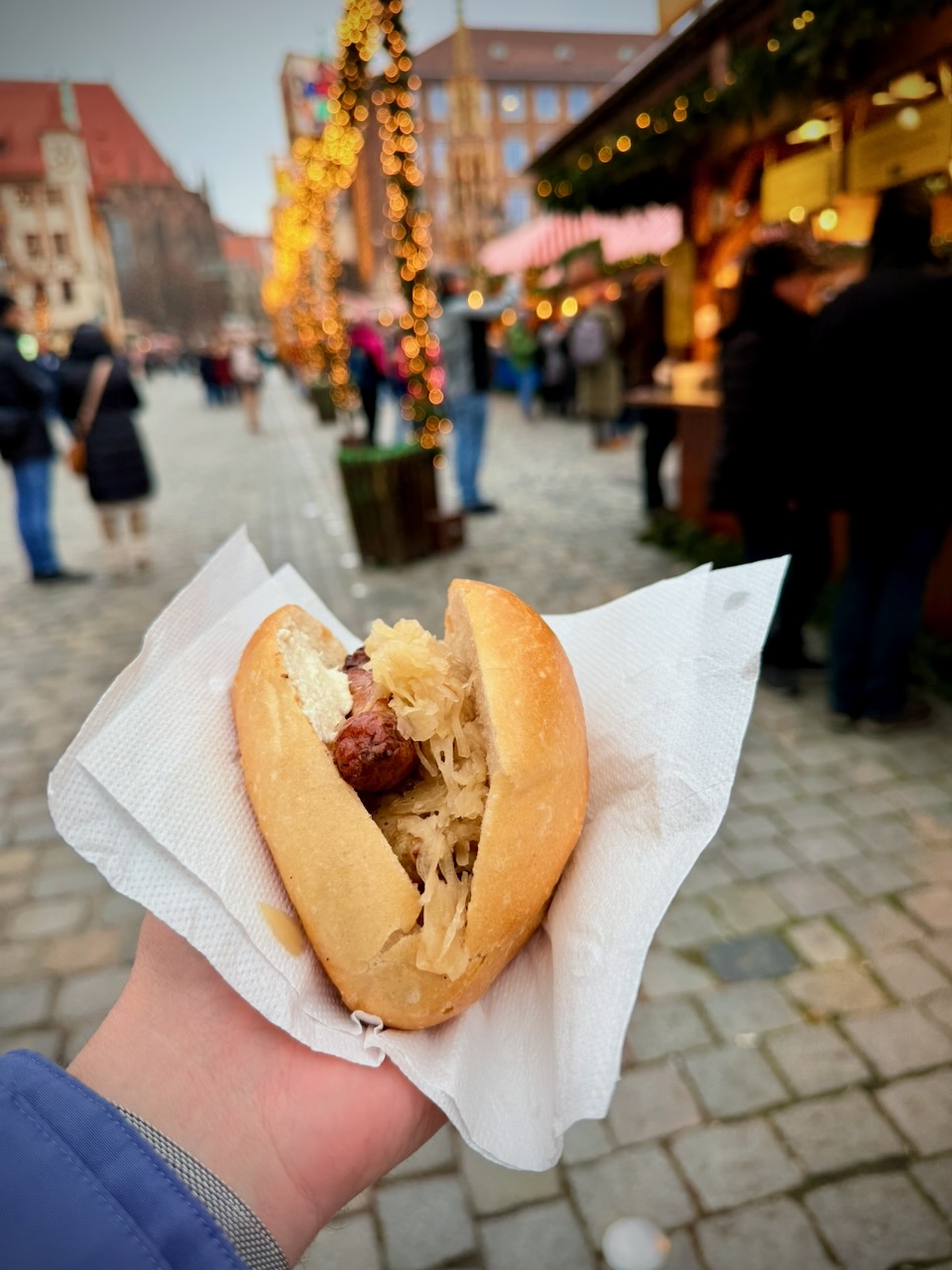
Three little sausages, one roll, the whole reason to stand in that line.
Then my phone rang. Tisane, the Michelin-starred chef’s table across the courtyard from our hotel, had two seats at 7:30. We’d been waitlisted for weeks, and the scramble was a two-minute walk. Sixteen seats wrap the open kitchen, and instead of a menu, you get a Polaroid of the night’s courses clipped to your napkin. Caroline teased the chef that it seemed like he knew what he was doing, and the whole counter laughed. The team talks with you all night. The meal was exceptional, the wine pairing leaned local with a Franken Silvaner, and yes, it was expensive. Worth it. It’s also a dinner a cruise schedule rules out, since ships want you back aboard by then. For clients, tables like this go into motion before flights are ticketed.
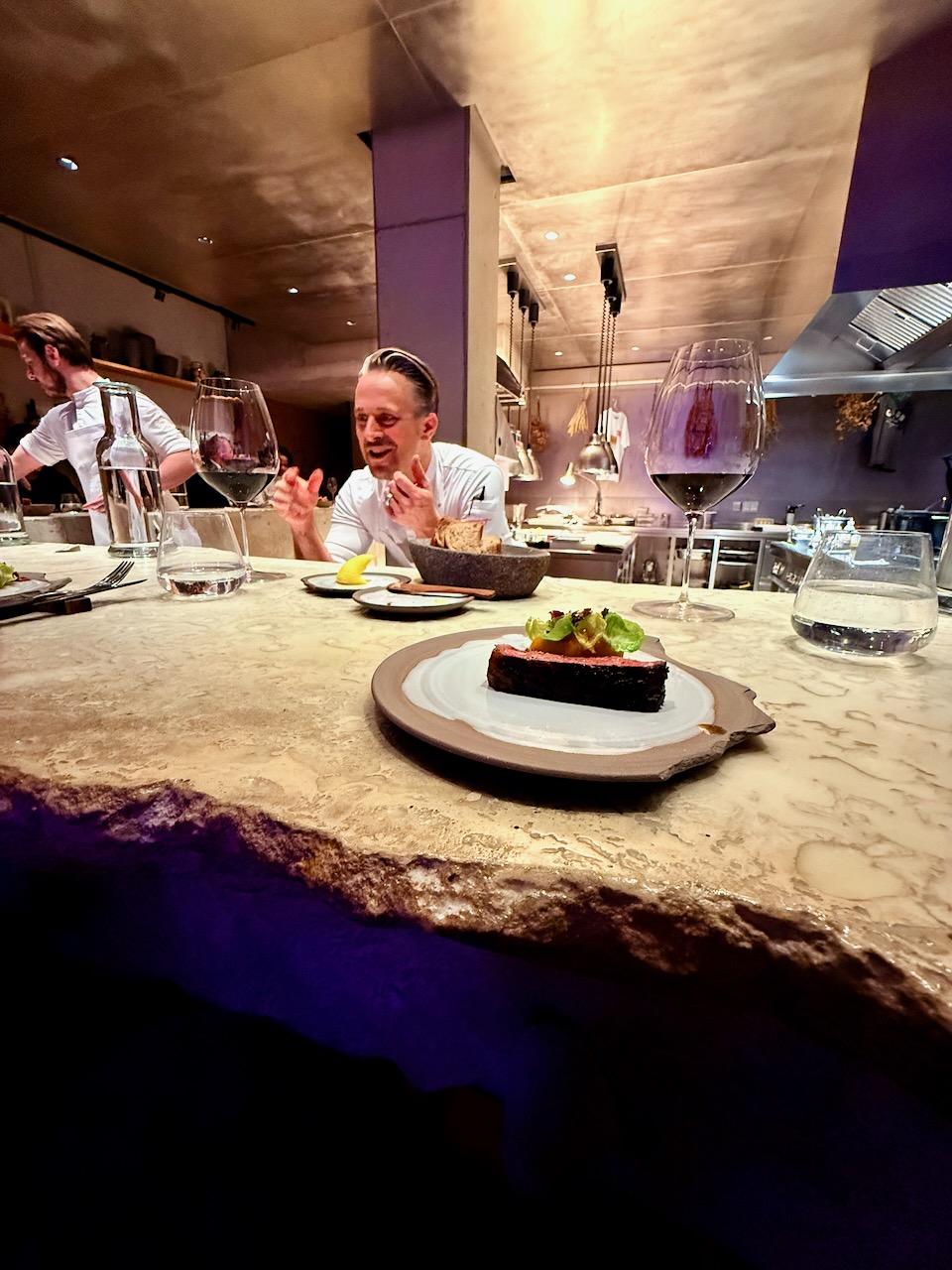
Sixteen seats around the counter at Tisane, where the kitchen talks with you all night.
Now the ledger. The rental counter set the tone: The German car we reserved wasn’t ready, so we got a Korean wagon that spent the Frankfurt days parked at the hotel while my uncle drove, then didn’t love 120 on my autobahn runs to Nuremberg and Berlin. We made it work, which became the trip’s quiet motto. Land let us stitch three river systems into one trip—Frankfurt on the Main, Trier on the Moselle, Nuremberg on the canal—which no single sailing can do. What it cost was every evening spent planning the next day: drives, parking, luggage, and walking a new restaurant through my sister’s allergies at every meal, when a ship would’ve done the driving overnight and one kitchen, briefed once, would’ve known her restrictions all week. It was her first trip to Europe, so we tried to do a whole lot, and we did, and we came home proud and tired.
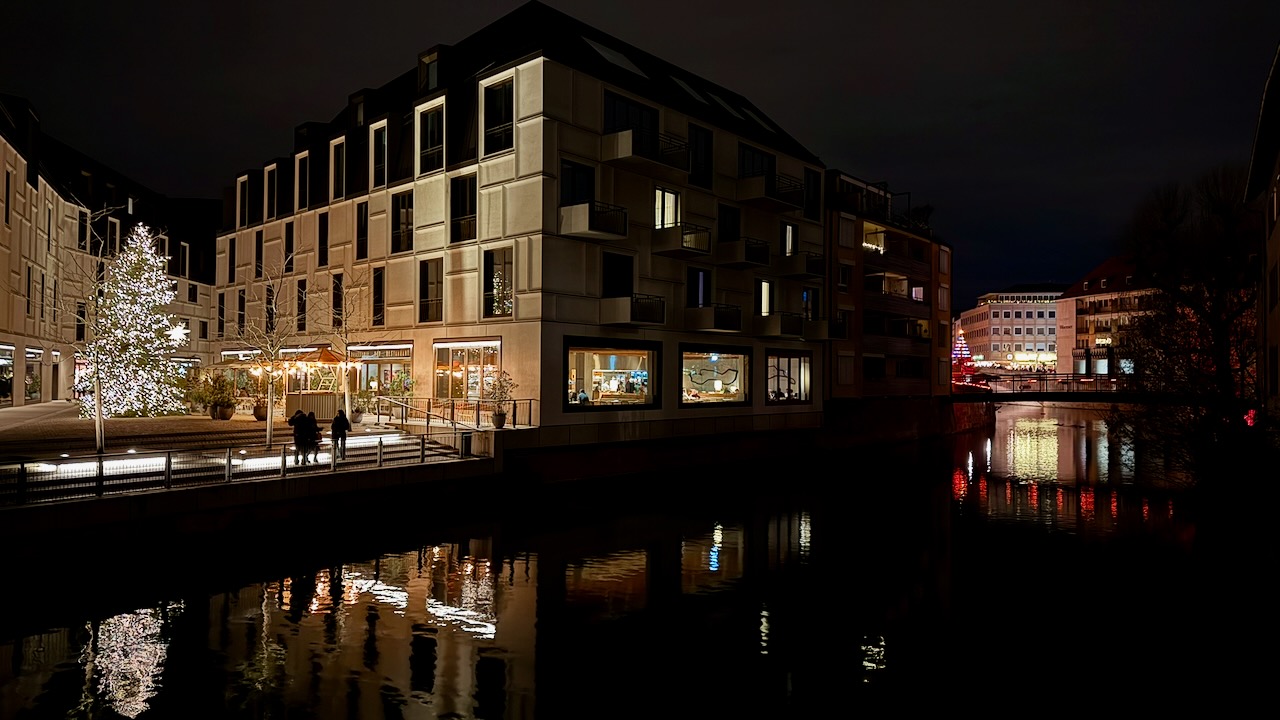
arl August at Augustinerhof, one minute from the Hauptmarkt and across the courtyard from Tisane.
Here’s the discovery I keep handing clients. Thanksgiving week is the wrong week for a German land trip and the right week for a Danube sailing. Most German markets open the Friday before the first Advent Sunday, so for our first days, only Frankfurt was lit, and Nuremberg opened on our last German day. Vienna and Budapest open in mid-November. A Danube ship that same week would’ve had two capitals glowing for two weeks already and delivered us to Nuremberg’s opening by water. We ran the experiment so you don’t have to.
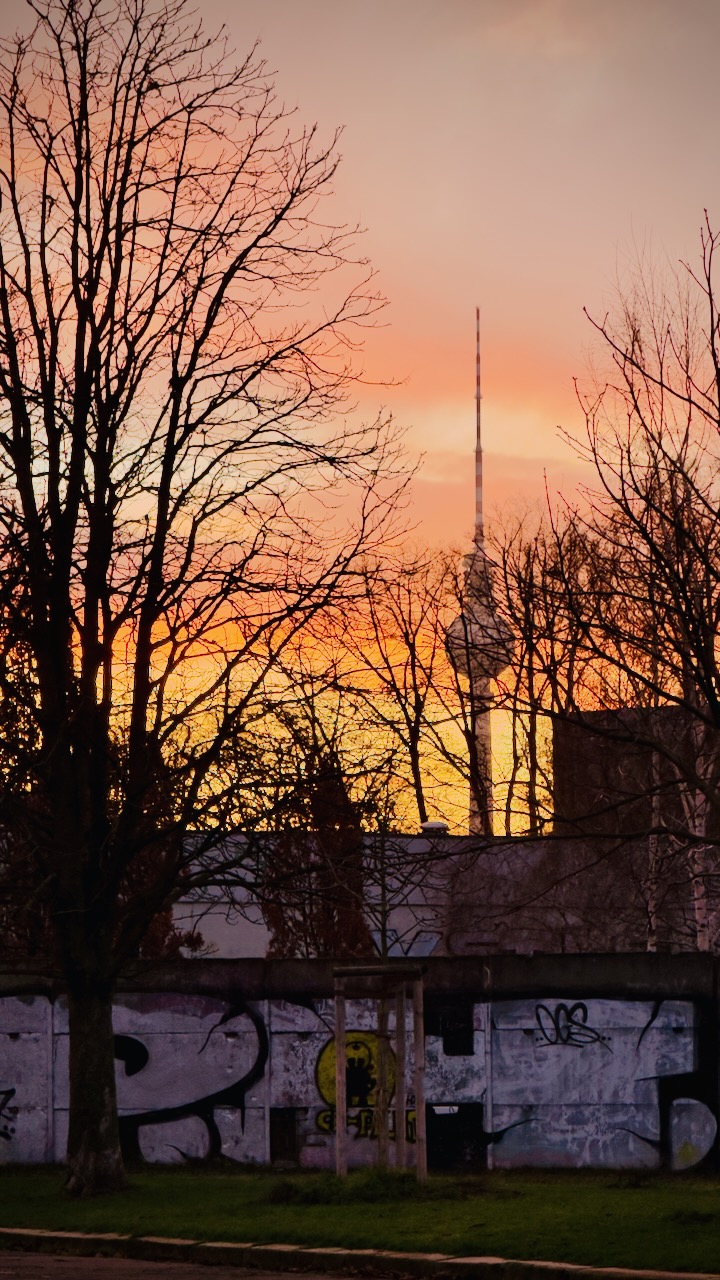
Sunrise over the Berlin Wall, the quiet morning the trip earned.
The trip wound down the way our bodies asked it to. A recovery night at the Waldorf Astoria Berlin—spa, room service, an early walk along the Berlin Wall. Then Copenhagen, where Villa Copenhagen, a photography walk through the lit-up streets, and an evening in the outdoor hot tubs at CopenHot did more repair work than any spa treatment of the trip. The city’s glowing markets deserve their own report. We finished at the Andaz on the Prinsengracht in Amsterdam: a canal boat at night, the Anne Frank House, fries from Fabel Friet eaten standing up. Amsterdam is where many Rhine Christmas itineraries begin. We ended by land exactly where the ships push off.
The verdict
With this family, I’d do it by land again and not trade a minute. But my next Christmas markets trip is on a ship, and I already know which one. AmaWaterways’ Iconic Christmas Markets sails seven nights between Nuremberg and Budapest, crossing the Main-Danube Canal to Regensburg’s castle market, Passau, Vienna, and Budapest—the route that fixes everything our calendar and our car got wrong. I want to arrive in Nuremberg from the water this time, knowing full well the ship docks four miles out and shuttles you in. Knowing is the whole job. Our aunt is already campaigning for a spring visit, says the weather is far less depressing then, and she’s not wrong. Spring by land for the family. December by river for the markets.
Need to know
The calendar is everything. For 2026: Frankfurt runs November 23 to December 22. Trier runs November 20 to December 22 and closes November 22 for Totensonntag. Nuremberg opens November 27 at 5:30 p.m. and runs through December 24. Vienna and Budapest light up in mid-November. That gap has a practical meaning: For Thanksgiving-week travel, a Danube river cruise beats a German land trip, because Vienna and Budapest are already glowing, while most German markets haven’t opened. Whatever you book, match your dates to the market calendar before you fall in love with a fare.
These cruises sell out earlier than almost anything else I book, often more than a year out even after the lines added capacity. If you want a specific week, cabin, or ship for 2027, the booking window is now, over a year in advance.
Where your ship docks decides your trip. Frankfurt ties up at the market’s edge on Mainkai. Nuremberg docks in the canal harbor about four miles out and shuttles you in. Trier can be a 10-minute walk or a 40-minute coach, depending on the line and the water. It’s the first question I ask before booking anyone.
River ships help with mobility more than they solve it. The wins: city-center docks, no parking, no repacking, a retreat steps away. The limits: elevators rarely serve every deck, sun decks are often stairs-only, and ships can moor two or three abreast, which means crossing neighboring vessels to reach shore. The working rule is 12 to 15 steps with a hand and a rest. Which ships, cabins, and berths work for a traveler who moves carefully is vetting I do before recommending anything.
Low water isn’t only a summer story. The Rhine has hit record lows in November, and when a stretch closes, the difference between a smooth trip and a bus tour is whether your line can swap you to a sister ship on the other side. Some can. I know which.
Gluhwein mugs carry a small deposit; return it for your coins or keep the mug. If you spot Heidelbeergluhwein, the blueberry version, it’s worth the detour from plain.
There are a dozen-plus lines on these rivers now—premium to ultra luxe—and there are clear winners depending on how you travel. Matching you to the right line, ship, cabin, and itinerary is the work I love most. If a Christmas markets trip is on your list, by river or by road, hit the contact button and tell me everything: who’s traveling, which weeks work, how you feel about cold and crowds, any mobility or dietary needs, and what you want the trip to feel like. The more you share, the faster we narrow to the right Christmas market experience for you. I’d especially love to build you the river version.
For more inspiration and insider recommendations, visit our Germany page.


Travel Advisor
The Bēhaven Collective


Bryant Blakeslee

Get in touch with The Bēhaven Collective
Did you like this guide? Reach out to customize and book your own experience. Or, just to chat about travel in general.