
8 Days of Small-Ship Alaska: How UnCruise Adventures Made a Cruiser Out of My Mother
Curated By
Stepan Travel

Curator’s statement
My mother had wanted to return to Alaska for seventy years. Her parents were stationed there in the 1950s, and the airstream they pulled up the Alcan Highway became family lore she never quite figured out how to act on. She’d never been on a cruise. I never thought she would. What finally brought her back was a kind of cruise she didn’t know existed—54 passengers on an 84-guest ship, no port stops once we left Juneau, and a small vessel built for wilderness rather than entertainment. Eight days later, we disembarked as converts. The closest thing I can compare it to wasn’t a cruise at all. It was summer camp with glaciers.
The Fora Difference
Book with Stepan Travel to access exclusive perks and experiences on your trip.

Killer perks
Free upgrades, spa credits and more—we got you

Personalized recs
Customized travel planning for your style

Insider knowledge
Expert advice from people who’ve actually been there
Where to stay
Unlock perks by contacting Stepan Travel to book your trip.
We flew into Juneau a day ahead of boarding, which turned out to be the cultural foundation for the rest of the trip. You can’t fit this into embarkation morning. The first afternoon went to the Sealaska Heritage Institute—a small, precise collection that rewards close looking, especially the fishing hooks carved from different weights of wood so they’d float and pivot correctly at depth—and to Kootéeyaa Deiyí, the self-guided totem pole trail through downtown.
The next morning, our cab driver from the airport had arranged for his cousin to pick us up—a professional fisherwoman with deep knowledge of her clan and the land. She took us to Mendenhall Glacier at first light before the crowds arrived, then on to watch the salmon run, where we spotted our first bald eagle standing at the waterline waiting for an easy catch.
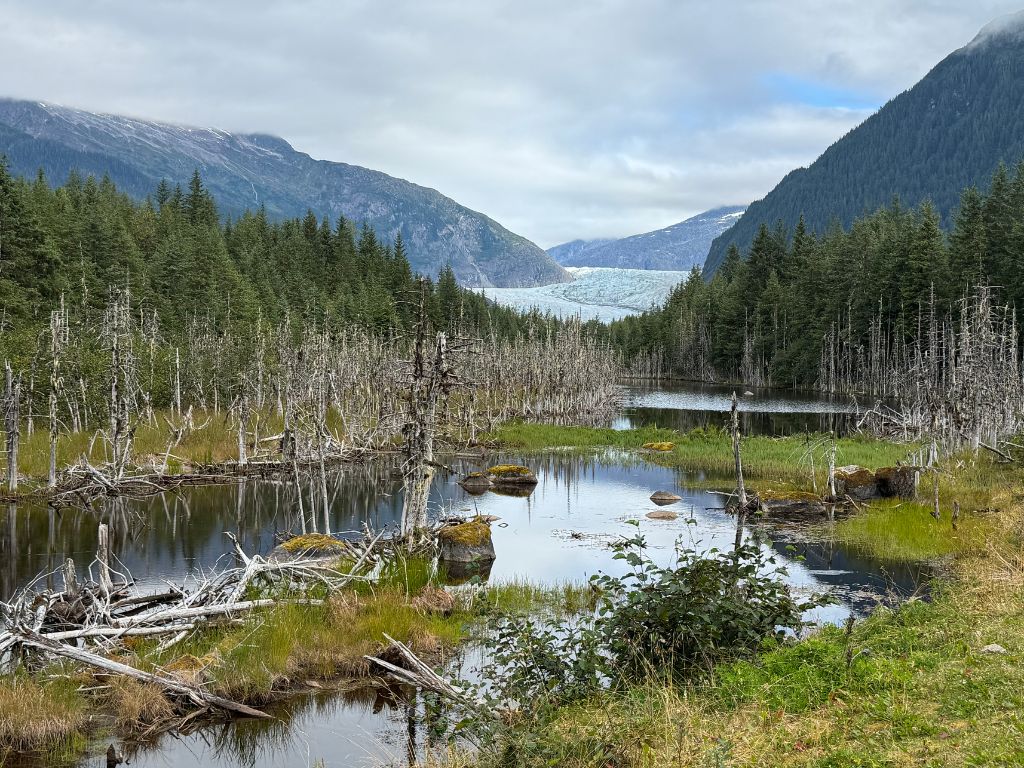
Mendenhall Glacier at first light, before the crowds arrived. The Juneau morning that set the tone.
After lunch, we made our way to the Alaska State Museum before boarding. The collection is vast and generational—fur parkas and fish-skin garments stitched so finely they read as art, bentwood hunting hooks, kayak frames, Yupik ceremonial pieces, carved ivory, and a contemporary Native artists gallery that earns its space. If I were sending a client to one cultural stop in Juneau, this would be it. By the time we handed our bags to the port, we’d laid a foundation.
Boarding happened at 4:30, and the Safari Endeavour was exactly the right size for what we’d come to do—54 guests on a vessel built for 84, a guest-to-crew ratio that felt personal from the first handshake. Our expedition leader, Keka, was from Costa Rica but lived in Durango, Colorado. Of all the small mountain towns in the world, Durango was the one where my parents met and where my family still has roots. Her energy was the kind that pulls a quieter person in, which my mother needed. We were still on the top deck going through safety briefings when a pod of orcas surfaced alongside the ship. The crew said they hadn’t seen them in weeks. Everyone ran to the railings. It became clear quickly: on a vessel this small, Alaska isn't something you watch. You’re in it.
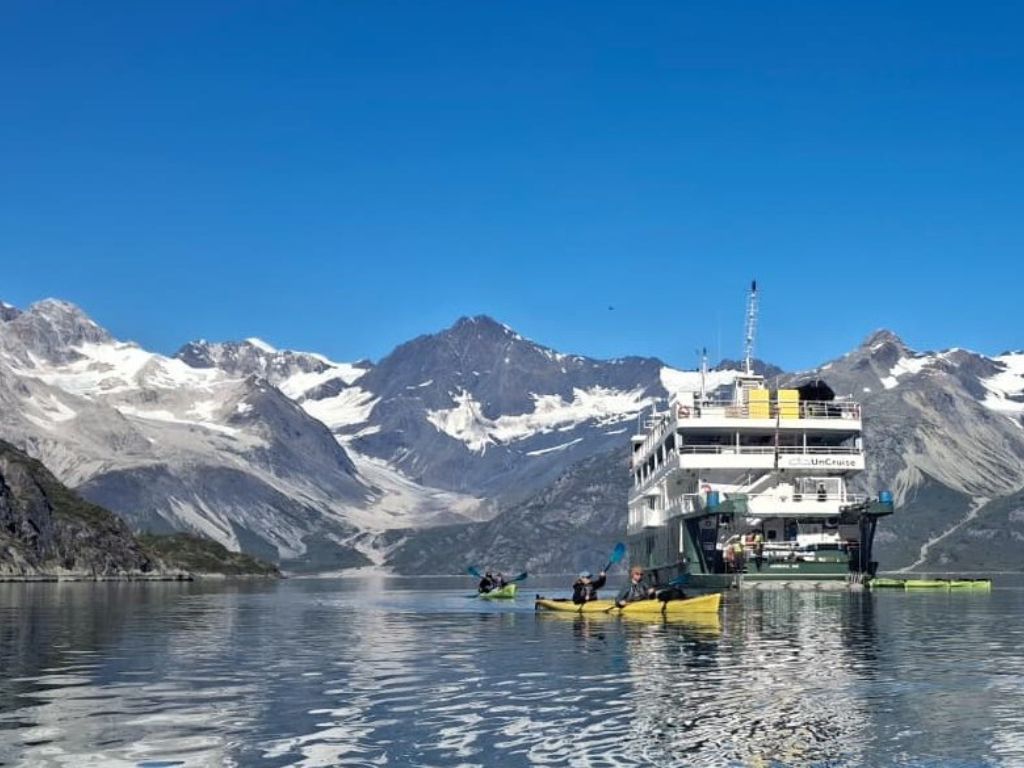
The Safari Endeavour in Glacier Bay. Eighty-four guests at capacity; fifty-four on our sailing.
By day two, the experience had a name. This wasn’t a cruise. It was summer camp for adults, with glaciers instead of arts and crafts. At lunch each day, Keka walked the dining room with a clipboard and laid out the next day’s options: a morning kayak or paddleboard, a bushwhack through the Tongass, a longer hike, a coastal meander, a Zodiac ride, or the choice to stay on board and do absolutely nothing. You signed up, and the next morning a magnet board tracked who was on and off the ship. Once we left Juneau, there were no port stops for the rest of the week. You left the ship by kayak or Zodiac; when an excursion involved going ashore, you stepped off into shallow water and walked up the beach. The oversized rubber boots the ship provided meant you didn’t notice—you just hopped off and went. The ship itself was the only infrastructure. The vessel had a floating platform that was lowered onto the water, so first-time kayakers could get in without wobbling. The upper deck had a full circular walkway—useful when someone spotted a pod on one side and you could run the whole way around. Cookie hour at three. Cocktail of the day at five-thirty. Open-seating dining, so you sat with new people every night or you didn’t. The food itself was a real surprise—thoughtful, ambitious cooking with meat, seafood, and vegetarian options every night, plus a half-and-half plate when indecision struck. Naturalist lectures after dinner, led by guides who were also graduate students and marine biologists. Alcohol and excursions were included—unlimited pours from the lounge bar, every outing built into the fare. You never thought about a tab.
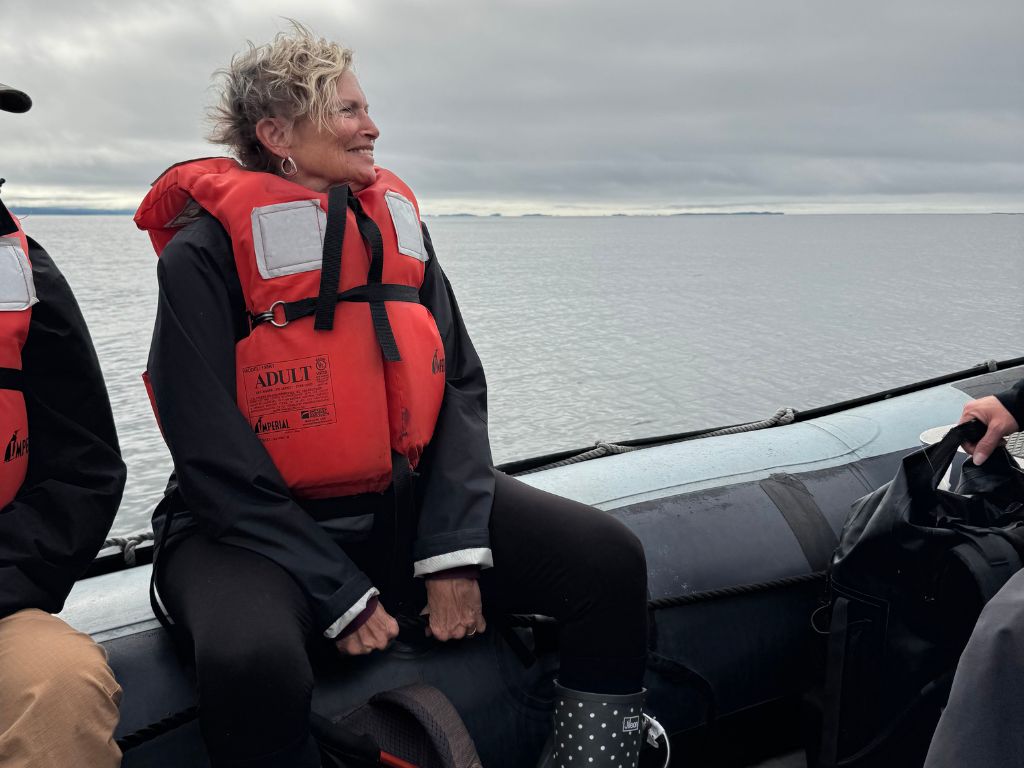
My mother on a morning Zodiac ride. By day two, the intimidation was gone.
Nothing prepared me for Glacier Bay. We arrived at Margerie Glacier at first light, the gentle tink, tink, tink of small ice chunks against the hull as we moved slowly through the water—mesmerizing, the kind of sound that pulls everyone into stillness. Guests came up wrapped in blankets, still in pajamas, silent. Later that morning we Zodiac-ed and kayaked near Lamplugh. After lunch, I was first on the list for the polar plunge; nearly twenty passengers took the jump, and the crew had hot toddies and the two upper-deck hot tubs waiting for us. By afternoon, we’d sailed to Johns Hopkins Glacier. The one mega ship we’d see the entire week was already there—twelve stories tall—but the park’s strict regulations meant it had to leave, and we got the glacier to ourselves. Listening to a tidewater glacier crack and fracture into the sea is the closest thing I know to hearing geological time. Seals dozed on the ice floes. Birds swooped for stunned fish wherever a sheet broke off. That night in bed, the speakers came on quietly: northern lights. We ran to the top deck, where the crew had dimmed every light so we could see. Faint to the naked eye but vivid through a longer camera exposure—green and violet pulling across the sky. Twenty-four hours, Margerie to the aurora. The next morning at breakfast, the crew laughed. We set that up for you.
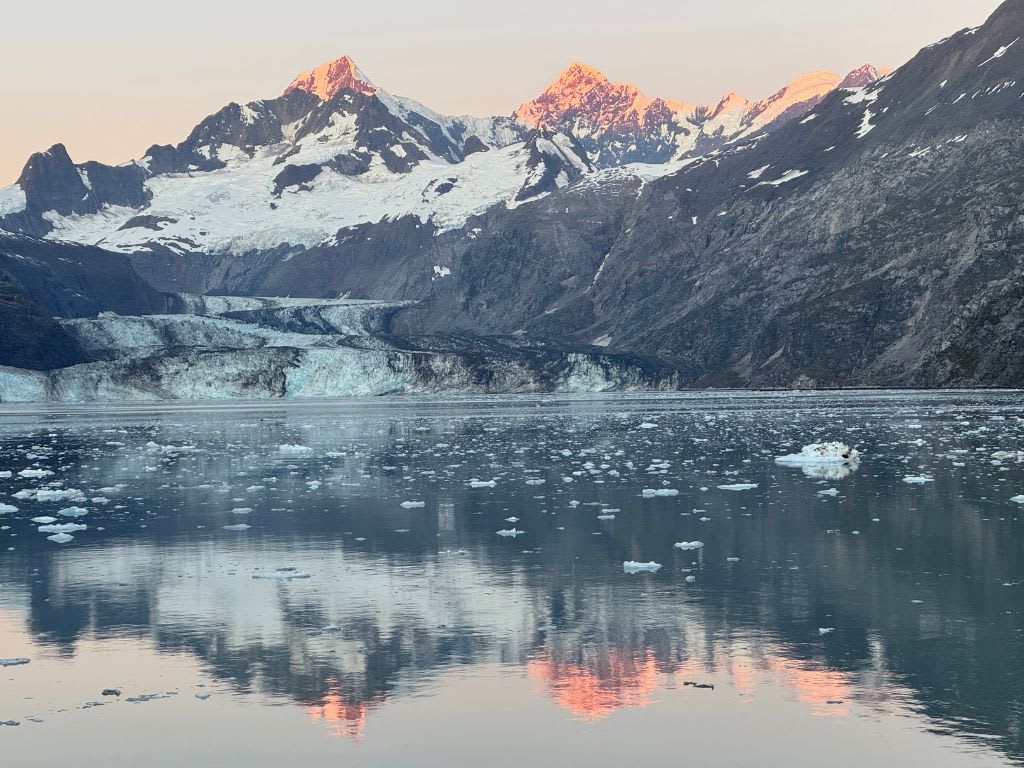
Margerie Glacier at sunrise. Ice tapping the hull pulled everyone on deck in blankets.
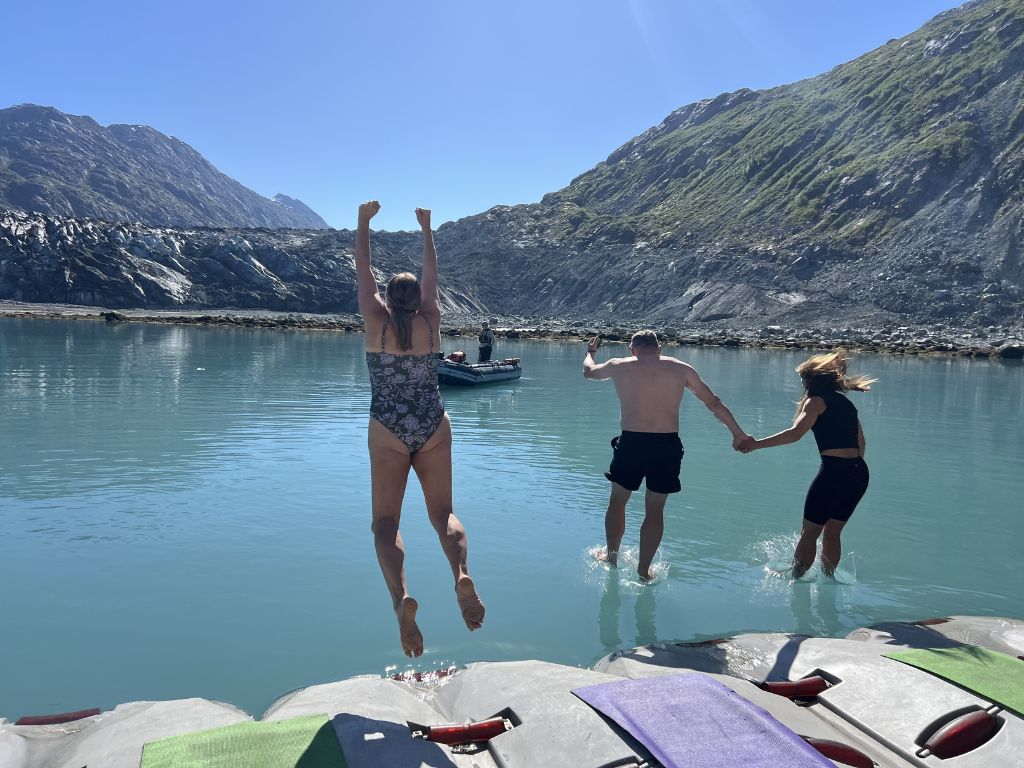
The polar plunge. Hot toddies and two upper-deck hot tubs waiting when we got out.
I’ve traveled with my mother before, but I’d never seen her like this. She prefers a slower morning; I’m an early riser, and by day three she was up with me for the 6 a.m. breakfast. I brought her coffee in the cabin the way she’d done for me in a different life. The intimidation she carried at embarkation—about her physical abilities, about whether she’d keep up with a more active group—was gone by day two. She’d settled into herself. She hiked Mountain Edgecumbe with walking sticks and a magnifying glass Keka passed around so we could see the micro-beauty of moss and fungi up close. She became the ship’s unofficial bird aficionado—she’d argue she’s not a birder, but she knows more than she lets on. One foggy morning we Zodiac-ed along a shoreline near a salmon fishery where a mother bear had parked herself in the salmon shoot, roaring off larger males as her cubs tumbled across the rocks above. I caught a photo of my mother smiling toward shore on the ride back—the kind of photo you keep. Later that week we followed a pod of humpbacks tail-slapping the surface from a careful distance, and on the final afternoon a raft of otters drifted past on their backs, babies balanced on the mothers' bellies. On a coastal meander one afternoon, she picked fresh blueberries off the bushes and handed one to me. She was 75 and she was having the time of her life.
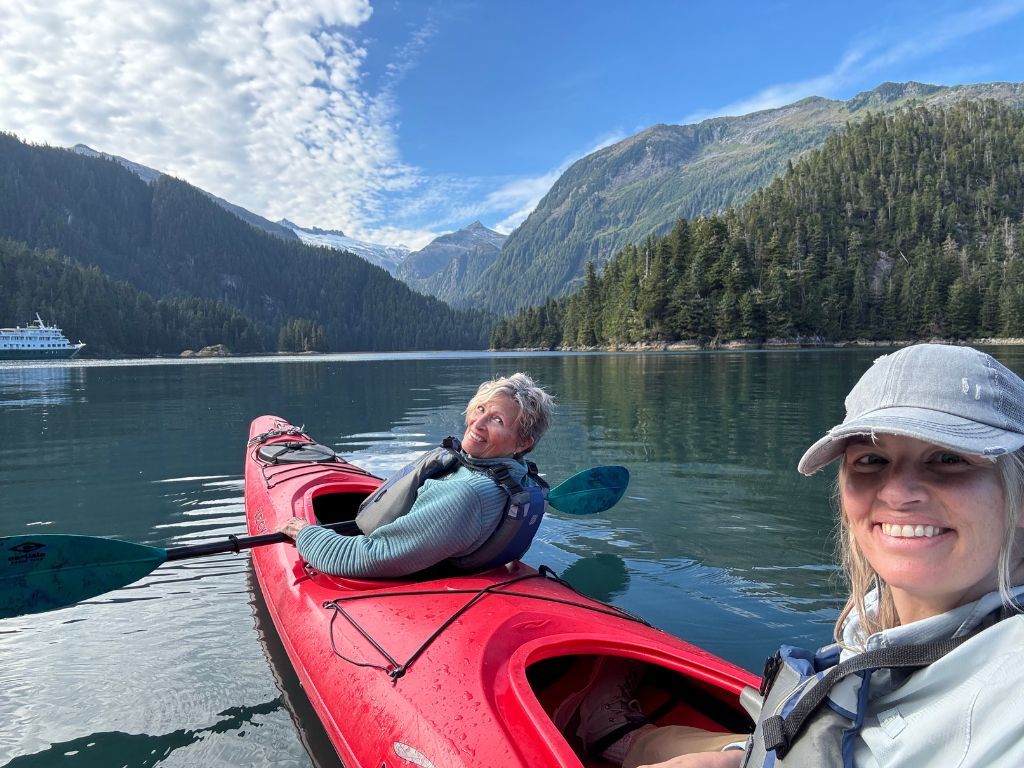
My mother on day three. By then she was up at 6 a.m. with the early risers.
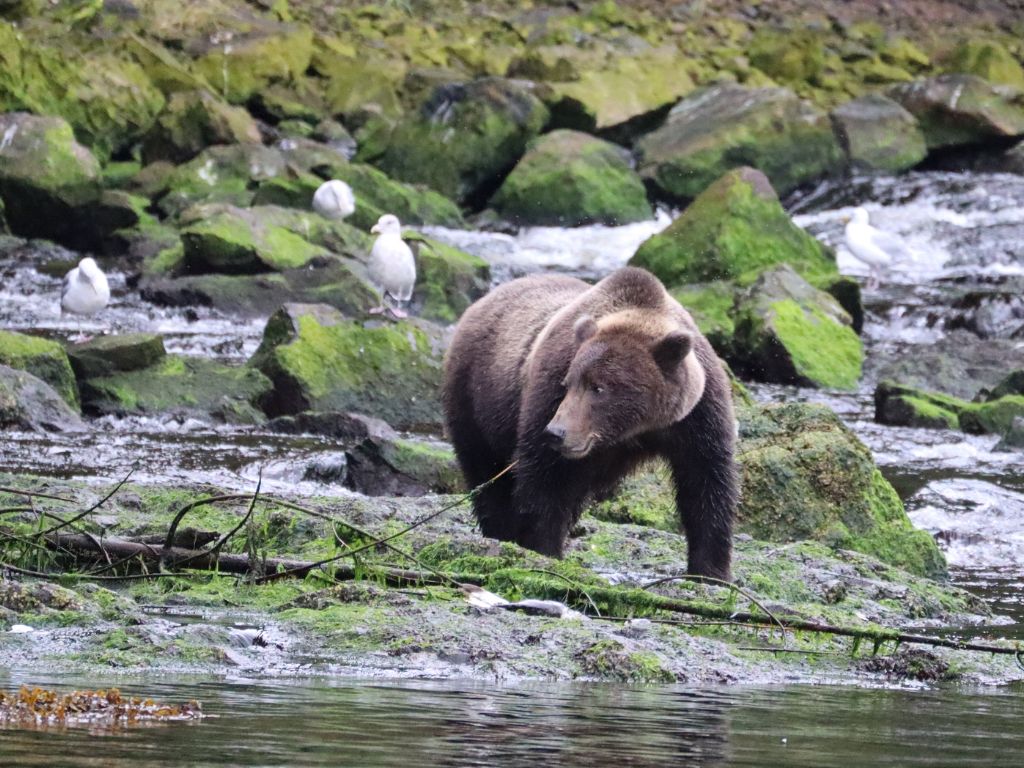
A brown bear working the shoreline. Photo courtesy of a fellow UnCruise passenger.
What surprised me almost as much as Alaska was the camp itself. The crew had worked together for years, and it showed—in how they read the weather each morning, in the impromptu sunset beach bonfire with s’mores when conditions aligned, in the snorkeling excursion they added mid-trip for the six of us who asked. A piece of floating ice picked up on day one sat on a rack in the lounge, and the whole ship bet on when it would melt. Guests ranged from 28 to 80, including a couple who got engaged mid-trip on one of the daily hikes to a waterfall, and travelers who’d come all the way from New Zealand to be there. I started sharing a Google album with the whole ship so no one would leave without the best photos of the trip. Passengers helped each other over logs on bushwhacks using what the guides called the Viking grip—forearm to forearm, never hand to wrist. You started the week with strangers. By day five, you knew everyone’s name.
Sitka closed the loop. Our small ship was allowed to dock right in town—mega ships can’t on weekends, which meant we walked off into a town that was, for once, not managing cruise crowds. The Tongass totem memorial trail runs through a forest of old pines, dotted with Tlingit and Haida totem poles, and we had it almost to ourselves. That afternoon, the Alaska Raptor Center was hosting one of its eagle releases—something that happens only a few times a year. The audience was locals and their children, no tourists. Four eagles, rehabilitated over months, were returned to the wild. People cried. My mother had volunteered at a wildlife rescue in Key West when we lived there, and for her this was the right ending. Inside the center was a replica eagle’s nest, and I have a photo of her pretending to be a bird in it. What had started at Sealaska Heritage in Juneau closed here in Sitka’s old-growth forest. In Alaska, the people and the wild aren’t two stories. They’re one.
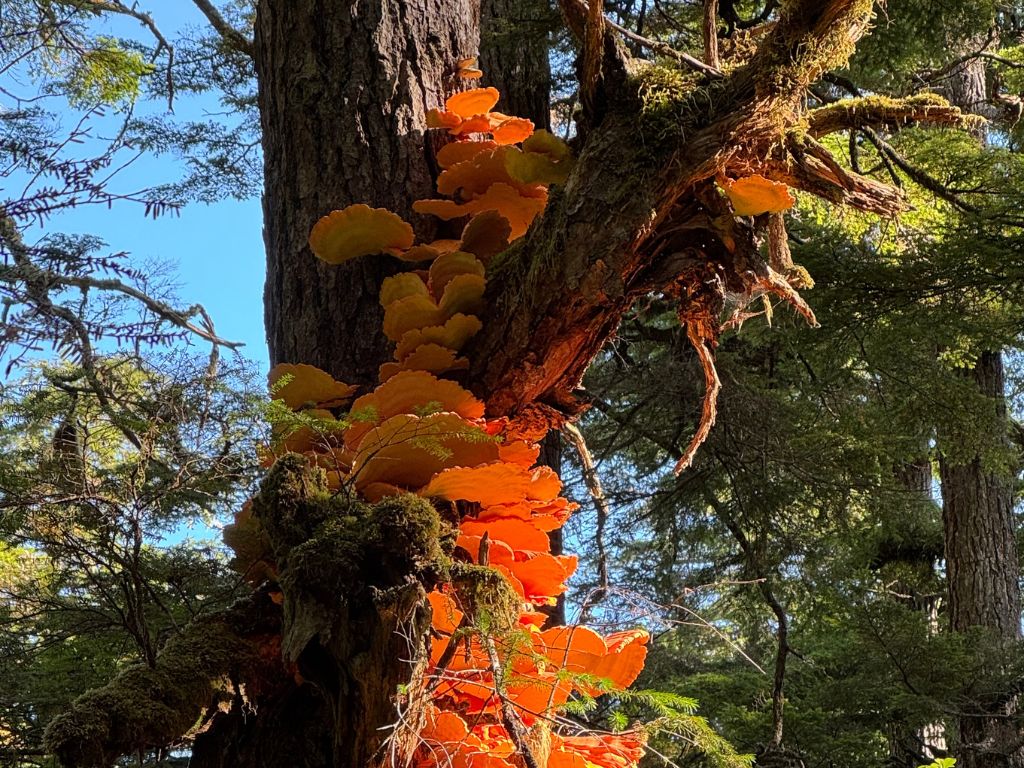
Bushwhacks through the Tongass. Moss six inches deep and mushrooms glowing on the bark.
Nothing about this week looked like the cruise industry’s default image—no atrium, no casino, no schedule to fight. What it offered instead was access: Zodiac rides at dawn, bushwhacks through moss six inches deep, a polar plunge, a glacier that cracks like lightning, a beach bonfire with s’mores that only happened because the weather aligned. UnCruise sails a similar model in Costa Rica, the Galápagos, Hawai'i, the Sea of Cortez, and the Aleutian Islands—with open-age, family-focused, and adults-only departures depending on the sailing. For travelers who’ve written cruising off—multigenerational families, parents who want to share a trip like this with their kids, couples looking at the adults-only Adult Escape departures, active travelers who want structure without the stage shows—this is the version that might change their mind. It changed ours. My mother said goodbye to the crew like she was leaving a friend’s house. We flew home together—she was looking up UnCruise’s Hawai'i sailings before we landed in Denver. I was reading about the Aleutians for the first time.
Need to know
Plan a full day in Juneau before boarding. The museums and totem trail don’t compress into embarkation morning—give yourself the day. The Baranof Downtown is a practical pre-cruise stay: walkable to the port, solid for a short stay. Hanger on the Wharf serves a casual lunch with views of the seaplane base.
Cabin size varies by vessel and category. Across the UnCruise fleet, these are expedition ships, so cabins run functional more than spacious. Larger categories and suites exist on some vessels but aren’t the norm—book early if size matters to you. The Safari Endeavour runs Navigator through Commodore Suite (the Commodore has a private balcony, separate tub and shower, sitting area, and mini-fridge); only four cabins on board have balconies.
Pack for the activity, not just the temperature. Alaska summers can be warm and sunny—a shirt and light jacket handle most days on board and on calmer excursions. Alaska can also turn cold and wet without warning, so layers and a rain jacket are essential. Bushwhack hikes are their own category: you’re moving through moss, downed trees, and dense forest with no trail, so long sleeves, long pants, and gloves are needed regardless of the temperature. XtraTuf-style rubber boots are provided on board.
Learn the Viking grip. Forearm to forearm, never hand to wrist, when helping someone over a log or up a bank. You’ll use it.
Meals, beverages (including alcohol), and excursions are all included. Gratuities are added at disembarkation. The onboard shop is the only other upcharge—grab a phone lanyard while you’re there. It’s the most useful piece of gear for a trip where you’re leaning over railings or bouncing on a Zodiac every day, and I couldn’t find one anywhere in town.
Ask about the sailing’s age mix. Most UnCruise Alaska departures are open age, but the line also offers family-focused sailings and Adult Escape departures that are adults-only. Worth asking which one fits your group.
The Safari Endeavour is built for adventure, not amenities. All cabins have ocean views—portholes or view windows, depending on the category. Four decks, two upper-deck hot tubs, a lounge with an under-bow camera feed, library, yoga mats, fitness equipment, and an EZ-Dock launch platform for kayaks, paddleboards, and skiffs. The lounge is where conversations happen; the upper deck is where the hot tubs are.
Stay a night in Sitka if your flight allows. Quieter and more walkable than Juneau, and worth more time than disembarkation day gives you. Our flight out was delayed by weather—plan for that possibility and leave a buffer for connections in Seattle.
Nothing is guaranteed. Whales, bears, plunges, and northern lights don’t come standard. The ship’s flexibility is what lets them chase what shows up.
For more inspiration and insider recommendations, visit our cruises page.


Travel Advisor
Stepan Travel


Caitlin Stepan

Get in touch with Stepan Travel
Did you like this guide? Reach out to customize and book your own experience. Or, just to chat about travel in general.