
Curator’s statement
Madagascar is one of those destinations that is unlike anywhere else on Earth: around 90% of its wildlife exists nowhere else on the planet; its landscapes shift dramatically from lush eastern rainforests to arid western savannah and limestone formations, and traveling through it gives you a real, unvarnished sense of the country in a way that more polished destinations simply cannot (which is a nice way of saying: it is rugged and adventurous). I went in May 2025 as a solo traveler, spending 15 days covering both the east and west sides of the island, and came home having spotted 21 species of lemurs, hiked the Tsingy rock formations, and marveled at massive baobab trees at both sunrise and sunset. Madagascar is rugged, remote, and logistically demanding in ways that mainland Africa is not (there are luxury resorts but really only in the coastal beach areas; inland, it’s adventurous), but that is precisely what makes it so extraordinary and so worth it.
The Fora Difference
Book with Wenli Plans Travel to access exclusive perks and experiences on your trip.

Killer perks
Free upgrades, spa credits and more—we got you

Personalized recs
Customized travel planning for your style

Insider knowledge
Expert advice from people who’ve actually been there
Where to stay
Unlock perks by contacting Wenli Plans Travel to book your trip.
Day 1: Arrival in Antananarivo
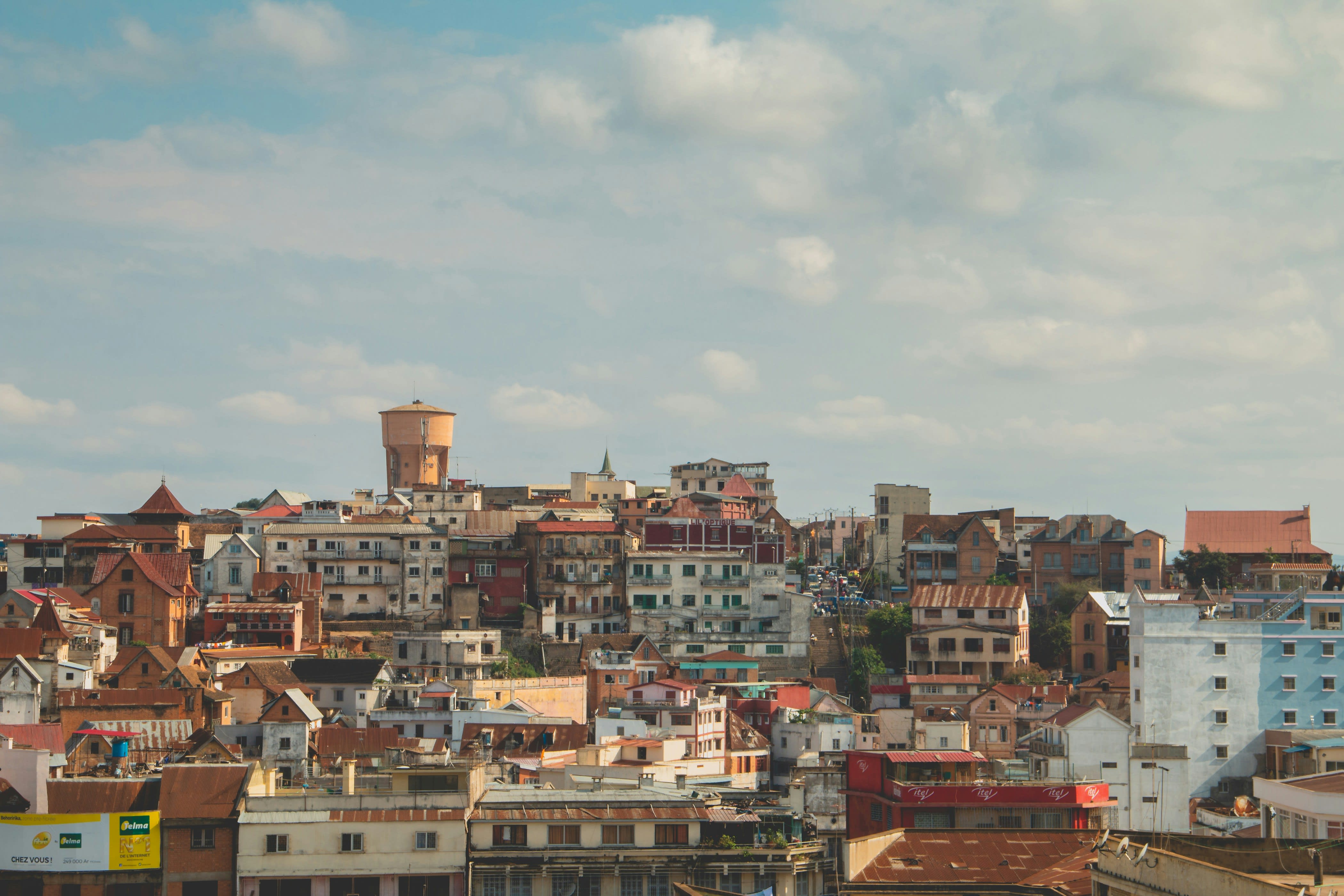
Your first day is purely logistical: arrive in Antananarivo (universally called “Tana”), clear customs and immigration (budget one to one and a half hours depending on the queue), and get settled at your hotel. I recommend La Varangue Hotel in Tana, and it is worth knowing that the garden rooms (separate from the main house) are significantly nicer than the main house rooms. The cozy, candlelit restaurant is ranked among the best in Tana and serves excellent, upscale French-style food (foie gras, extensive wine list) in generous portions, which matters since Tana is not a city you want to wander alone at night (or even during the day).
Day 2: Antananarivo to Andasibe
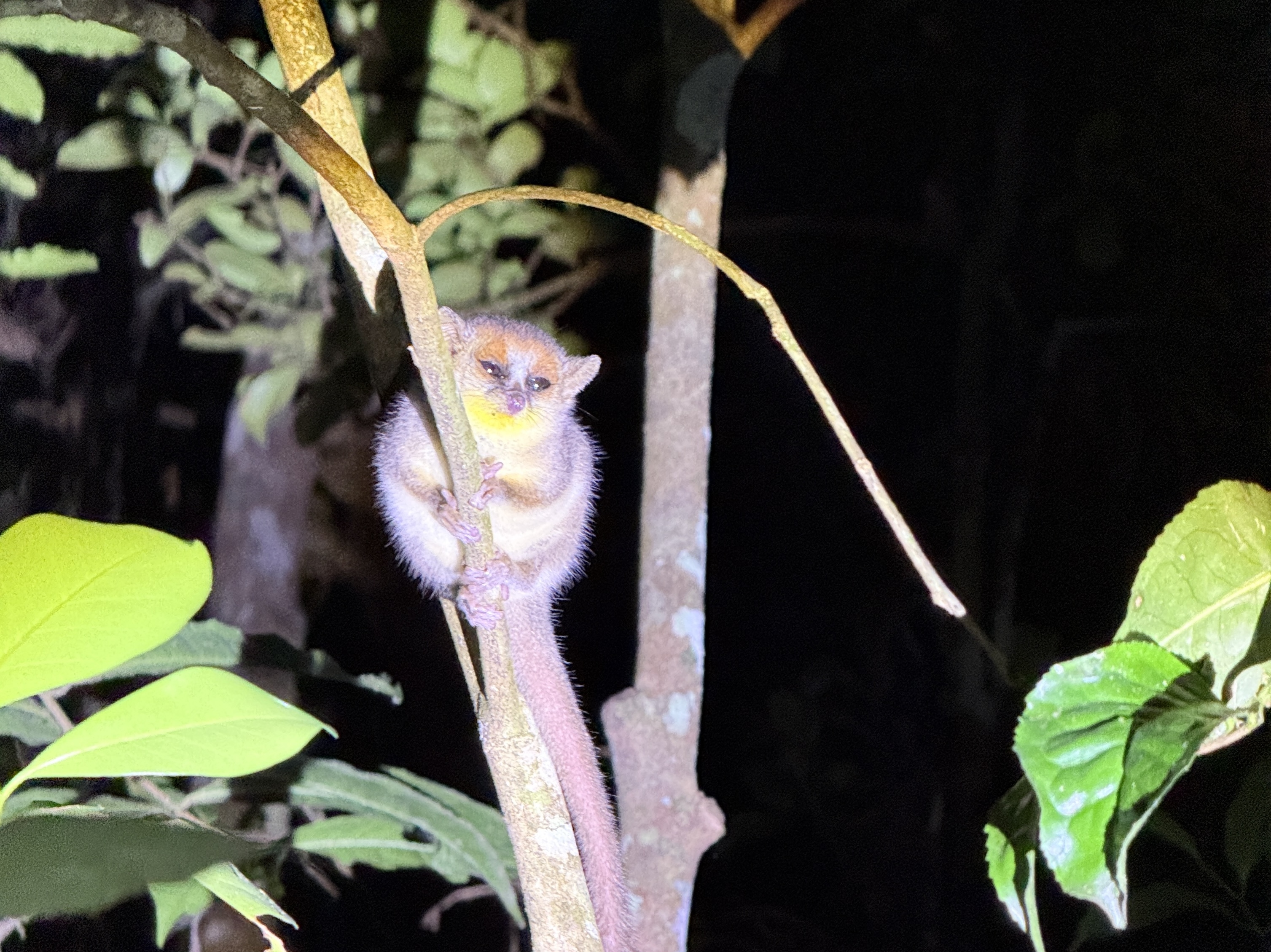
The cutest, sleepiest, most deer-in-the-flashlights mouse lemur
The drive east to Andasibe takes around four hours, mostly on paved roads, though with plenty of potholes, winding through green hills and small villages. The scenery is absolutely beautiful and the housing (mostly small huts) along the way gives you your first real sense of how Malagasy people outside the capital live. Take your motion sickness remedy before you get in the car: the combination of potholes and mountain curves can be rough even for people who don’t normally get carsick.
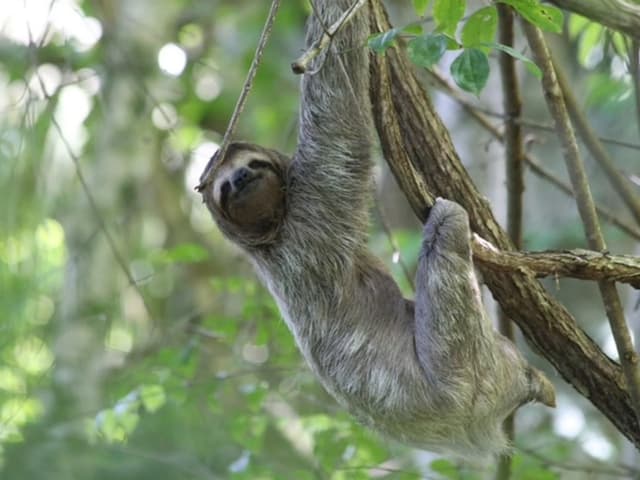
Upon arrival in Andasibe, do an introductory hike in a small community-managed private reserve, followed by a night walk to spot nocturnal animals. The night walks throughout the trip were consistently among the highlights: you see mouse lemurs, dwarf lemurs, and sportive lemurs hiding in tree holes, all of which are different from what you encounter during the day (smaller, shyer, super adorable).
Days 3-6: Andasibe National Park
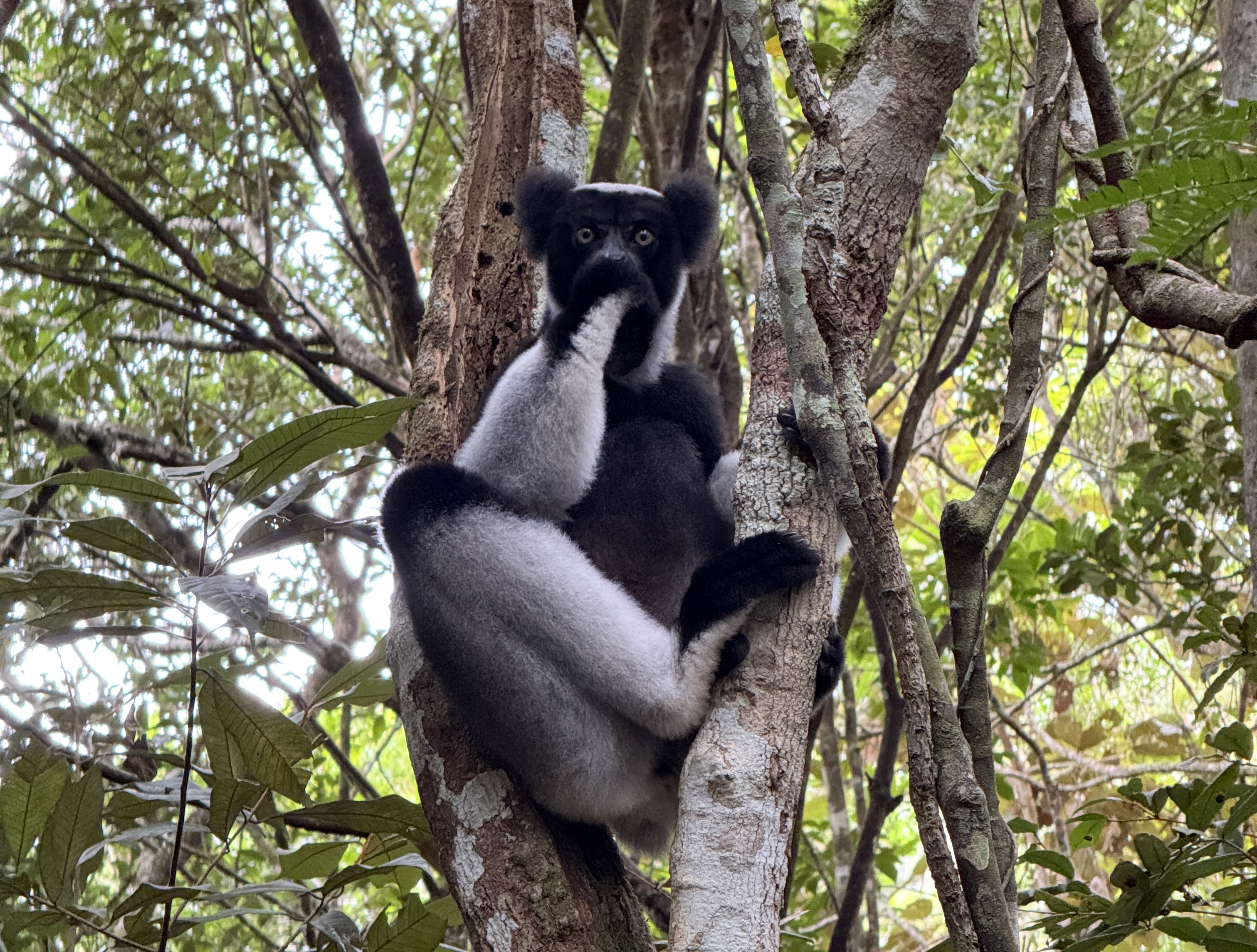
Indri indris are really good at staring deep into your soul
Spend several days exploring the various parks and reserves that make up the greater Andasibe area, each with a slightly different character: Mantadia Reserve for a more challenging four-hour rainforest hike in primary forest, Analamazaotra Nature Reserve to find the Indri indri (stunningly black and white, the largest of all lemurs, and the source of that haunting wailing call you will hear echoing through the forest), Mitsinjo Private Park, and Maromizaha Reserve for wildlife and birding. The rainforest hiking is not technical, but it is real hiking: a narrow one-foot-wide path cut through the vegetation, walking on mud or flat ground, uphill stretches, occasional bridges and stairs, and moments where you push through dense brush to follow a lemur. A good comparison point: if you have done the mountain gorilla hike in Rwanda, this is somewhat similar in spirit but much less intense. Wear shoes with solid tread (I don’t like hiking boots, so I tend towards trail runners; they will get wet, so I like that trail runners will dry quickly, and that they aren’t as suffocating as hiking boots). Wear your rain jacket essentially every day on the east side. And prepare to see an enormous number of lemurs, including many at relatively close range.
A few specific notes: you can also visit Lemurs Island for a couple of hours, which involves habituated lemurs that approach the park guides for bananas. It makes for excellent photos, and you will see a few species up close, but if you have already seen most of the same species in the wild, it feels a bit redundant. The Vakona Forest Lodge reptile reserve may be included in your itinerary, but it is skippable if you are not particularly interested in crocodiles and chameleons in a controlled environment. Neither of these is unpleasant, just a lower priority than the actual, wild rainforest time.
Day 6-7: Pangalanes Channel & Palmarium Reserve
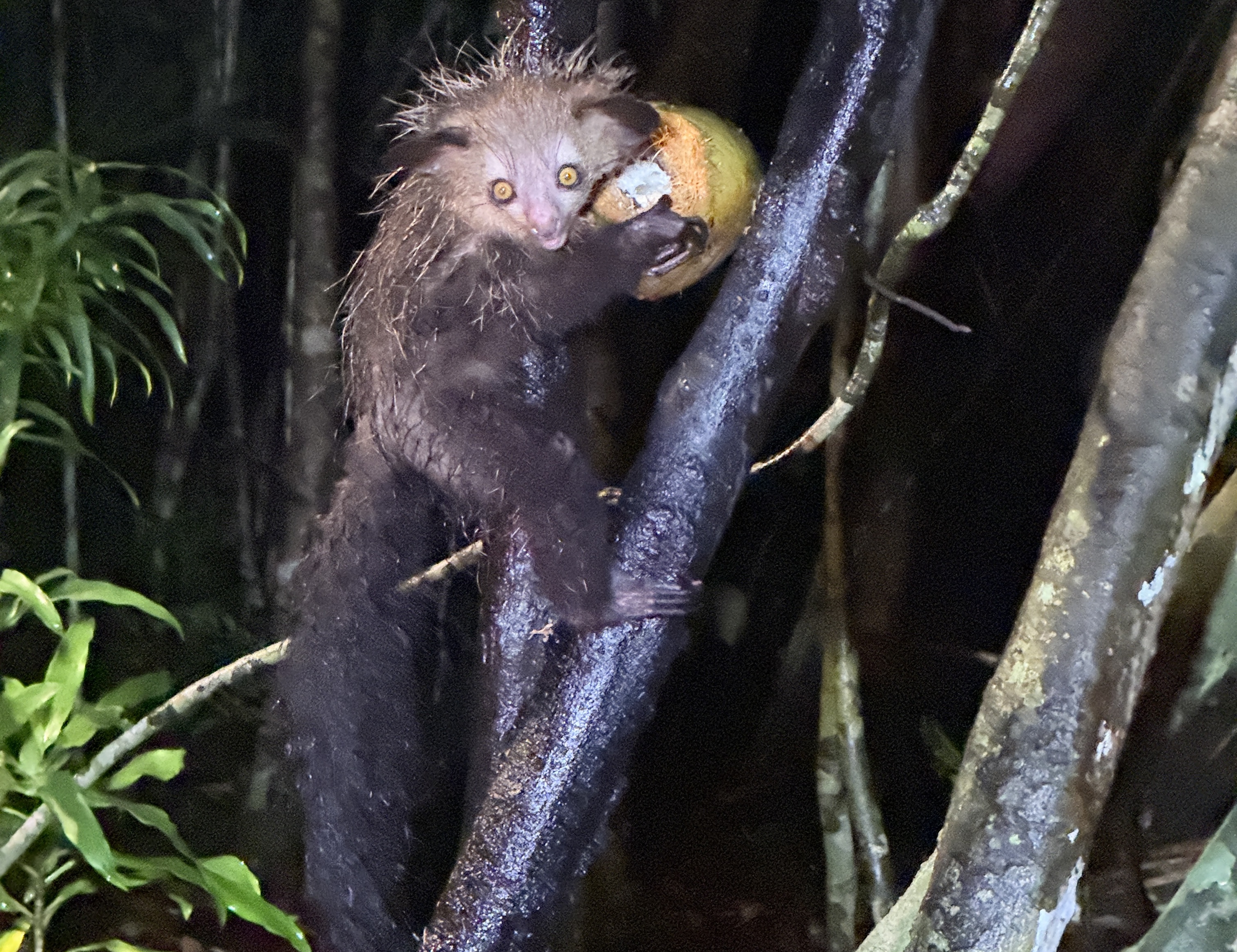
The creepy-cute aye aye, possibly the strangest looking primate on the planet
The transit day from Andasibe east to Palmarium involves a mix of driving (on increasingly bumpy dirt roads, including one stretch that was active construction mud when I was there) and a boat transfer across Rasoabe Lake. It is a long half-day. The Palmarium Reserve itself is a small private reserve where habituated lemurs roam the hotel grounds and guides use bananas to bring them close. I have mixed feelings about this style of encounter, having spent several days watching lemurs in the wild, but Palmarium has one thing that makes it almost non-negotiable: the aye-aye. The aye-aye is nocturnal, extremely shy (despite its rather insane and somewhat creepy appearance), and nearly impossible to see in the wild.
Palmarium brings a few to a small feeding station island each evening between 6 and 7 p.m., where they come out to eat coconuts under lights. It is not a fully natural experience, but it is the best and essentially only reliable way to see this incredibly strange and unique animal. Go to Palmarium for this alone. A note on the accommodations: Palmarium Lodge is the only option in this area, and it is the most basic of the trip, with limited electricity, no air conditioning, and high humidity. It is manageable, but mentally prepare yourself for damp clothing and an occasional mosquito inside your net. Bring at least one headlamp.
Day 8 (transit): Pangalanes Channel back to Antananarivo
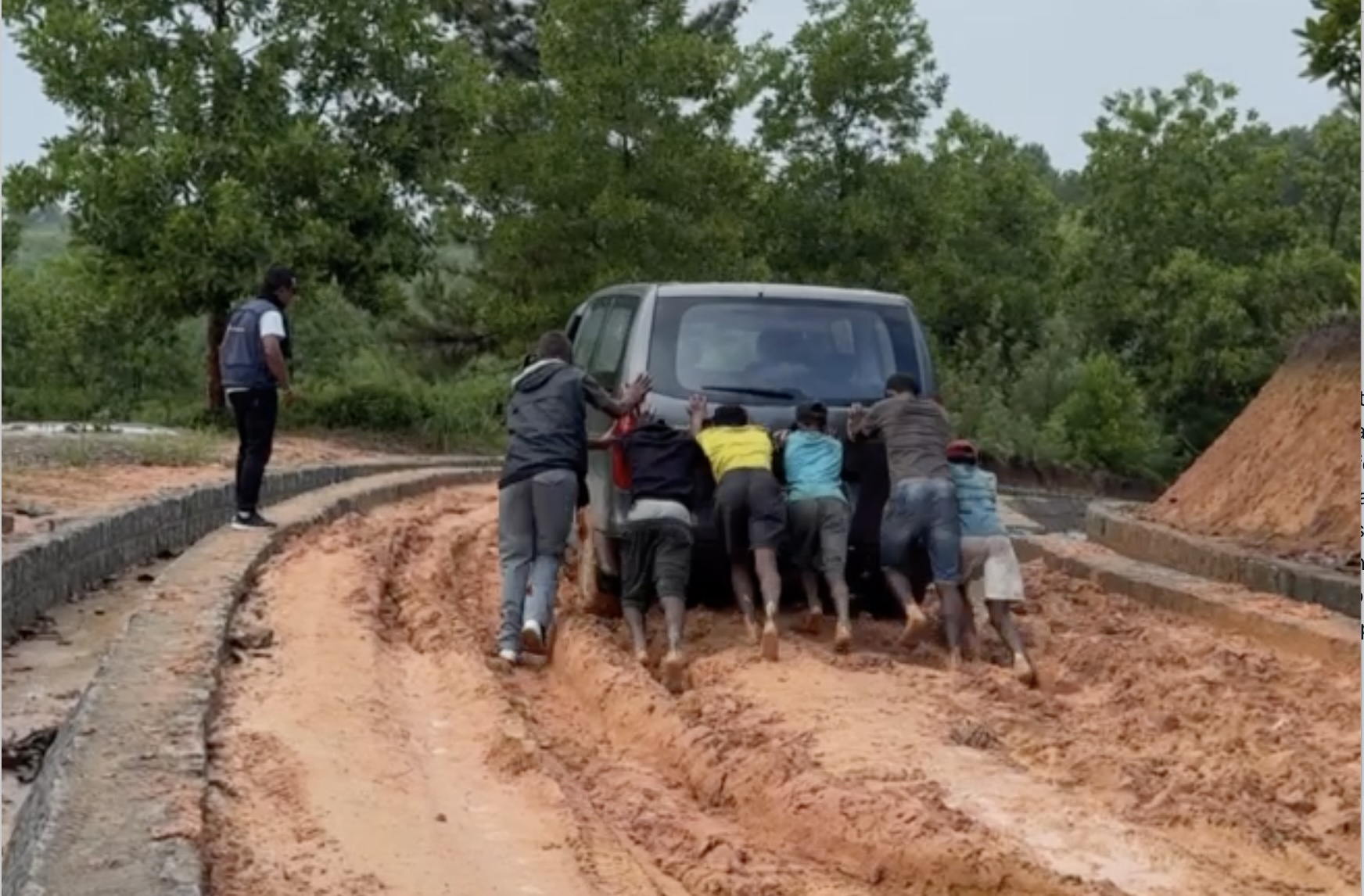
Un-sticking a car that is stuck in the mud is a (common and) communal process in Madagascar!
A full day of transit back to Tana: boat, then a long drive of around eight hours (more if the car in front of you gets stuck in the mud) with a lunch stop. The road through the eastern escarpment is beautiful if you can appreciate it through the bumps. This is a full travel day with no wildlife component; bring a book, download podcasts, and enjoy the landscape through the window.
Day 9: Antananarivo to Morondava & Kirindy
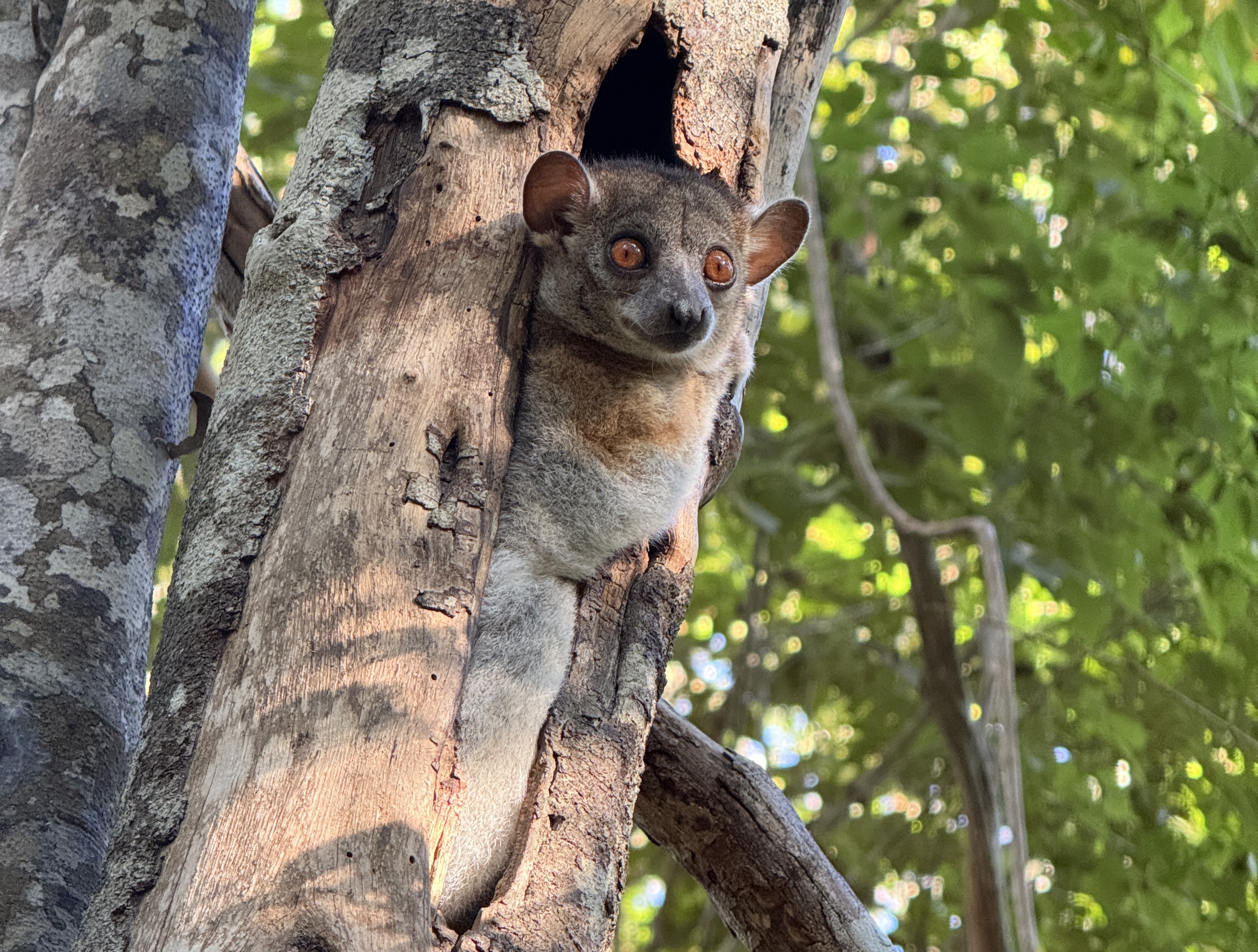
A sportive lemur hiding (not very well) in a tree hold
An early morning flight from Tana to Morondava (Air Madagascar is the only domestic carrier; it has a reputation for delays, and I did experience a three-hour delay on the return leg, so always build buffer between your domestic and international connections).
From Morondava, it is about two hours by road to Kirindy Reserve, driving through baobab forest and savannah that signals the complete shift from the lush, damp east to the hot, dry west. A night walk inside Kirindy Reserve rounds out the day: easy walking on flat ground through dry forest, with small lemurs including mouse and sportive lemurs visible in tree holes, often at close range. Pleasant and unhurried.
Day 10 (transit): Kirindy to Bekopaka
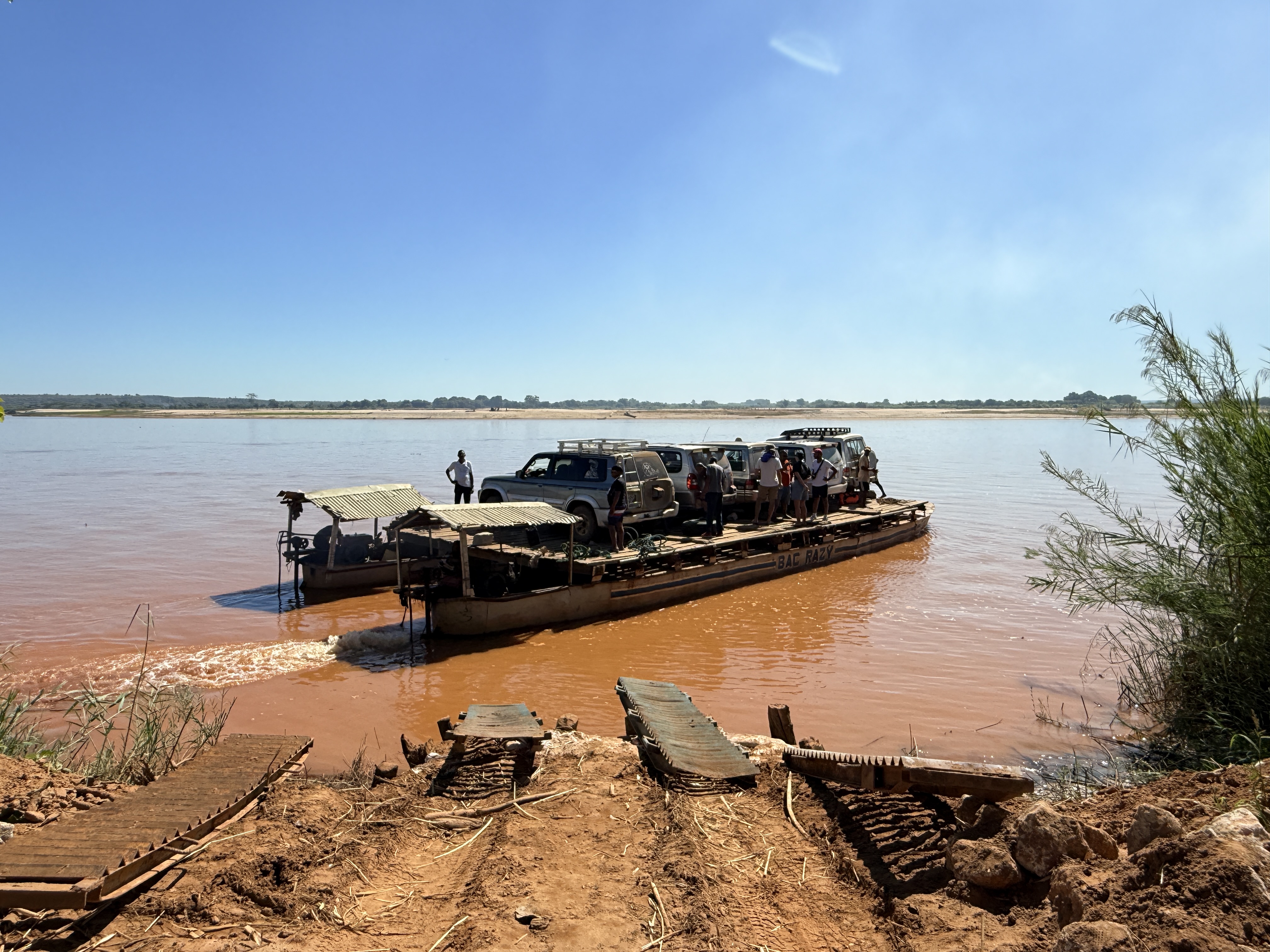
The local "ferry"! It looks basic (and technically it is), but the way everyone (drivers, guides, ferry drivers/helpers/loaders) knows the system is impressively efficient.
This is the hardest transit day of the trip, so be prepared (mentally and physically). After a morning walk in the reserve, you spend the rest of the day driving unpaved, dusty, bumpy dirt roads northward to Bekopaka, the gateway to the Tsingy. The actual distances are not far, but the roads make everything take two to three times longer than you would expect. There are also two river crossings by “ferry,” which are wooden platforms mounted on parallel motorboats that fit four to five SUVs each. The whole loading and unloading operation is entirely manual, with workers waist-deep in water maneuvering metal planks and pushing the platform by hand. It is chaotic, fascinating, and somehow works. Bring water, bring snacks, bring lots of patience (the ferries don’t run on a particular schedule and instead wait till enough cars have come to fill the platform; we just missed the last ferry so had to wait for the next one, then it took some time to get all the cars loaded), and if a car gets stuck in the mud ahead of you (which is possible), treat it as community theater rather than a catastrophe: everyone gets out, spectates, helps push, and moves on. I found these moments surprisingly delightful and entertaining, and the whole drive gave me a much richer sense of rural Madagascar and the communal spirit of its locals than any guided tour could.
Day 11-12: Tsingy de Bemaraha National Park
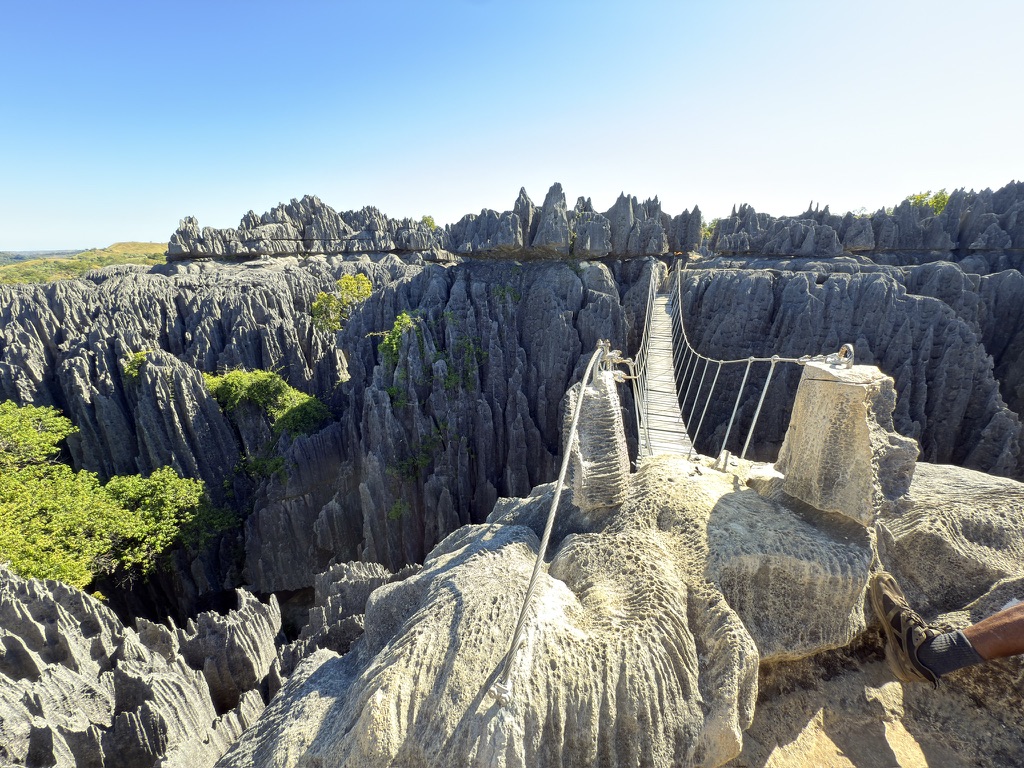
Incredible limestone formations (and one terrifying but I made it across suspension bridge) in Tsingy Grand National Park
The Tsingy are a UNESCO World Heritage Site and one of the most unusual landscapes on Earth: a dense forest of razor-sharp limestone spikes, formed over millions of years and found in only two places in Madagascar. Day one covers the Petit Tsingy and a canoe ride down a muddy river (start early, wear sun protection, the heat is real by mid-morning). The Petit Tsingy involves some ladder and rock climbing to reach the formations but takes only about an hour and is very manageable.
Day two is the Grand Tsingy, a longer outing of around three and a half to four hours total including forest and cave sections, plus the actual limestone formations. The caves are cool and one requires a headlamp; the rock climbing sections are well-constructed with stairs and ladders for most of the route, and a harness and carabiner system for exposed drops. There is a suspension bridge that looks intimidating in photos but turns out shorter and more manageable than expected, especially with a harness. Unless you have significant mobility limitations, you can do this hike. The actual time spent standing on the Tsingy formations is surprisingly brief (maybe 30 minutes total across both days) given how long it takes to get there and back, but the landscape is spectacular and worth every logistical effort.
Day 13 (transit): Bekopaka back to Morondava & Avenue of the Baobabs at Sunset
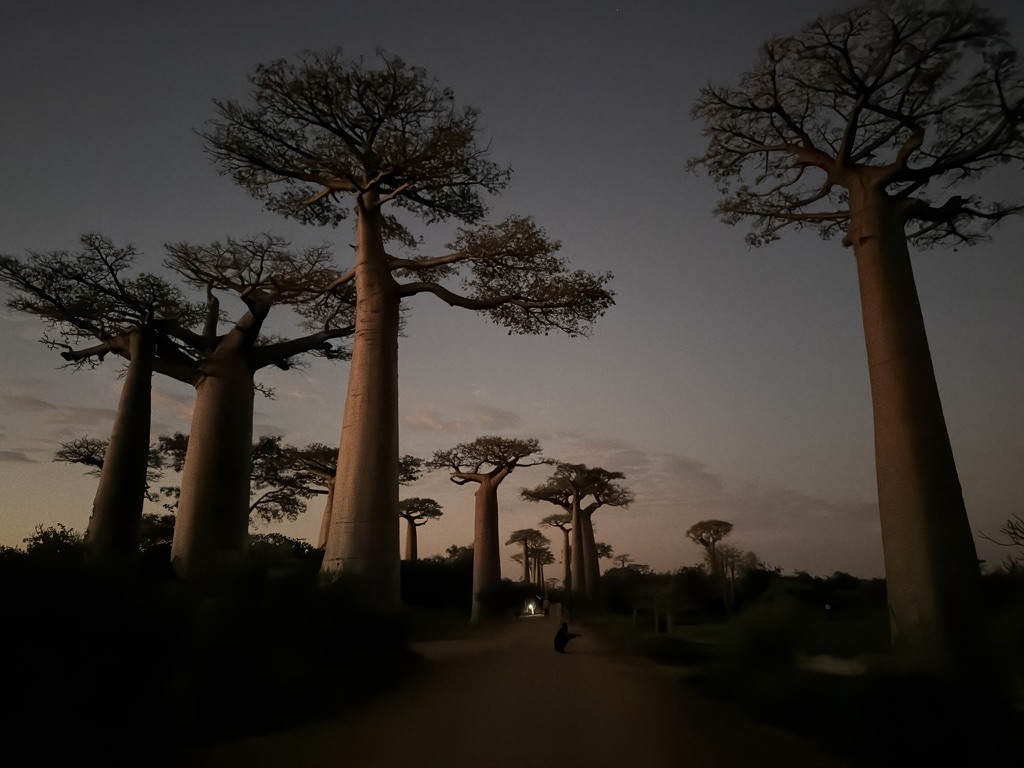
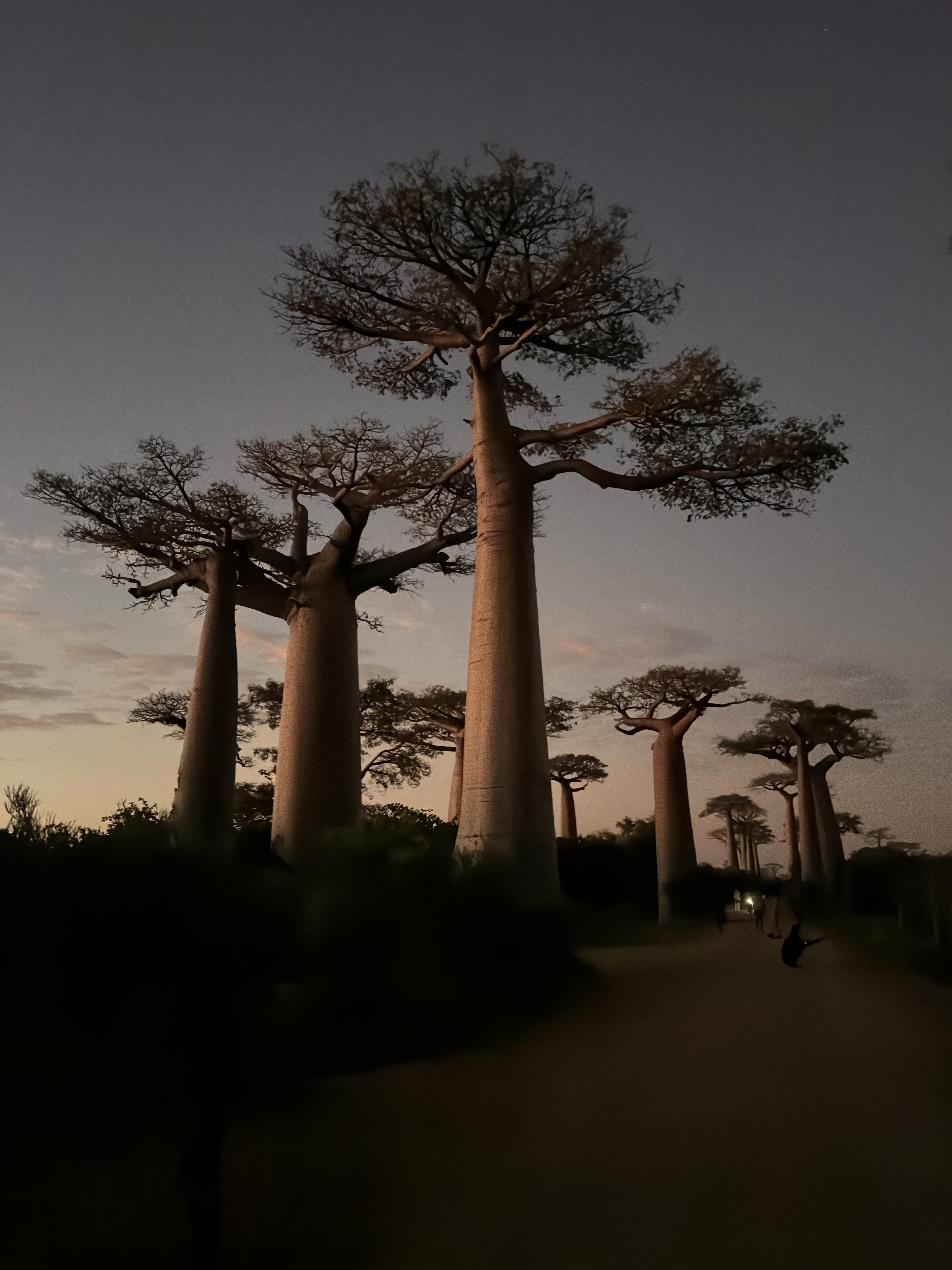
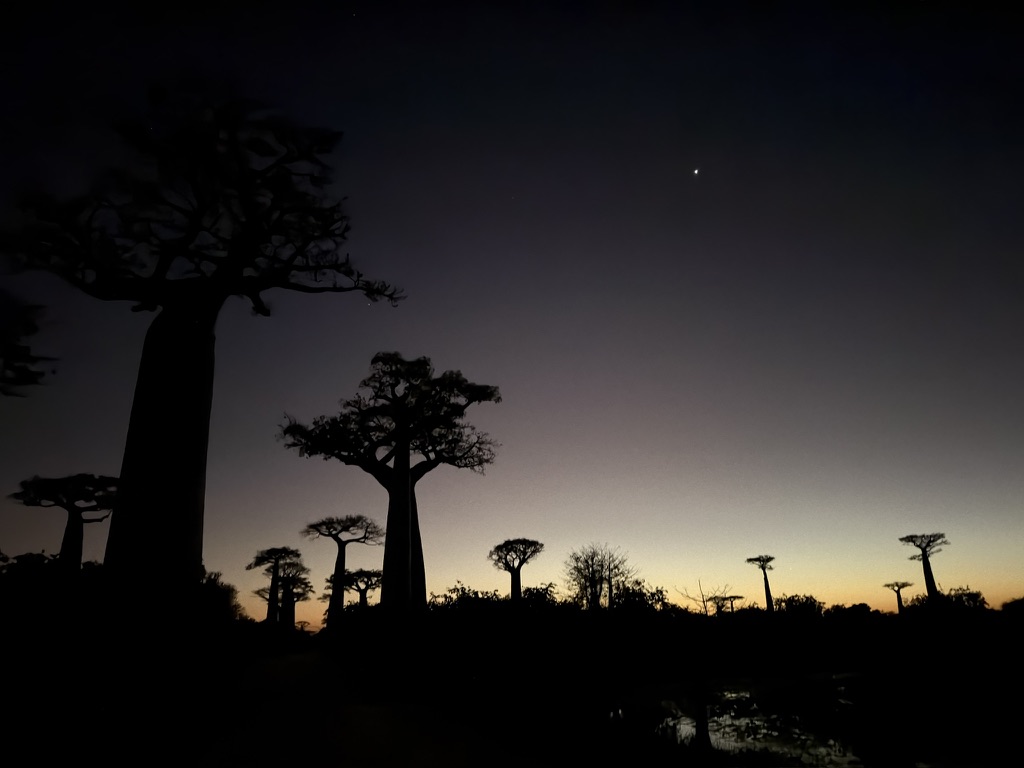
Some of the most gorgeous light I've ever seen, at the Avenue of the Baobabs at twilight
The long reverse drive back to Morondava, including the “ferry” crossings again. The day ends at the famous Avenue of the Baobabs in time for sunset, a stretch of road flanked by a dense row of ancient baobab trees. A word of expectation management: the baobab trees are giant, but the “Avenue” itself is somewhat overhyped (there are other similar baobab stretches along the drive that are comparably beautiful), and sunset crowds can be substantial. That said… the photos I took here are truly stunning. My recommendation: do the main viewing spot facing across the lagoon toward the tree line for the classic shot, but also walk around to the other side and photograph the trees up close in the softer post-sunset glow reflecting off the trunks. That light is gorgeous and less photographed.
Then back to Morondava for the evening; it will be late, which is too bad because the Palissandre Cote Ouest in Morondava is the nicest hotel on the western leg, with the luxury of 24-hour electricity and actual air conditioning; I was barely at the hotel for six hours (see: early morning wake up the next day), so I would recommend taking an extra day just relaxing at this hotel.
Day 14: Baobab Avenue at sunrise, then fly back to Antananarivo
A completely different but no less stunning light at dawn at Avenue of the Baobabs. Worth the 4am wakeup!
Sunrise at Baobab Avenue requires leaving your hotel around 4:40 a.m. It is very early and you have just seen the same trees at sunset the evening before, so you may not be super excited about this (I certainly was not). Go anyway. Sunrise is much less popular than sunset, so this morning was just my car and one other, and the quality of light is completely different. You start when it is completely pitch black and over the course of an hour and a half, watch the streams of light slowly fill the sky. I loved this experience more than the sunset one (but I still think you should do both and find out for yourself).
Then back to the airport for an afternoon flight back to Tana.
Day 15: Antananarivo, then fly out

Had to say hi to King Julien before I left!
If you have a late international departure, your last morning can include a visit to Lemurs Park, about 1.5 hours outside Tana. I was initially unenthusiastic about another habituated-animal reserve after 14 days and a few of these less-natural experiences already, but this one was actually worthwhile because it has species I had not encountered elsewhere in the wild due to those species not being endemic to the areas I went to, including the ring-tailed lemur (the famous one, King Julien from the movie), which lives in the south and is not on the east-west circuit. The weather on my last two days in Tana was perfect: mid-70s, sunny, and completely clear. A lunch in Tana at a nice cafe and a walk through a local market with your guide rounds out the trip nicely.
On the vanilla question that any food-obsessed traveler will have: Tana has shops near the airport and stalls in the local market that sell vanilla pods and vanilla powder at reasonable prices, and your driver and guide can point you to them. Pick some up (I certainly did, and my friends who like baking are grateful).
Need to know
Book through a travel advisor
Madagascar is one of the few destinations where I don’t think you can do it yourself, even for experienced solo travelers. The logistics of getting between parks, navigating road conditions, and arranging park guides at each reserve are complex enough that having a local expert handling everything makes an enormous difference. You also need a serious car—a 4x4—and the know-how to get yourself out of a sticky situation (literally), so even travelers who don’t go through a travel advisor will still hire a local driver. Group tours through operators like G Adventures and Intrepid are also available and more affordable, but most do not combine both the east side rainforests and the Tsingy in a single itinerary, and most include beach days that did not interest me. If your budget and schedule allow, a private custom itinerary arranged through a travel advisor is worth the premium.
Be prepared for the accommodations
Along the coast, in the popular beach and whale watching areas, there are a few true luxury resorts. However, inland and for the areas along this itinerary, the accommodations at the top end are clean, private, and comfortable, but they are not the luxury safari camps of Kenya or Tanzania: limited electricity at some lodges (typically available for a couple hours in the morning, then again from around 5:30 p.m. to 10:30 p.m. on generators), no air conditioning in most places, and WiFi generally only in common areas, if at all. Go in with appropriate expectations (and preparations: headlamps, bug spray, cold showers).
The roads are a real part of the experience
Some routes are paved with potholes, others are dirt, and the road from Kirindy to Bekopaka is entirely unpaved, deeply bumpy, and occasionally muddy. Distances that look short on a map can take an entire day to cover. This is not a complaint: the long drives through rural Madagascar were some of the most interesting and memorable parts of the trip. But plan your motion sickness remedies accordingly (Dramamine is useful on the east side mountain roads especially), bring water and snacks for the long days, and pack dust protection (a light mask or buff) for the dry western roads.
Packing essentials
Bug spray everywhere, all the time: I used Sawyer picaridin spray and Natrapel picaridin wipes, which work well almost everywhere in the world and were about 90% effective in Madagascar (you will still get some bites regardless). I also Permethrin-treated my clothing in advance, which helped. A headlamp is non-negotiable (and I suggest bringing two): for night walks, caves, and the lodges with limited electricity when you need to pack in the dark at 6 a.m. Good trail runners with solid tread are sufficient for all the hiking; you do not need full hiking boots, but do not bring regular running sneakers because you will slip. A quality rain jacket is essential on the east side. On the west side, sun protection and a good wide-brimmed sun hat matter far more. Bring your own toilet paper and hand sanitizer everywhere outside hotels and nicer restaurants.
Money
The local currency is the Malagasy Ariary. Euros are slightly more convenient than US dollars for exchange within Madagascar, though both work. ATMs are available in Antananarivo, Moramanga (on the road to Andasibe), and Morondava, but not in the more remote areas, so stock up in the larger cities before heading out (your driver and guide can assist with finding an ATM). Visa cards are significantly more widely accepted than Mastercard; American Express is essentially useless. Carry cash. Tipping is discretionary but customary: roughly 5 to 10% at restaurants, $2 to $5 for park guides, and around $8 to $10 per day for your main guide and driver if you are satisfied with their service.
Safety
Antananarivo has a reputation for pickpocketing and petty theft, and it is warranted enough to take seriously. Do not have your phone out in the car near open windows in the city, be aware of your bag in markets, and consider not going out alone at night. In Tana, there are people everywhere, it’s incredibly crowded. Elsewhere in the country, I never felt unsafe, though I kept my passport and cash on me at all times rather than leaving them in the car during ferry waits or park walks. Your guide from the tour company will be with you at all other times, which provides both practical safety and reassurance.
One local customs note
Pointing with a single index finger is considered disrespectful to ancestors in Madagascar. Use your whole hand or several fingers to point. It is the main cultural taboo to be aware of, and Malagasy people are generally very warm and gracious with visitors.
A standout restaurant you will not expect
Mad Zebu in Belo-sur-Tsiribihina, the small town between Kirindy and the first ferry crossing, was a pleasant surprise—it’s a remarkable restaurant in an otherwise very basic village. The food is French-influenced and plated beautifully, incredibly affordable by Western standards and for food that rivals anything you will eat in a French bistro. If your itinerary passes through this way, eat here in both directions if you can.
Otherwise, elsewhere, the local food is hearty and comforting: lots of stews on rice.


Travel Advisor
Wenli Plans Travel


Wenli Cai

Get in touch with Wenli Plans Travel
Did you like this guide? Reach out to customize and book your own experience. Or, just to chat about travel in general.
For more inspiration and insider recommendations, visit our Africa page.