
Gorillas and Hikers in the Mist: 4 Days of Gorilla Trekking in Rwanda and Uganda

Curated By
Regan Kirk


Curator’s statement
As someone who seeks out animal-related experiences in every corner of the globe, gorilla trekking has been on my bucket list for a long time. These gentle giants are difficult to reach, but the challenge is part of the adventure, and the hour (or four, on a habituation trek!) you spend with them is one you’ll never forget. There’s really nothing like staring into the soulful eyes of a massive silverback, or watching a proud young gorilla beat its chest and glare at you.
The Fora Difference
Book with Regan Kirk to access exclusive perks and experiences on your trip.

Killer perks
Free upgrades, spa credits and more—we got you

Personalized recs
Customized travel planning for your style

Insider knowledge
Expert advice from people who’ve actually been there
Where to stay
Unlock perks by contacting Regan Kirk to book your trip.
Our trip took place at the very end of December 2025, after completing a week-long Tanzania safari (check out that separate trip report to learn more!). We (myself and fellow travel advisor, and my mother, Mei-Mei) arranged for a guide to escort us through both countries.
Rwanda
We began in Rwanda, which is easier to fly into. Rwanda’s infrastructure is terrific, though traffic in Kigali is brutal! The Rwandan countryside is absolutely beautiful, with rolling green hills and idyllic farmland.
We stayed at, and loved, Sambora Kinigi. The food and service were excellent and the rooms very comfortable, though they have no view. One nice point was they had much of the trekking gear you’d need (specifically, gloves, gaiters, and raincoats) and provided it at no charge. (Some very high-end lodges also provide fleece jackets, hiking pants, and hiking boots for those who truly wish to pack light.) They also included a free short massage, which is an excellent way to cap off a day of hiking.
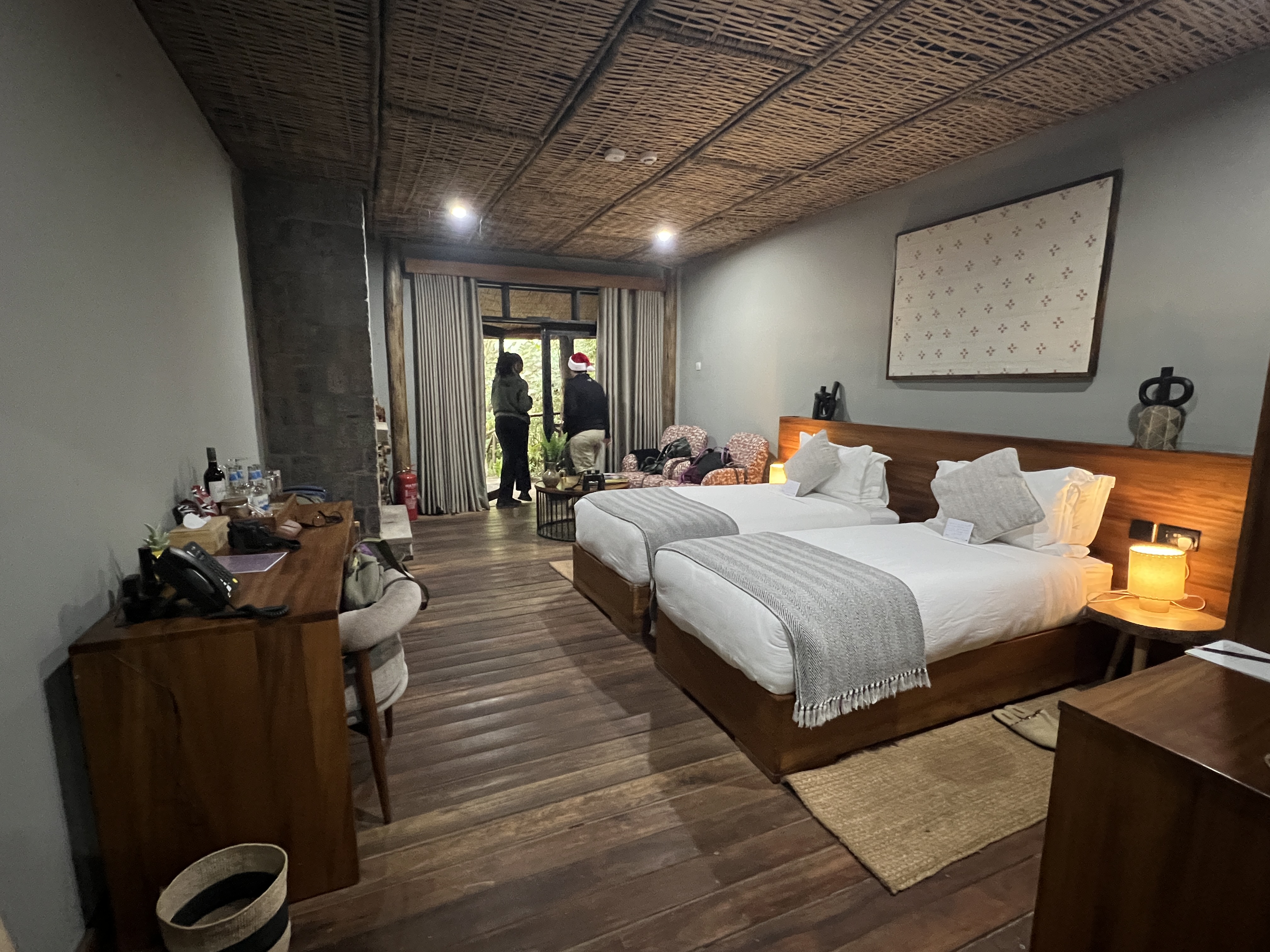
Our beautiful room at wonderful Sambora Kinigi
Rwanda treks
Both of our Rwanda treks took place in the Bisoke region. These treks start going through farmland, then cut over the wall that borders the national park once the trackers find your gorilla family. From there, you set off through dense, overgrown, and muddy trails until you eventually depart from the path and the trackers, rangers, and guide blaze a new trail through the jungle until you reach the family.
For the first trek, we requested medium difficulty and it ended up being easy. We reached the gorilla family within about 45 minutes of setting out. Upon arrival, we spent a magical hour with them. The family was large and in a fairly open area, which meant we had a lot of opportunity to observe them playing with each other, nursing, eating, and generally being delightful. There was one mischievous “toddler” who was fascinated by me and kept coming close and then darting away, occasionally pirouetting as he went.
When we got back to the lodge, the staff took off our gaiters and shoes and whisked them away to be cleaned. Later, we visited the nearby cultural center and the Ellen DeGeneres Campus of the Dian Fossey Gorilla Fund, both of which were interesting and worthwhile.
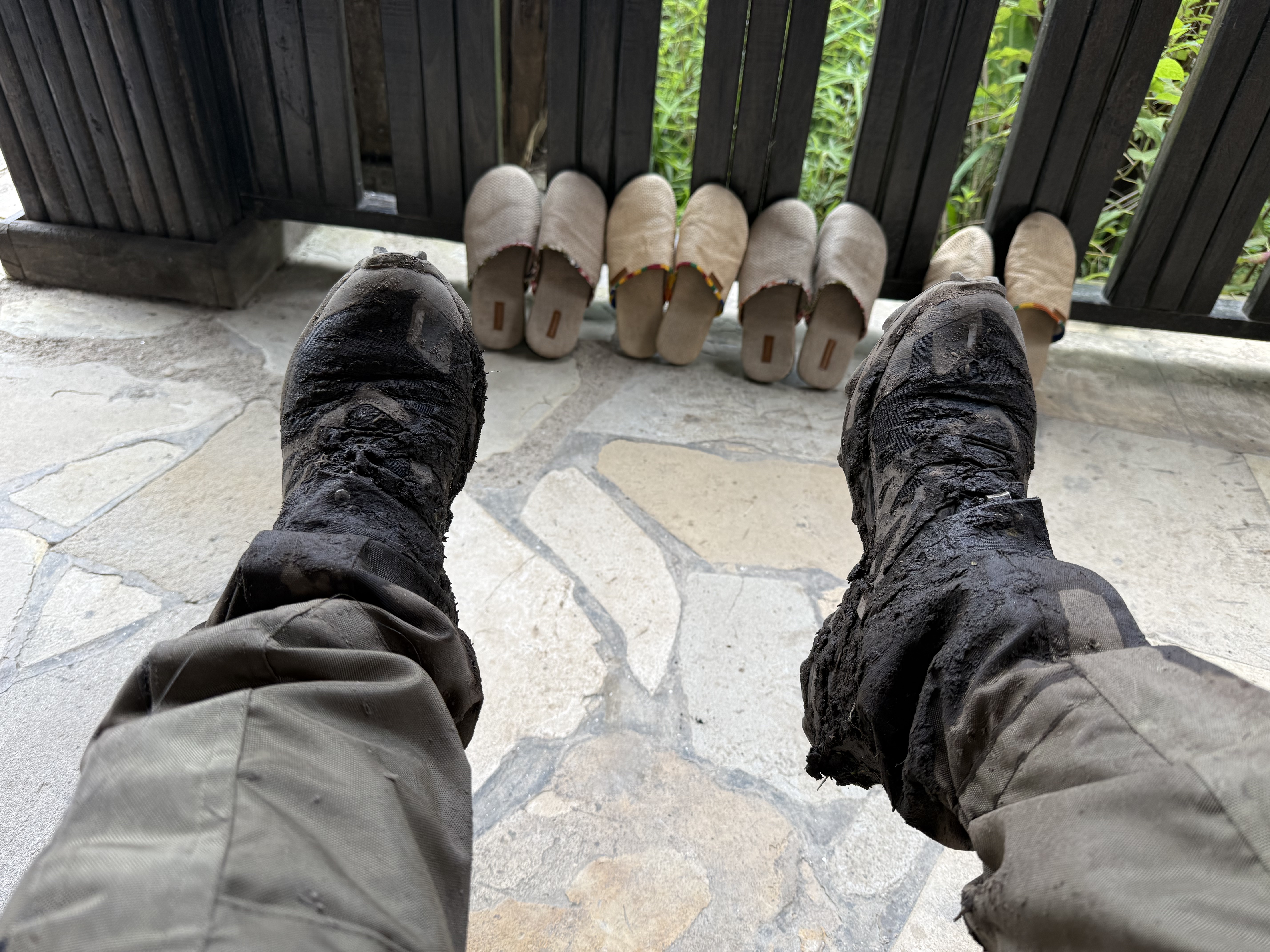
My boots and gaiters after the first trek
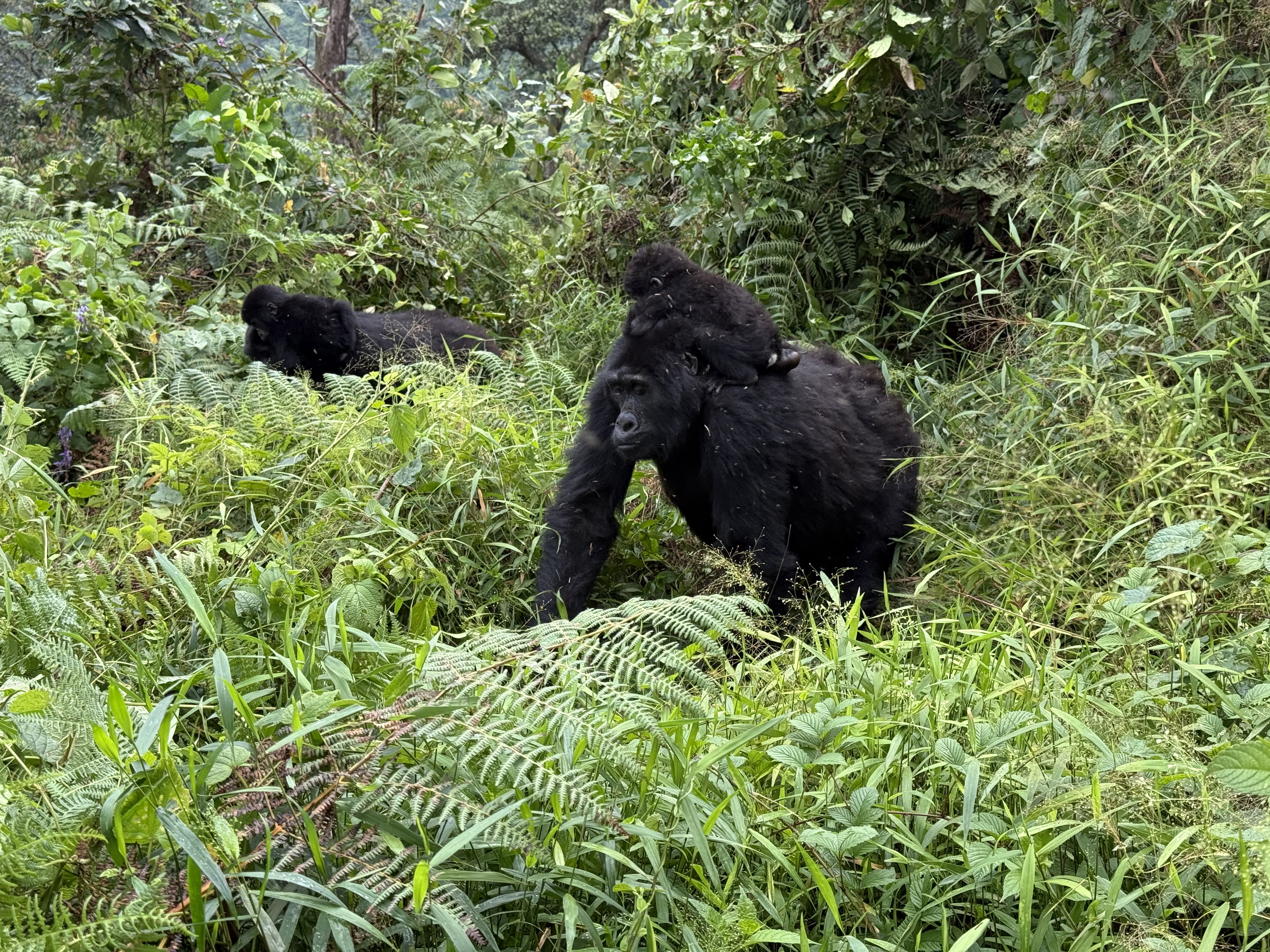
Mom and young gorilla, Rwanda
The next day, our “easy” trek ended up more of a medium difficulty. Coincidentally, after entering the park we started with the same trail as the day before, but we ended up heading deeper into the forest. Eventually, we reached the family, which was unusual in that it consisted predominantly of Silverbacks (dominant males 12 years old or older). It was a very different experience than the day before; the Silverbacks were much more spread out, which gave us a great opportunity to walk from one to another and see their different behavior. At one point, two disappeared into the trees and we listened to them roar and scream as they fought for dominance. They then emerged and went back to munching on bamboo as if nothing had happened.
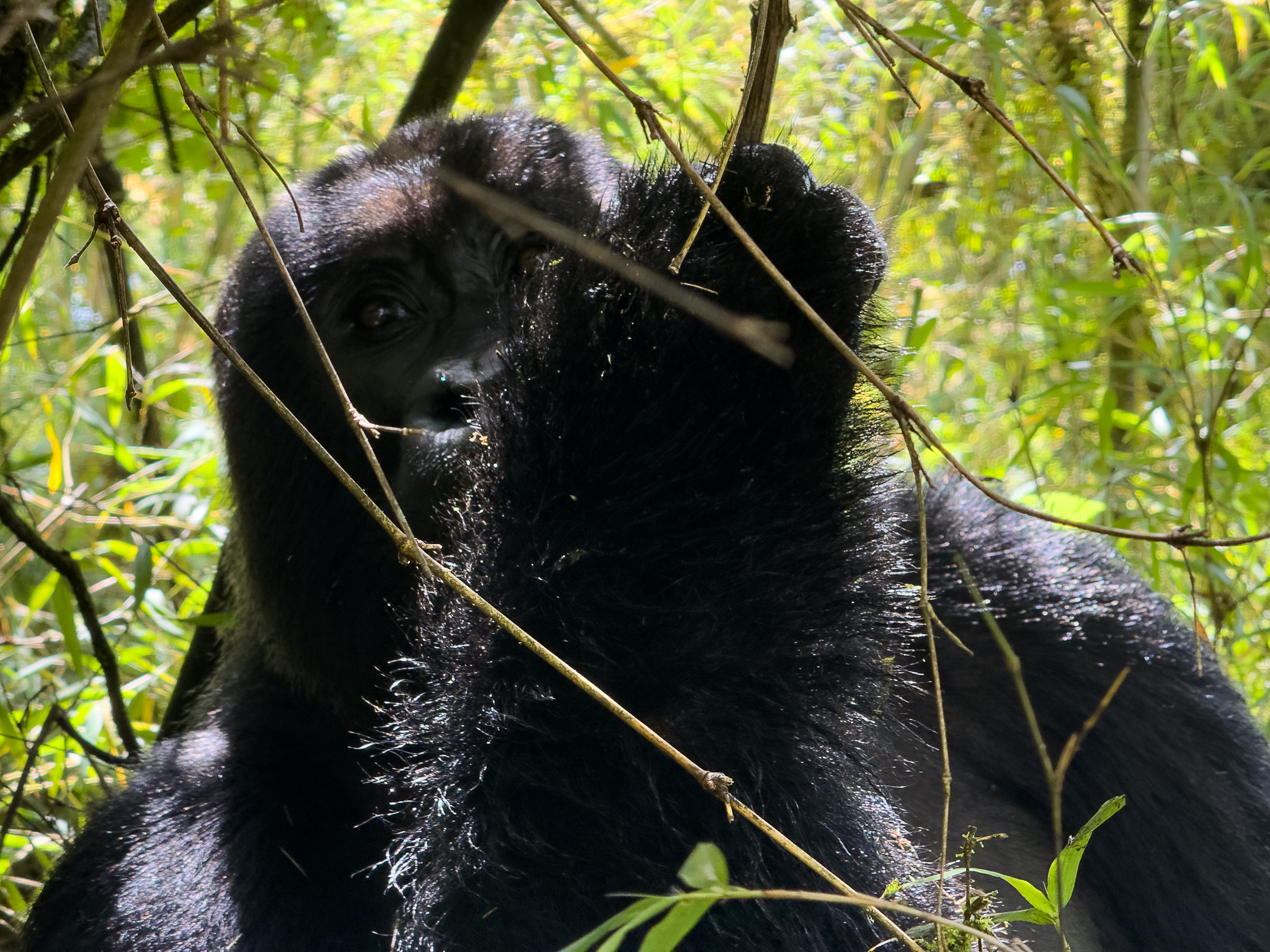
A black-backed gorilla enjoying a meal, Rwanda
Uganda
After Rwanda, we crossed the border to Uganda and drove to Four Gorillas Lodge on the outskirts of Bwindi Impenetrable Forest. We had permits to do a habituation trek the first day and a regular trek the next. Habituation treks are unique to Uganda, and ours was a highlight of the trip: this is where you visit a gorilla family that is still in the process of being habituated to visitors and get to spend four hours with them instead of the usual one.
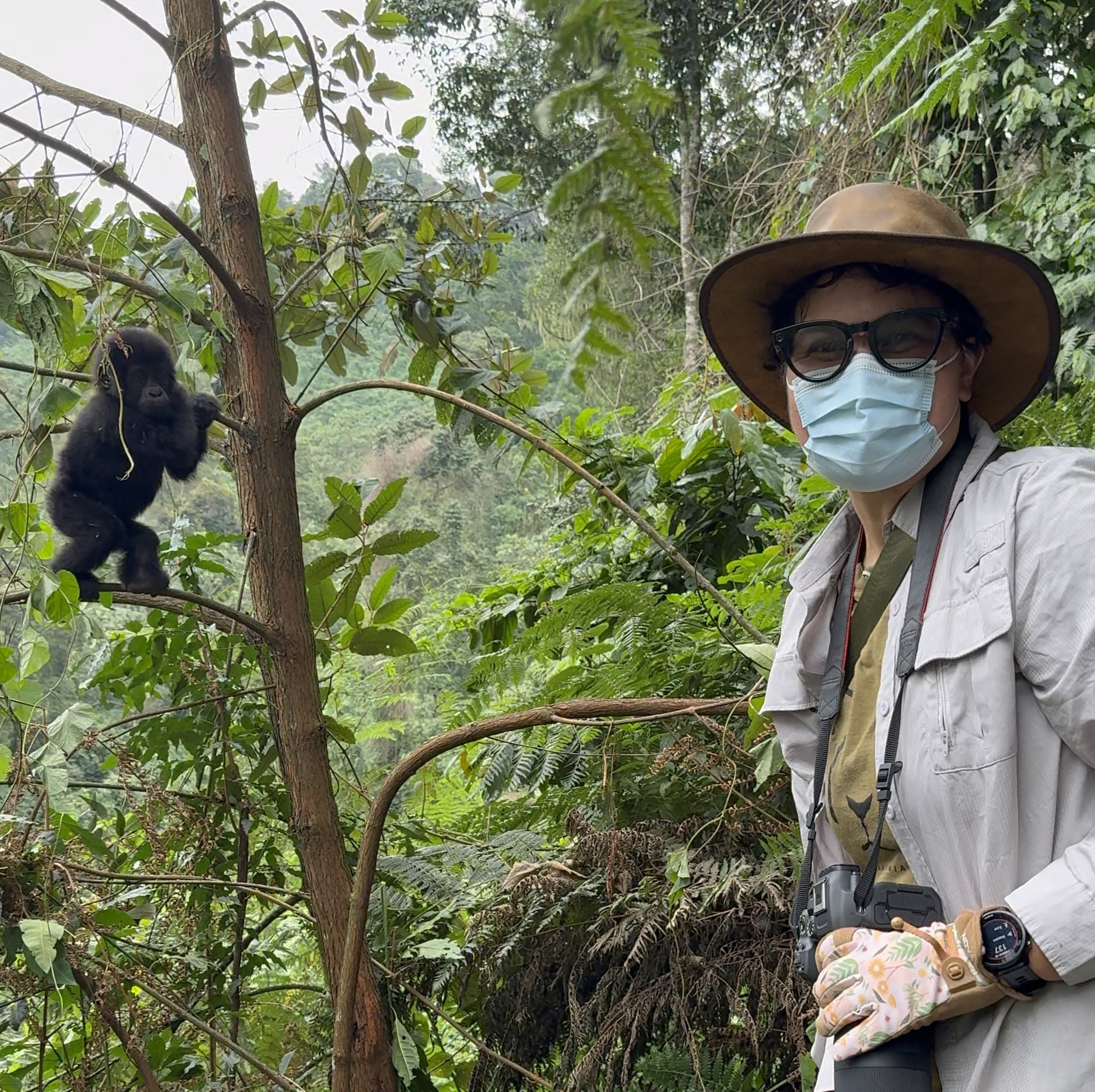
Me with a young gorilla in a tree, Uganda
On the morning of the habituation trek, we left quite early and picked up our guide, then drove to one of the starting points. We were pleasantly surprised to learn it would be just the two of us in the group (all of the other treks had a total of seven or eight trekkers; they cap habituation treks at four or five). We’d been warned that this would be a hard trek, and indeed it was. It started with a long, steep uphill portion just to reach the forest. We then set out up a ridge on a well-maintained trail as we waited for the trackers to report in.
Once we heard from the trackers, we immediately deviated off of the path, and this is where things became much more exciting and difficult than any of the trekking we did in Rwanda. The foliage in Uganda was much thicker and the angle far steeper. This made for a lot of slipping and sliding, grabbing onto trees, vines, and nettle bushes, and generally fighting our way through the woods. It took about an hour of this slog (so about 2.5 hours after starting the trek) before we came upon the trackers. From there, we started our fabulous four-hour observation window.
The family we’d been assigned (Bikyingi) has gotten very used to people even though they aren’t officially habituated yet (habituation is a process that takes many years, for everyone’s safety). Over the course of the four hours, we watched them climb trees, play, groom each other, eat, goof off, eat, cuddle, and eat some more. They moved through the forest effortlessly, often disappearing into seemingly impenetrable foliage in search of more food, and we’d follow, with the trackers using machetes to carve our way through and then helping position us so we’d have a great view. They took wonderful care of us and were very invested in giving us a great experience.
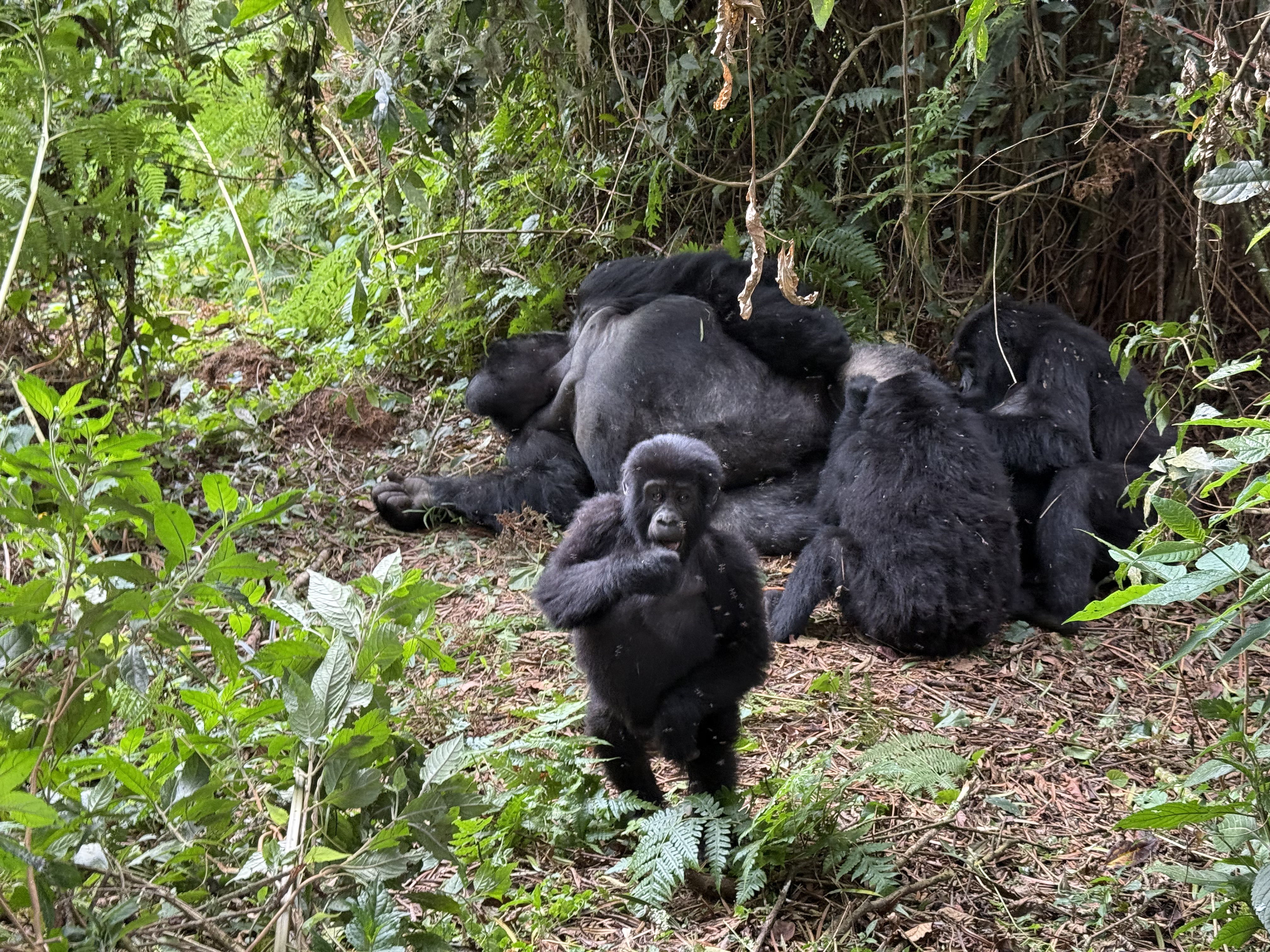
A curious young gorilla on our habituation trek, Uganda
At four hours on the dot, we set off back the way we’d come. This was the hardest part, as it meant climbing straight back up the mountain to the ridge where we’d left the main trail. It had been a very active day (even when observing the gorillas, you’re on the move for much of the time), so we were weary for this big push near the end. The porter and guide were a huge help here. Eventually, about eight and a half hours after we’d started the trek, we reached the end, exhausted but joyful.
For our last day of trekking, we asked for an easy or short one because we were still exhausted from the day before and the two days of trekking before that. Unfortunately, this ended up being our most grueling trek and another eight-hour day! We were in a group of seven, with a wide range of ages (probably 20–70), though all of us were fairly fit. One young couple with a great deal of trekking experience started off saying the pace was too slow and the trek was too easy. They weren’t saying that by the end, and the wife was desperately wishing she’d brought gloves after accidentally grabbing onto a stinging nettle plant.
From the beginning, the guide had trouble reaching the trackers due to poor signal (they use cell phones; or, when that doesn’t work, they holler into the forest and wait to hear if someone hollers back). We left the main path very early on and proceeded to wander up and down that steep, rough hillside for hours. By the time we finally found the trackers at noon, everyone in the group was filthy, wet, and very fatigued. We then spent an hour with our final gorilla family. Observing the gorillas is more difficult in Uganda than Rwanda (at least the areas I visited) because the terrain is so challenging and there’s no flat ground, so you’re often struggling to find solid footing and the gorillas are usually either below or above you, with bushes obscuring your view (though the trackers try to machete away such obstacles).
After our hour was done, we started our way up the hillside. We were leaving via a completely different route than the one we came in on because we’d crossed over the valley to the other side. Upon reaching the end of the trek, I was astonished to find that we had somehow arrived at the Four Gorillas Lodge on foot! We staggered our way up the stairs to our room and thus closed out the gorilla portion of our trip.
The next day, we drove back to Rwanda to fly out of Kigali. It was a beautiful scenic drive almost the entire way, offering a pleasant finale to a terrific trip.
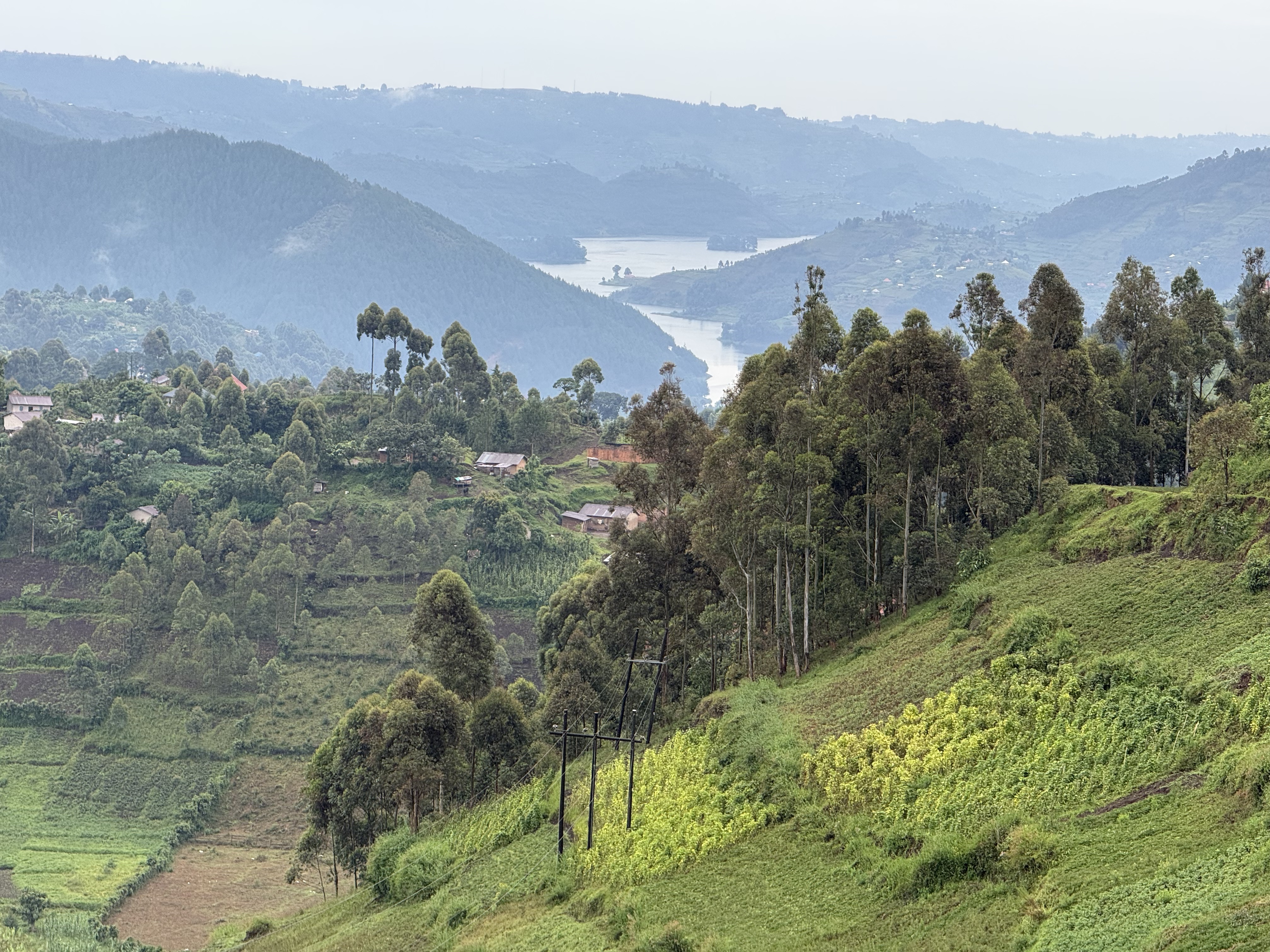
Stunning scenery driving through Uganda
Need to know
A common question is, do I really need a porter? The answer is yes. They cost $20 (anything above that is optional tip), which is paid directly to them and is their only source of income, and they can be an invaluable resource over the course of your trek. The least of what ours did was carry our bag; far more important was the way they helped us navigate the terrain, which was at times extremely challenging. In Uganda, there were times the porter nearly had to carry one of us over sections that seemed impassable. The recommendation is to have one porter per person, or at most one for two people.
Bring more cash (USD or local currency are fine) than you think you need. We underestimated, and most people do, how many people are involved in the trek (and therefore potential people to tip). In addition to the porter and the guide (who works for the national park service or government), you most likely have two rangers with guns for your security and then three to six trackers who have spent the previous evening and all morning following the gorilla family for you. We suggest tipping them all, though of course, that’s up to you.
You should have hiking shoes with good traction, gaiters that cover your shoes and protect your calves, gloves (simple gardening gloves work great), a long-sleeve shirt, long pants (we saw someone with shorts), and a raincoat. Depending on where you stay, many of these items may be provided free of charge.
Masks are required whenever you are observing the gorillas. Bring your own, and consider what color will look best in your pictures!
You can borrow a hiking stick for free and it is a must-have, as it provides stability, lets you test footing, and keeps you upright when you’re ready to collapse. They have some beautiful stylized sticks; I ended up buying one for $10 and using it on three treks. It will have a place of honor on my wall at home.
Lodges will offer you a packed lunch; we found that we never actually ate ours, except on the long habituation trek where there was a built-in lunch slot. You can give any leftovers to your porter, or you might find you don’t need to carry more than a few snacks (but check with your lodge and guide).
They didn’t warn us about ants before our first trek, and at one point our entire group was standing in a colony of biting ants while observing the gorillas. This resulted in about ten minutes of people frantically ripping off their clothes and swatting the ants away. I was very lucky to have been on the outskirts. We proceeded to see similar ant colonies on all of the other treks and avoided them assiduously!
Most people will choose either Rwanda or Uganda for their trekking experience. The two are very different! For one thing, Rwanda’s permits are twice the cost of Uganda’s.
If you have time, a golden monkey trek is a common add-on in Rwanda. In Uganda, many people do a chimpanzee trek in addition to looking for tree-climbing lions and walking with rhinos. Uganda is also home to the famous shoebill stork (look up a picture!).
Remember: there’s no such thing as an “easy” gorilla trek, and no way to predict how challenging your trek will end up being!
In a worst-case scenario, don’t be too proud to use the “African helicopter”: 16 strong porters who will carry you down (and up) the mountain. At the time of our trip, the helicopter cost $300. Again, bring more cash than you think you need.
For more inspiration and insider recommendations, visit our Rwanda and Uganda pages.


Travel Advisor
Regan Kirk

Regan Kirk

Get in touch with Regan Kirk
Did you like this guide? Reach out to customize and book your own experience. Or, just to chat about travel in general.