

Curator’s statement
Osaka is arguably the best food city in Japan, which by extension makes it one of the best food cities in the world. In fact, the Japanese have a nickname for Osaka: Tenka no Daidokoro (天下の台所), or “The Kitchen of the Nation.” While it originally referred to the city’s role in the trade of ingredients like rice and dashi, it is now primarily used to celebrate Osaka’s vibrant street food culture and its reputation as a gastronomic playground. If you’re planning your first trip to Osaka, let this guide serve as your introduction to the city’s most iconic dishes. Follow my tips and you too can take part in the time-honored Osakan tradition of Kuidaore (食い倒れ)—“eat until you drop!”
The Fora Difference
Book with Oblique Route to access exclusive perks and experiences on your trip.

Killer perks
Free upgrades, spa credits and more—we got you

Personalized recs
Customized travel planning for your style

Insider knowledge
Expert advice from people who’ve actually been there
Where to stay in Osaka
Unlock perks by contacting Oblique Route to book your trip.
Things to do in Osaka
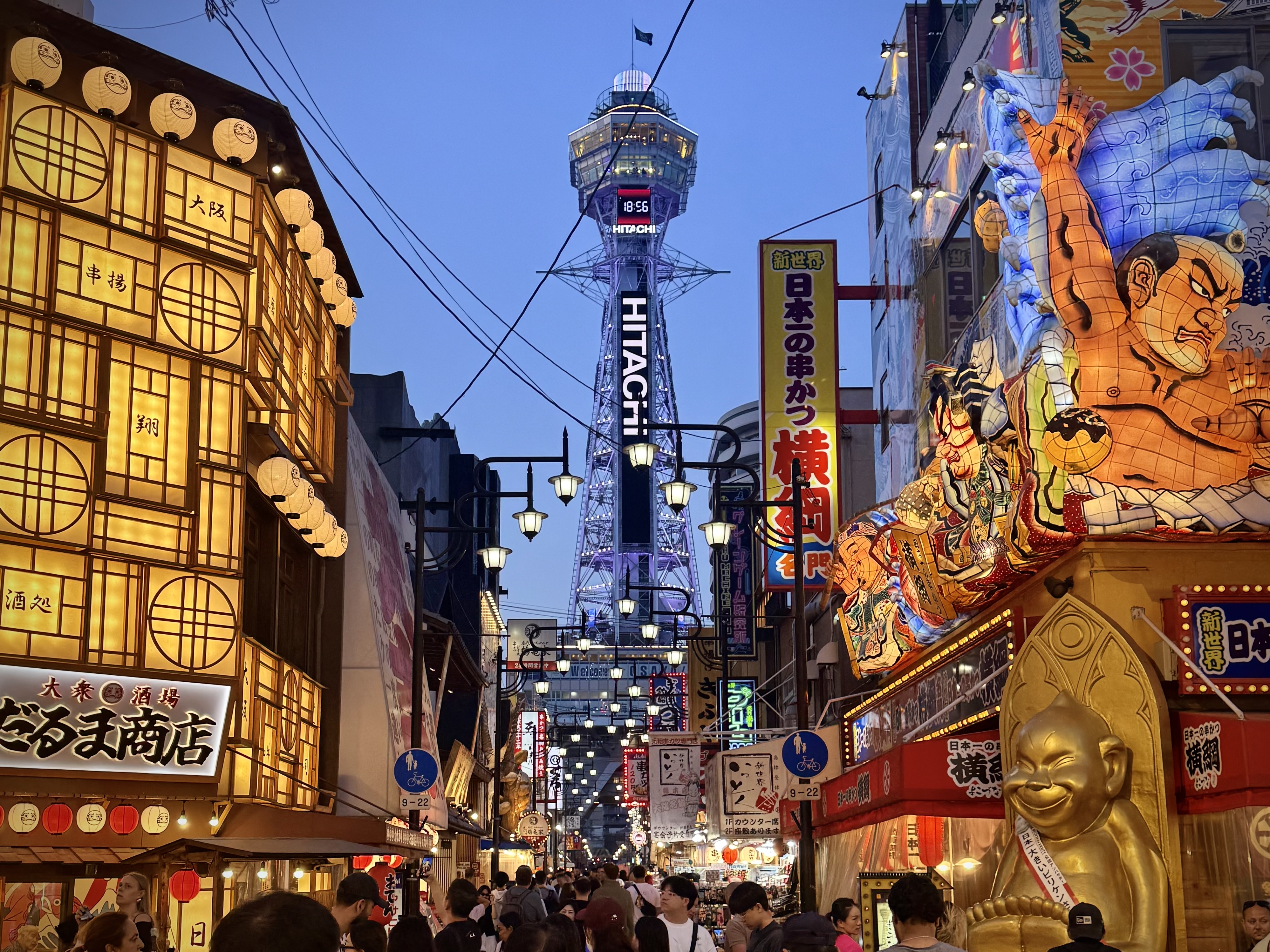
Tsutenkaku Tower looms over the main thoroughfare in Shinsekai at dusk.
Beyond the food scene, there are plenty of things to do in Osaka that are worth your time. But if you’re seeking more general tips about touring Osaka Castle, visiting Universal Studios, or shopping at Shin Sai Bashi-Suji, you’ll need to look elsewhere. There are some excellent Osaka guides available here on the Fora site that provide practical information about sightseeing and other activities, if that’s what you’re looking for. For this guide, though, I want to keep the focus on food—what to eat and where to find it. If your primary objective in Osaka is to thoroughly explore the city’s culinary delights, your “things to do” list might look something like this.
Explore the kushikatsu spots in the Shinsekai neighborhood
Kushikatsu are deep-fried skewers of meat, seafood, and vegetables coated in a light, crispy panko batter and served with a communal dipping sauce. It is the ultimate Osaka comfort food. While you can find it all over the city, Shinsekai is its spiritual birthplace and the best place to experience it. The neighborhood itself is a bit like a trippy time capsule of mid-century retro Japan. At dusk, the streets become a neon-lit maze of giant, theatrical restaurant signs. Just walking around is a sensory experience in itself, but you won’t want to leave without trying the district’s iconic dish. The neighborhood is packed with dozens of historic, narrow kushikatsu joints where you’ll likely sit at a counter, elbow-to-elbow with locals. The cramped quarters and brusque service are part of the whole experience. You can order your choice of skewers one by one—pick and choose whatever sounds tasty. And don’t forget the cardinal rule, which you’ll see posted in just about every shop—no double dipping! See the next section for specific restaurant recommendations.
Compare the takoyaki options in Namba/Dotonbori
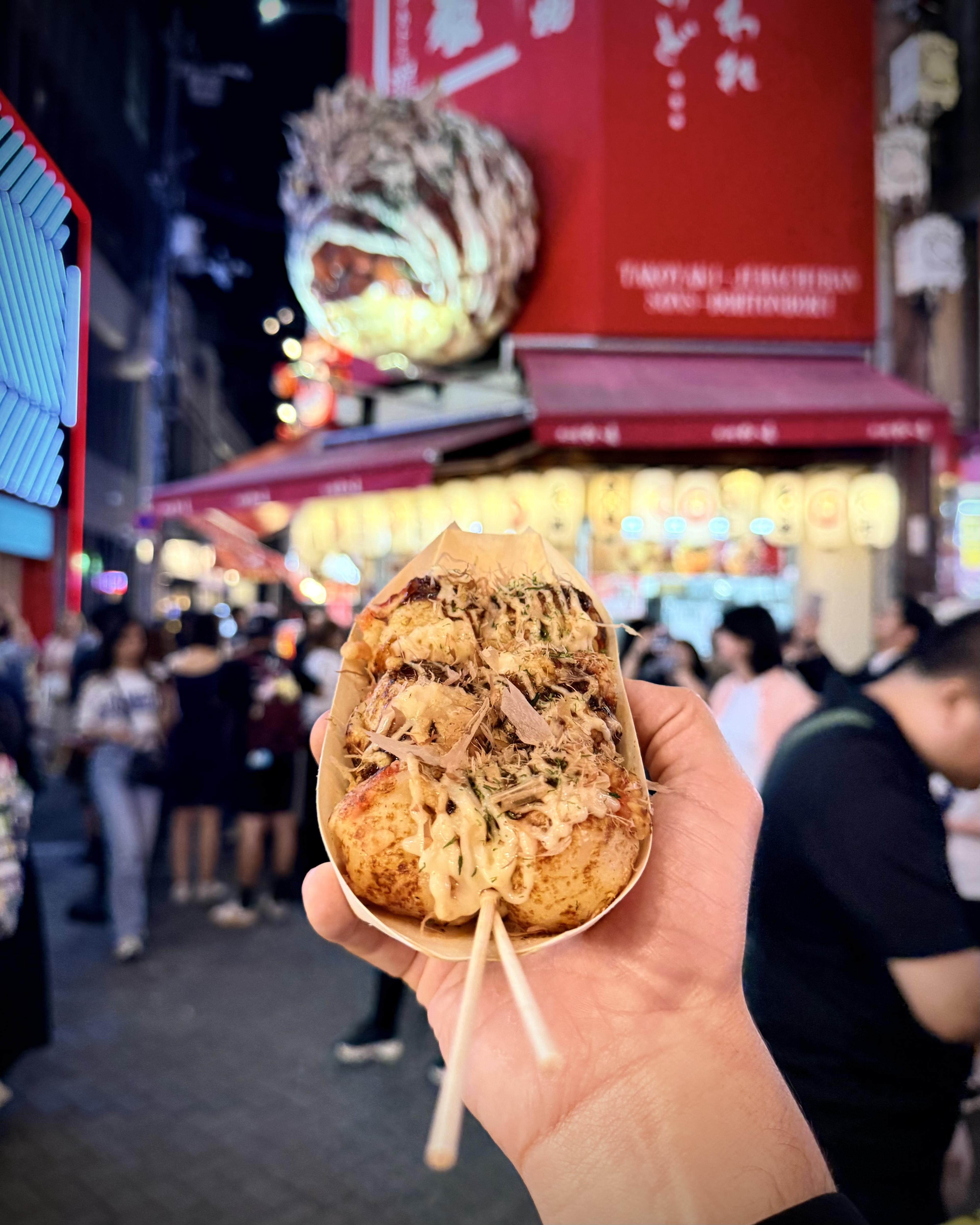
Takoyaki are round, golf ball-sized dough balls filled with diced octopus. Essentially, it’s a bit of seafood encased in a pillowy pancake-like batter, then drizzled with mayonnaise, a sweet-savory sauce, and dried bonito flakes. That may all sound incongruous to the uninitiated, but I promise you—it’s incredible, and it’s usually the very first snack I grab after I land.
The Namba/Dotonbori area is not exactly “off the beaten path”—actually, this is easily the most touristy part of Osaka. But it’s also where the best takoyaki can be found. As you fight your way through the tourist crowds and take an obligatory photo of the canal, your olfactory receptors will be under a constant assault of mouth-watering aromas. Because this is the epicenter of Osaka nightlife and entertainment, you will find dozens of takoyaki stalls within a few blocks of each other, each competing to outdo the others. As a result, the quality is exceptionally high, and styles vary wildly—from ultra-crispy to soft and broth-heavy. This creates the perfect conditions for a food crawl. Buy a small boat of 6-to-8 balls from one stall, scald your mouth as you inevitably inhale them too quickly, then move on to the next stall. And do so without guilt. This isn’t gluttony; this is you fully embracing the Kuidaore culture of Osaka.
The Namba/Dotonbori area is also the heaviest battleground for the best okonomiyaki restaurants in Osaka. Okonomiyaki is difficult to describe. You’ll often see it described as a “savory pancake” but I think that description falls short. It’s a hodgepodge of grilled foods—a variable combination of seafood, meat, egg, cabbage, and other vegetables, mixed in batter, grilled, carefully stacked and slathered in an ungodly amount of sweet-savory sauce, and served hot on the griddle. Together with kushikatsu and takoyaki, okonomiyaki rounds out the holy trinity of classic Osaka comfort foods. These are the city’s three signature dishes, and any serious foodie would make them a top priority of their Osaka trip.
Eat your way through Kuromon Ichiba Market
While Namba/Dotonobori specializes in flour-based comfort foods, Kuromon Market located just a few blocks away offers a very different kind of eating experience—a sort of “point and grill” approach to dining. This is where you’ll find some fresh world-class seafood. Tuna sashimi, gargantuan king crab legs, spiny sea urchins, tiger shrimp the size of your forearm. You’ll also find wagyu beef skewers, gyoza, and other classic Japanese delights. The variety is staggering, but it’s worth mentioning that you’re likely to pay “tourist prices” here. There’s a bit of a mark-up compared to other parts of the city, but the cost-to-quality ratio is still very good by international standards. If good sushi is what you’re after, you’ll easily find it at Kuromon Market—but Kuromon certainly doesn’t have a monopoly on good seafood in Osaka. Come here for the visual spectacle and the immersive market experience, but if you want to save a few yen, head a few blocks in any direction and you’ll find other options that are more in line with what the locals pay.
Café-hop in Nakazakicho
Nakazakicho is a trendy, artsy neighborhood. In stark contrast to the ultramodern towering skyscrapers of nearby Umeda, Nakazakicho is a quiet low-rise oasis of narrow streets, retro architecture, and an unhurried bohemian atmosphere. This is where you’ll find some of the best cafés in Osaka. From small independent roasteries serving up gourmet coffee to quirky brunch spots offering Japanese-western fusion options, you’ll be spoiled for choice within a few compact blocks. This is my favorite place in the city for a late-morning stroll. It is a slow-travel sanctuary in an otherwise frenetically-paced metropolis.
Places to eat & drink in Osaka
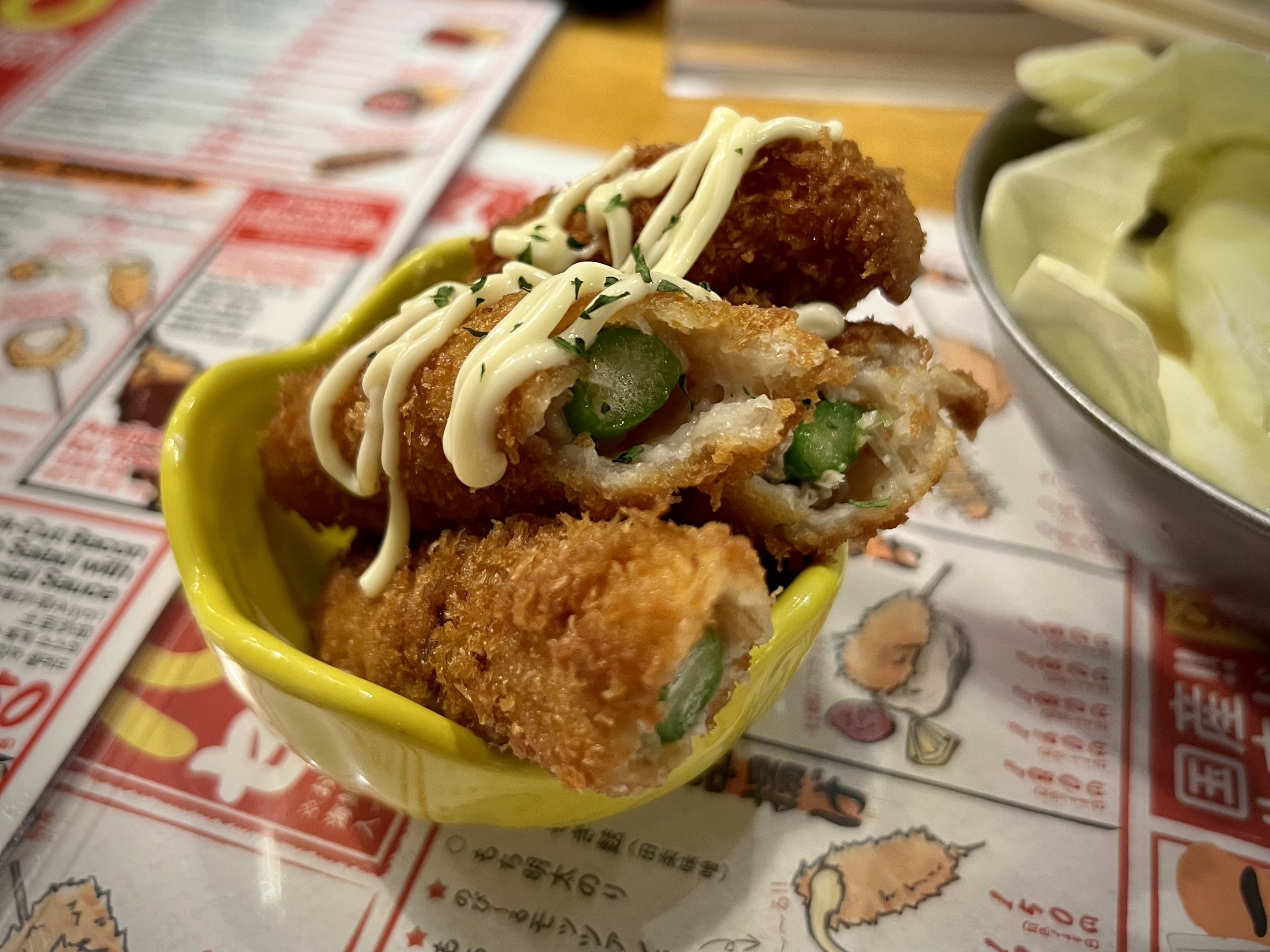
Kushikatsu: one of the "big three" of classic Osaka cuisine.
Most tourists go to Japan and gorge themselves on sushi and ramen. And hey, I get it. Sushi and ramen are delicious, after all. So, you’ll find no judgement or condemnation here. But you’d be doing yourself a disservice if you didn’t also take advantage of the opportunity to partake in some local specialties. You haven’t really done Osaka until you’ve eaten the big three, the trifecta, the holy trinity of Osakan cuisine: takoyaki, okonomiyaki, and kushikatsu.
Kushikatsu recommendations
As previously mentioned, the Shinsekai neighborhood is the origin and epicenter of kushikatsu in Japan. And no Osaka food guide would be complete without mentioning Kushikatsu Daruma. This is the place that supposedly started it all back in the 1920s. Despite its historic pedigree, the place is tiny, unpretentious, and unbelievably affordable. You’d likely walk right past it if you didn’t know better. Inside you’ll find an intimate, compact room, smoky with the smell of grilled meat, with a short L-shaped counter and a few stools. Order a highball and a few skewers, and this is about as authentic an Osaka food experience as you’re likely to find.
Located within just a few meters of each other, Tengu and Yaekatsu are two other oft-recommended kushikatsu places in Shinsekai. Tengu is known for its doteyaki, skewers of beef sinew slow-cooked in a sweet-savory miso paste. Yaekatsu, on the other hand, is livelier and favored by locals for its exceptionally airy batter. When I was last there, I sat next to a friendly local who emphatically told me that this is the best kushikatsu place in Osaka.
Takoyaki recommendations
For takoyaki in Namba/Dotonbori, I’ll mention two specific places, both of which are essentially street stalls. First, Takoyaki Wanaka Sennichimae is probably the most famous, and for good reason. This is the Osaka classic version, with a gooey, creamy center. Simple and delicious. For something a little different, head over to Takoyaki Juhachiban, just a seven-minute walk away. Here, they mix crispy tempura bits into the batter, which results in a unique texture. This one is in the heart of bustling Dotonbori, so expect crowds and a queue.
These two places are likely to be featured on just about any Osaka food guide, but it must be said that there are dozens of other options of comparable quality. You really can’t go wrong in this area. My first time in Osaka, I had my first proper takoyaki and my mind was promptly blown by a nondescript no-name stall somewhere in Namba. I’ve tried to return to that place on subsequent trips, but I’ve never been able to find it again, which suggests I might have dreamt the whole thing in some sort of feverish, hunger-induced fugue state.
Okonomiyaki recommendation
For classic Osaka-style okonomiyaki, I have only one restaurant to recommend: Namba Okonomiyaki Ajinoya Honten. This is my favorite place to eat in Osaka, full stop. I stop in this place every time I’m in town, and I always recommend it to anyone I know who’s visiting. It’s a Michelin-recognized institution where the staff cooks the entire meal on the griddle right in front of you. My go-to order is the signature Ajinoya mix okonomiyaki. All the ingredients are perfectly balanced in their proportions, and it’s easy to see why this place always has a queue extending out into the street.
Speaking of which, here’s a pro tip: they open at 11 a.m., and if you get there at about 10:45 or so, you’ll be one of the first in line and likely get seated as soon as the doors open. Otherwise, you’ll be in for a bit of a wait—but believe me, it’s worth it.
Other recommendations
When researching food recommendations in Osaka, you’re likely to come across at least one or two references to Rikuro Ojisan’s Cheesecake. It’s one of those places that’s gone viral on TikTok and Instagram, so there’s always a queue—but the staff churns out cheesecakes with an assembly-line-like efficiency, meaning the queue moves fast. Given its popularity, it’s probably obvious that this is not your normal cheesecake. It is an impossibly fluffy, airy, sponge-like version of the confection that jiggles like jello at the slightest touch. You’ll hear a bell ringing in the shop to signal that a fresh batch is ready, and as you walk away with your cheesecake it’ll still be warm from the oven. Make sure you ask the staff for a fork or two. I didn’t, and I am only mildly embarrassed to admit that upon arriving back at my hotel with a still-warm cheesecake, and realizing I had no fork, I decided that tearing into the thing with my hands like a baboon was my best option. No regrets. It was delicious.
Ramen recommendation
If ramen is what you’re after, you’ll find no shortage of options, everything from classic tonkotsu ramen to local Takaida-style, which showcases a dark, punchy, soy sauce-based broth blended with chicken and kelp stock, with thick al-dente noodles. The standard bearer for the latter is Menya Jouroku in Namba. For something a little different, I recommend Moeyo Mensuke Ramen in the Fukushima neighborhood. Among Osaka’s most respected and top-rated ramen shops, it represents the modern, high-end evolution of the city’s noodle scene. The signature dish is Kishu Duck Ramen—a light and refined shoyu broth topped with tender, semi-rare duck breast, smoky charred leeks, and a prized Kagoshima egg with a rich, deep-orange yolk. It’s light on the palate but an umami bomb of flavor—the perfect balance and possibly the best bowl of noodles in the city.
One last recommendation
My final “where to eat” recommendation for Osaka is advice I would give to anyone traveling in Japan, regardless of the specific city they’re visiting: go to an izakaya. Literally any izakaya. If it looks inviting and other people are eating there, head on in. You’re almost certain to have a good time. If you’re unfamiliar with the term, an izakaya is a casual tavern-like establishment where you’re meant to sit for a while with a highball or draft beer, sharing a continuous flow of small, savory dishes with friends. It is one of the most enjoyable experiences in Japanese dining. Personally, I enjoy the vibe as much as I enjoy the food and drink. Izakayas are a dime a dozen. You’ll find them in nearly every neighborhood in every major Japanese city, and Osaka is no exception. Ending your night at an izakaya is, in many ways, the purest expression of Kuidaore culture—not a meal with a beginning or an end, but an unhurried evening of noshing that simply unfolds and extends until you either run out of money or you explode—whichever comes first.
Need to know
Getting around Osaka and beyond
Japan’s rail network is famously extensive, making it an efficient way to get around the city. But a word of warning: Japan’s major hub stations can be labyrinthine, with multiple train lines converging in one place, which can be quite confusing for newcomers—allow yourself extra time when navigating them for the first time. Osaka’s central location and extensive rail connections make it a great jumping-off point for exploring other nearby destinations, like Kyoto and Nara, both of which are only about an hour away by train.
When to visit Osaka
Late March to early April is peak cherry blossom season in Osaka, which is lovely, but expect crowds and higher prices. May and October are the sweet spots: mild temperatures, lower humidity, and fewer tourists. Summer (July–August) is hot and oppressively humid, though the city’s festival season—including the massive Tenjin Matsuri in late July—gives it a certain energy that some travelers find worth the discomfort. December through February is cool and occasionally cold, but perfectly manageable, and the winter crowds are the thinnest you’re likely to find.
A few more practical notes worth keeping in mind before you eat your way through Osaka
Cash is still king at many smaller restaurants and street stalls in Japan. While larger establishments increasingly accept cards, don’t assume—carry enough yen to cover a full day of eating, which in Osaka is unlikely to break the bank anyway.
Queueing is taken seriously here. If there’s a line outside a restaurant, join it without complaint—it’s almost always a reliable indicator of quality, and the locals are patient and orderly about the whole affair. Cutting the queue, even inadvertently, will not endear you to anyone.
And finally, a reminder about the cardinal rule of kushikatsu that bears repeating: no double dipping. Ever. The communal dipping sauce is shared by everyone at the counter, and the rule is enforced with a cheerful but firm seriousness.


Travel Advisor
Oblique Route


Kevin Miller

Get in touch with Oblique Route
Did you like this guide? Reach out to customize and book your own experience. Or, just to chat about travel in general.
For more inspiration and insider recommendations, visit our Osaka page.